JSTOR Global Plants Home
  • Home
  • Browse
  • About
  • Access
  • Account
    • Saved Items
    • Profile
  • Log in

Global Plants

Skip to Main Content
  • JSTOR Global Plants Home
  • Global Plants

    • Browse
    • About
    • Access
    • Account
      • Saved Items
      • Profile
Log in
  • Browse
  • About
  • Access
  • Account
    • Saved Items
    • Profile
Advanced Search

Compilation
Aloe fosteri

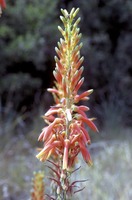
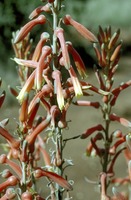
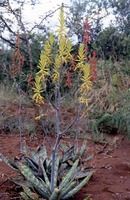
10 Images see all

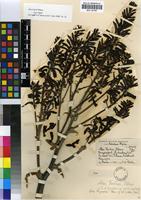
Aloe fosteri Pillans
Filed as Aloe fosteri Pillans [family ASPHODELACEAE]
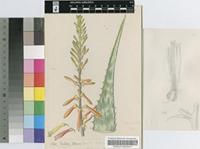
Aloe fosteri Pillans
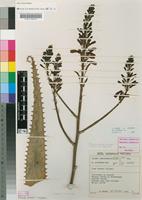
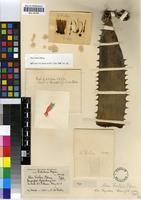
Isotype of Aloe fosteri Pillans [family ASPHODELACEAE]
Aloe fosteri Pillans
Type of Aloe fosteri Pillans [family ALOACEAE]
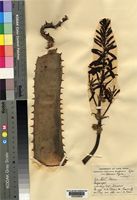
Isotype of Aloe fosteri Pillans [family ASPHODELACEAE]
Aloe fosteri Pillans
Previous
Next

Name

Identification
Aloe fosteri Pillans [family ASPHODELACEAE ]
Related name
  • Aloe fosteri

Flora

Entry for Aloe fosteri [family ALOACEAE]
Herbarium
South African National Biodiversity Institute, Compton Herbarium, Cape Town (SAM)
Collection
Flora of Southern Africa
Resource Type
Reference Sources
Entry From
Flora of South Africa, (2003) Author: Dr J.P. Roux
Names
Aloe fosteri [family ALOACEAE]
Information
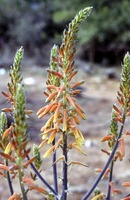
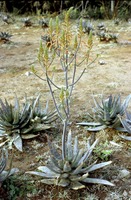
Plants solitary, 250-400 mm tall excluding inflorescence, usually stemless. Leaves 16-24, suberect, 300-400 x 40-80 mm, upper surface flat to slightly channelled, dark green with many pale green spots in irregular transverse bands, lower surface convex, paler green, unspotted. Inflorescence with 15-40 ultimate branches, 1.0-1.5 m tall; racemes cylindric, lax, longer than 190 mm; bracts deltoid-acuminate, 10-15 x 2-4 mm, many-nerved. Flowers yellow to red, 21-38 mm long, subclavate above basal con­striction; outer segments free for 5-9 mm, inner segments mostly adnate to outer; pedicels 8-12 mm long. Anthers exserted up to 2 mm. Ovary 5-6 x 2-3 mm, green; style exserted up to 2 mm. Fruit 17-26 x 8-13 mm, pale brownish grey. Flowering time March to April.
Habitat
Differences between this species and A. branddraaiensis (no. 43) are dealt with under that species. The fine, grey, pruinose, waxy cov­ering of the leaves, which can be rubbed off with a cloth, is unique to this species. The flow­ers vary from lemon-yellow to deep crimson and even to pale pink. It is the most variable of the maculates in this character.
Use
52. Aloe fosteri Pillans in South African Gardening and Country Life 23: 140 (1933b); Pole Evans: t. 612 (1936g); Reynolds: 252 (1950); Jeppe: 89 (1969); Bornman & D.S.Har­dy: 115 (1972); B.-E. van Wyk & G.F.Sm.: 192 (1996). Type: Mpumalanga, Lydenburg District, Pillans BOL 20447 (BOL!).
Range
Aloe fosteri occurs in thorny woodland on thin, rocky soils near the Northern Province and Mpumalanga escarpment, on the plateau side; there are also two records from the Lebombo Mountains, one on each side of the Mozam­bique/South Africa border. Map 39.

Related Materials

  • Terms and Conditions
  • Privacy Policy
  • Cookie Policy
  • Cookie Settings
  • Accessibility
  • Help
  • Contact Us
  • Facebook
  • Twitter
ITHAKA

JSTOR is part of ITHAKA, a not-for-profit organization helping the academic community use digital technologies to preserve the scholarly record and to advance research and teaching in sustainable ways.

©2000-2026 ITHAKA. All Rights Reserved. JSTOR®, the JSTOR logo, JPASS®, Aluka®, and ITHAKA® are registered trademarks of ITHAKA.

╳