South African National Biodiversity Institute, Compton Herbarium, Cape Town (SAM)
Collection
Flora of Southern Africa
Resource Type
Reference Sources
Entry From
Flora of South Africa, (2003) Author: Dr J.P. Roux
Names
Aloe excelsa [family ALOACEAE]
Information
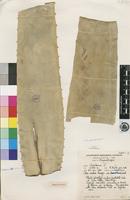
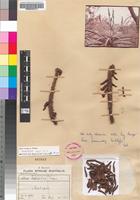
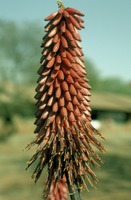
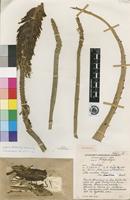
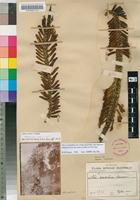
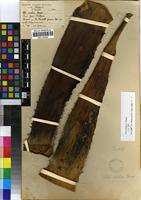
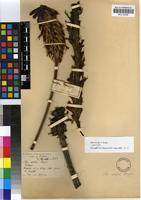
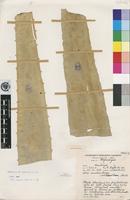
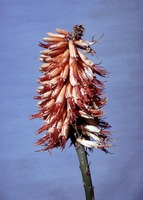
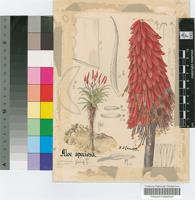
Trees; stems simple, 2-4 m tall. Leaves ± 30, 500-900 x 60-150 mm, channelled, olive-green, tinged reddish, lower surface usually with few scattered prickles. Inflorescence with ± 6-12 racemes, 0.8-1.0 m tall; racemes erect to suboblique, cylindric-conical, very dense; bracts deltoid-acute, 4-6 x 3-6 mm, 3-5-nerved. Flowers scarlet to reddish orange, 25-35 mm long, cylindric-ventricose; outer segments connate in basal quarter, inner segÂments free; pedicels 1-5 mm long. Anthers exserted 7-15 mm. Ovary ±6x2 mm; style exserted 10-15 mm. Fruit 17-20 x 11-12 mm, blue-grey. Flowering time July to September.
Habitat
Differences between this species and A. rupestris (no. 112) are discussed under that speÂcies. A. excelsa differs from A. thraskii (no. 113) in habitat (not occurring in nature anywhere near the sea), in having spreading to erect, not recurved leaves with surface prickles, and in having oblique racemes of brilliant red, orange or yellow (rarely white) but not brown flowers.
Use
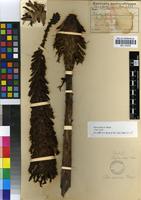
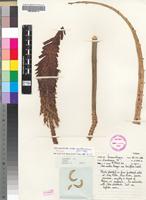
115. Aloe excelsa A.Berger in Notizblatt des Botanischen Gartens und Museums zu Berlin 4: 247 (1906b); A.Berger: 314 (1908); Pole Evans: t. 62 (1922c); Reynolds: 314 (1966); Jeppe: 45 (1969); Bornman & D.S.HarÂdy: 273 (1972); West: 81 (1974); B.-E. van Wyk & G.F.Sm.: 50 (1996). Type: Zimbabwe, Bulawayo, F. Eyles 1240 in Herb. Marloth 3888 (PRE, holo.!;BOL!).
Range
Aloe excelsa is found in Botswana and the Northern Province; also in Zambia and Zimbabwe. It occurs on rocky outcrops and hillÂsides, very often in shade in thick bush in mopane or msasa woodland. Its area of distribution is characterised by hot summers with modÂerate to low rainfall and warm, dry winters. Map 82.