South African National Biodiversity Institute, Compton Herbarium, Cape Town (SAM)
Collection
Flora of Southern Africa
Resource Type
Reference Sources
Entry From
Flora of South Africa, (2003) Author: Dr J.P. Roux
Names
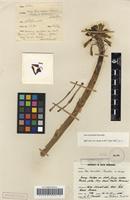
Aloe dominella [family ALOACEAE]
Information
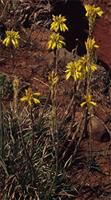
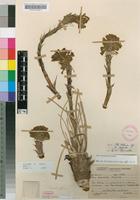
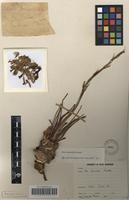
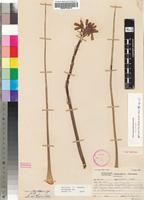
Much-branched, short-stemmed grass aloe 300-400 mm tall, forming dense tufts; roots fusiform. Leaves ± 20 in a rosette, linear, 70-375 x 2-10 mm, D-shaped in section, marÂgins dentate. Inflorescence a simple capitate raceme; peduncle 250-350 mm long, with sterÂile bracts; bracts ovate-deltoid, ± 15 x 3-4 mm, 3-5-nerved. Flowers lemon-yellow, 13-18 mm long; pedicels 13-20 mm long; all segments free to base. Anthers exserted 2-4 mm. Ovary 2-4 x 1.5-2 mm, green; style exserted up to 7 mm. Flowering time June to September.
Habitat
A note attached to Acocks 10693 states that the flowers are sweet-scented. This seems to be the only record of this character in this species. The only taxon with which it is likely to be conÂfused is A. chortolirioides. Differences between this species and the latter are discussed under that species.
Use
10. Aloe dominella Reynolds in Journal of South African Botany 4: 101 (1938a); Reynolds: 129 (1950); Jeppe: 130 (1969); Bornman & D.S.Hardy: 19 (1972); B.-E. van Wyk & G.F.Sm.: 258 (1996). Type: KwaZulu-Natal, between Estcourt and Mooi River, Reynolds 2094 (PRE!).
Range
Occurring in Swaziland and KwaZulu-Natal. Like A. chortolirioides (no. 9), A. dominella occurs wedged between rocks in grassland. Flowering in this species does not seem to be as strongly linked to fire as in A. chortolirioides. Reynolds (1950) notes that in cultivation, flowÂering occurred in February (a very unusual time for field plants) in an unburnt plant and July to October (a month later than usual for field plants) in a plant that was deliberately burnt. Evidently, therefore, there is some link between fire and flowering in this species. Map 8.