JSTOR Global Plants Home
  • Home
  • Browse
  • About
  • Access
  • Account
    • Saved Items
    • Profile
  • Log in

Global Plants

Skip to Main Content
  • JSTOR Global Plants Home
  • Global Plants

    • Browse
    • About
    • Access
    • Account
      • Saved Items
      • Profile
Log in
  • Browse
  • About
  • Access
  • Account
    • Saved Items
    • Profile
Advanced Search

Compilation
Aloe corallina

3 Images see all

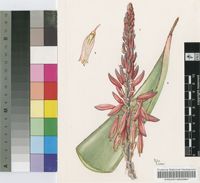
Filed as Aloe corallina I.Verd. [family ASPHODELACEAE]
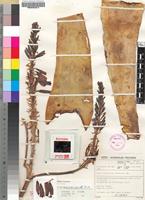
Aloe corallina I.Verd.
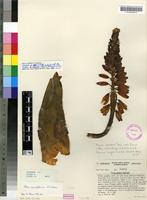
Holotype of Aloe corallina I.Verd. [family ASPHODELACEAE]
Previous
Next

Name

Identification
Aloe corallina I.Verd. [family ASPHODELACEAE ]
Related name
  • Aloe corallina

Flora

Entry for Aloe corallina [family ALOACEAE]
Herbarium
South African National Biodiversity Institute, Compton Herbarium, Cape Town (SAM)
Collection
Flora of Southern Africa
Resource Type
Reference Sources
Entry From
Flora of South Africa, (2003) Author: Dr J.P. Roux
Names
Aloe corallina [family ALOACEAE]
Information
Plants solitary, pendent, short-stemmed, ± 500 mm tall excluding inflorescence. Leaves 16-20, spreading to slightly recurved, brownish green, 400-500 x 80-110 mm. Inflorescence 2-4-branched from about the middle, arcuate-ascending to arcuate-erect, ± 600 mm long; racemes narrowly conical, dense; bracts del­toid-acuminate, ± 10-15 x 4 mm, ± 7-nerved. Flowers coral-red to brilliant scarlet, 28-35 mm long; segments connate for 10-12 mm. Anthers not or hardly exserted. Ovary ±7x2 mm, pale green; style exserted up to 5 mm. Fruit +12x5 mm, dark brown to dark greenish grey. Flowering time July to August. Plants solitary, pendent, stemless or short-stemmed, ± 500 mm tall excluding inflorescence. Leaves 14-22, glaucous to grey-green, 350-500 x 90-150 mm, apices recurved, mar­gins red. Inflorescence rarely simple, usually 2-4-branched near base, to 850 mm tall; racemes dense, cylindric-conical; bracts oblong-obovate, acuminate, 12-18 x 5-7 mm, + 7-nerved. Flowers scarlet in bud, creamy yel­low at flowering, cylindric-trigonous, 23-33 mm long; outer segments free for two thirds to three quarters of their length, inner segments free but dorsally adnate to outer; pedicels 3-5 mm long. Anthers exserted for 1-6 mm. Ovary 5-6 x 2-3 mm, green; style exserted for 1-4 mm. Fruit not seen. Flowering time December to January.
Habitat
Aloe mendesii, with which this species has been confused, is an Angolan species with a pendent habit on cliff faces, not erect. The leaves of A. corallina are leathery, with hard spines, whereas those of A. mendesii are much softer, with softer spines. The inflorescence of A. corallina is usually branched, whereas that of A. mendesii is simple. The anthers and style of A. corallina are not exserted as far as those of A. mendesii, and the perianth segments are free for two thirds, not half, of their length. There are also considerable microscopical differences in the leaf surface between these two species. In A. dewinteri (no. 74), the inflorescence is branched in the lower half, and the branches ascend at an angle to the main axis, whereas the inflores­cence of A. corallina is branched in the upper half, and the branches are roughly parallel to the main axis. The racemes of A. corallina are sub-lax and conical, not dense and cylindric, and the flowers do not change colour from bud to flow­ering. Differences between this species and A. corallina are dealt with under that species. It would be difficult to confuse this species with any other southern African aloe, but it bears a superficial similarity to A. niebuhriana, an Arabian species.
Use
73. Aloe corallina /. Verd. in The Flowering Plants of Africa 45: t. 1788 (1979). Type: Namibia, Otjomborombonga, Leistner et al. 179 (PRE, holo.!). without Latin description; D.S.Hardy: 521 (1974); Jankowitz: 34 (1975); I.Verd.: t. 1752 (1978b). Type: Namibia, Sesfontein, Buhr sub Giess 10990 (WIND, nolo.; M, PRE!).
Range
Aloe corallina occurs on very steep cliffs in the mountains of the Kaokoveld. Rainfall in this area is minimal, and occurs mostly in summer. Fog may occur at any time of the year, but this, too, is rare here. The cliffs where A. corallina grows are so steep as to preclude the presence of other vegetation. Map 51. Aloe dewinteri is endemic to Namibia, growing on steep cliff faces a relatively short distance to the south of A. corallina (no. 73). This is a very arid area with hardly any (summer) rainfall and minimal moisture from fog. Map 51.

Related Materials

  • Terms and Conditions
  • Privacy Policy
  • Cookie Policy
  • Cookie Settings
  • Accessibility
  • Help
  • Contact Us
  • Facebook
  • Twitter
ITHAKA

JSTOR is part of ITHAKA, a not-for-profit organization helping the academic community use digital technologies to preserve the scholarly record and to advance research and teaching in sustainable ways.

©2000-2026 ITHAKA. All Rights Reserved. JSTOR®, the JSTOR logo, JPASS®, Aluka®, and ITHAKA® are registered trademarks of ITHAKA.

╳