JSTOR Global Plants Home
  • Home
  • Browse
  • About
  • Access
  • Account
    • Saved Items
    • Profile
  • Log in

Global Plants

Skip to Main Content
  • JSTOR Global Plants Home
  • Global Plants

    • Browse
    • About
    • Access
    • Account
      • Saved Items
      • Profile
Log in
  • Browse
  • About
  • Access
  • Account
    • Saved Items
    • Profile
Advanced Search

Compilation
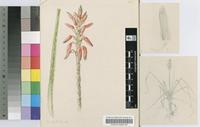
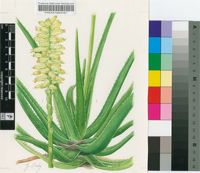
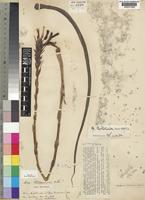
Aloe buchananii

3 Images see all

Aloe buchananii Baker
Type of Aloe buchananii Baker [family ALOACEAE]
Previous
Next

Name

Identification
Aloe buchananii Baker [family ASPHODELACEAE ]
Related name
  • Aloe buchananii

Flora

Entry for Aloe buchananii Baker [family ALOACEAE]
Herbarium
Royal Botanic Gardens, Kew (K)
Collection
Flora Zambesiaca
Resource Type
Reference Sources
Entry From
FZ, Vol 12, Part 3, page 48, (2001) Author: S. Kativu
Names
Aloe buchananii Baker [family ALOACEAE], in Bull. Misc. Inform., Kew 1895: 119 (1895). —Engler, Pflanzenw. Ost-Afrikas C: 423 (1895). —J.G. Baker in F.T.A. 7: 457 (1898). —Berger in Engler, Pflanzenr. IV, fam. No. 38, III, II (Heft 33): 167 (1908). —Christian in Fl. Pl. S. Africa 20: pl. 763 (1940). —Brenan et al. in Mem. New York Bot. Gard. 9: 89 (1954). —Reynolds, Aloes Nyasaland: 5 (1954); Aloes Trop. Africa & Madagascar: 29 (1966). —Court, Succ. Fl. South. Africa: 149 (1981). Type: Malawi, Shire Highlands, 1892; cult. Kew Gardens, fl. 18.xii.1894, Buchanan s.n. (K, holotype).
Information
Perennial herb, solitary, or suckering to produce a cluster of 2–3 stems, rarely more. Stems up to 20 cm long and up to 5 cm thick. Leaves distichous or rosulate, erect, grass-like, c. 60 cm long, linear, 1.5–2 cm wide, expanded to 4–6 cm wide at the base, tapering towards the apex, deeply channelled on the upper surface, ± fleshy, bright green, white-spotted towards the base, especially on the lower surface and then often spinulescent; margin cartilaginous, with minute white teeth to 0.5 mm long, 5–15 mm apart near the leaf base, teeth obsolescent towards the apex. Inflorescence simple, erect, to 60–90 cm high; peduncle with large, pinkish-tinged, sterile, papery bracts on the upper half, 2–6 cm apart. Raceme 15–25 × 7–8 cm, cylindric, ± densely flowered, with overlapping bracts in bud; bracts 22–27 × 8–10 mm, ovate-acuminate; pedicels 2.5–4 cm long, elongating to 4.5–5 cm in fruit, red-tinged. Perianth salmon-pink, green-tipped, c. 25–30 mm long and c. 10 mm in diameter across the ovary, cylindric-trigonous, narrowing toward the mouth, base tapering into the pedicel; outer segments free almost to the base with tips rounded, not spreading. Stamens scarcely exserted, the style a little longer. Capsule (immature) stipitate for 1.5 mm, c. 2.5 × 1 cm, oblong-ovoid. Seeds not seen.
Habitat
In montane grassland and open Brachystegia woodland
Range
So far, known only from Malawi
Altitude range
1150–1940 m.
1940
1150
Distribution
Malawi C Chongoni Forest Reserve, fl. 7.ii.1969, Salubeni 1248 (K; SRGH).Malawi S Zomba Plateau, fl. 4.vi.1946, Brass 16228 (K; SRGH).
Notes
Very similar to A. nuttii when not in flower, but the inflorescence of A. buchananii differs in the narrower floral bracts, longer pedicels (especially in fruit), and shorter slightly broader perianths.

Related Materials

  • Terms and Conditions
  • Privacy Policy
  • Cookie Policy
  • Cookie Settings
  • Accessibility
  • Help
  • Contact Us
  • Facebook
  • Twitter
ITHAKA

JSTOR is part of ITHAKA, a not-for-profit organization helping the academic community use digital technologies to preserve the scholarly record and to advance research and teaching in sustainable ways.

©2000-2026 ITHAKA. All Rights Reserved. JSTOR®, the JSTOR logo, JPASS®, Aluka®, and ITHAKA® are registered trademarks of ITHAKA.

╳