JSTOR Global Plants Home
  • Home
  • Browse
  • About
  • Access
  • Account
    • Saved Items
    • Profile
  • Log in

Global Plants

Skip to Main Content
  • JSTOR Global Plants Home
  • Global Plants

    • Browse
    • About
    • Access
    • Account
      • Saved Items
      • Profile
Log in
  • Browse
  • About
  • Access
  • Account
    • Saved Items
    • Profile
Advanced Search

Compilation
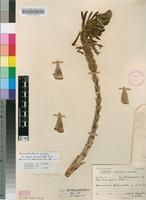
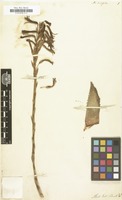
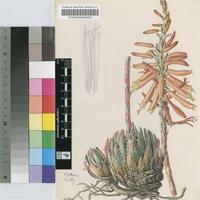
Aloe brevifolia

3 Images see all

Filed as Aloe brevifolia Mill. var. brevifolia [family ASPHODELACEAE]
Filed as Aloe brevifolia [family LILIACEAE]
Aloe brevifolia Mill. var. brevifolia
Previous
Next

Name

Identification
Aloe brevifolia Mill. [family ASPHODELACEAE ]
Related name
  • Aloe brevifolia

Flora

Entry for ALOE brevifolia Miller [family ALOACEAE]
Herbarium
Royal Botanic Gardens, Kew (K)
Collection
Flora Capensis
Resource Type
Reference Sources
Entry From
Flora Capensis, page 253, (1897) Author: (By J. G. BAKER).
Names
ALOE brevifolia Miller [family ALOACEAE], Gard. Dict. edit. viii. No. 8;—DC. Plantes Grasses, t. 81; Haw. Syn. 80; Lindl. in Bot. Reg. t. 996; Salm-Dyck, Aloe, sect. xvi. fig. 1; Baker in Journ. Linn. Soc. xviii. 160, non Haworth.
ALOE prolifera Haw. [family ALOACEAE], in Trans. Linn. Soc. vii. 16; Kunth, Enum. iv. 519.
Information
old plants with a stem a few inches long, 1/2 in. diam. below the rosette of leaves; leaves 30–40 in a dense rosette, lanceolate-deltoid, 3–4 in. long, an inch broad at the base, narrowed gradually to the apex, 1/4– 1/3 in. thick in the middle, very glaucous, without either spots or distinct lines; margin with white, lanceolate-deltoid, horny prickles 1/12– 1/8 in. long, which extend to the keel of the upper part of the back; peduncle stout, simple, about a foot long, with many deltoid empty bracts; raceme dense, simple, 6–9 in. long; pedicels 1/2–1 in. long; bracts deltoid, rather shorter than the pedicels; perianth cylindrical, pale red, 1 1/4–1 1/2 in. long; tube cylindrical, shorter than the segments; stamens equalling the perianth; style considerably exserted. null
Distribution
SOUTH AFRICA without locality, living cultivated plants!
Notes
Introduced into cultivation at the beginning of the eighteenth century. Two of the varieties are figured by Commelyn in his Præludia, tt. 21 and 22.

Related Materials

  • Terms and Conditions
  • Privacy Policy
  • Cookie Policy
  • Cookie Settings
  • Accessibility
  • Help
  • Contact Us
  • Facebook
  • Twitter
ITHAKA

JSTOR is part of ITHAKA, a not-for-profit organization helping the academic community use digital technologies to preserve the scholarly record and to advance research and teaching in sustainable ways.

©2000-2026 ITHAKA. All Rights Reserved. JSTOR®, the JSTOR logo, JPASS®, Aluka®, and ITHAKA® are registered trademarks of ITHAKA.

╳