JSTOR Global Plants Home
  • Home
  • Browse
  • About
  • Access
  • Account
    • Saved Items
    • Profile
  • Log in

Global Plants

Skip to Main Content
  • JSTOR Global Plants Home
  • Global Plants

    • Browse
    • About
    • Access
    • Account
      • Saved Items
      • Profile
Log in
  • Browse
  • About
  • Access
  • Account
    • Saved Items
    • Profile
Advanced Search

Compilation
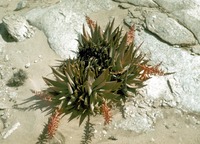
Aloe asperifolia

5 Images see all

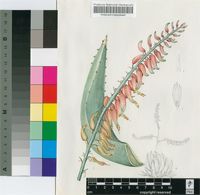
Aloe asperifolia A.Berger
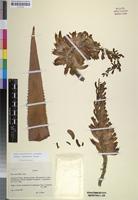
Isotype of Aloe asperifolia subsp. suberecta Giess [family ALOACEAE]
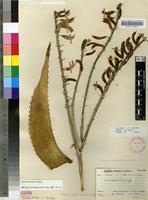
Filed as Aloe asperifolia A.Berger [family ASPHODELACEAE]
Aloe asperifolia A.Berger
Previous
Next

Name

Identification
Aloe asperifolia A.Berger [family ASPHODELACEAE ]
Related name
  • Aloe asperifolia

Flora

Entry for Aloe asperifolia [family ALOACEAE]
Herbarium
South African National Biodiversity Institute, Compton Herbarium, Cape Town (SAM)
Collection
Flora of Southern Africa
Resource Type
Reference Sources
Entry From
Flora of South Africa, (2003) Author: Dr J.P. Roux
Names
Aloe asperifolia [family ALOACEAE]
Information
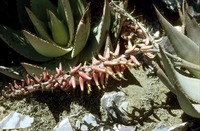
Plants in solid groups of 20-40, 150-300 mm tall. Leaves lanceolate, erect, 150-250 x 35-70 mm, greyish to almost white. Inflorescence 2- or 3-branched, oblique, 500-750 mm long; racemes sublax, cylindric; bracts deltoidacuminate, 10-15 x 3-4 mm, 3-5-nerved. Flowers scarlet, 19-28 mm long, mouth upturned; outer segments free for 6-10 mm, inner segments dorsally adnate to outer for 12-18 mm; pedicels 5-8 mm long. Anthers exserted 3-10 mm. Ovary 6-8 x 2-3 mm, deep olive-green; style exserted 3-10 mm. Fruit ± 20 x 13 mm, subglobose, pale grey-brown. Flowering time March to May
Habitat
Aloe asperifolia is endemic to northern Namibia and occurs on limestone and conglomerate in parts of the Namib Desert which are not only devoid of other plant life, but almost devoid of soil. Most of the moisture available to plants of this species is derived from fog. Map 49. This species is very similar to A. claviflora (no. 70). The inflorescence in this species is almost always branched, whereas in A. claviflo­ra it very seldom branches, and the peduncle is much stouter in A. asperifolia, with much laxer racemes than in A. claviflora. The bracts of A. asperifolia are papery, not fleshy, and are much smaller than those of A. claviflora. The flowers of A. asperifolia are almost cylindric, with slightly upturned mouths, whereas those of A. claviflora are straight and clavate. In A. falcata (no. 69), which is similar in habit, the inflores­cences are erect and the flowers are straight and cylindric.
Use
67. Aloe asperifolia A.Berger in Botanische Jahrbiicher 36: 63 (1905a); A.Berger: 219 (1908); Reynolds: 312 (1950); Jeppe: 28 (1969); Soldi, Roessler & Merxm.: 16 (1970); Bornman & D.S.Hardy: 163 (1972); Jankowitz: 20 (1975); I.Verd.: t. 1753 (1978a). Type: Namibia, Zwartbankberge, F. Stapf 7 (Z).

Related Materials

  • Terms and Conditions
  • Privacy Policy
  • Cookie Policy
  • Cookie Settings
  • Accessibility
  • Help
  • Contact Us
  • Facebook
  • Twitter
ITHAKA

JSTOR is part of ITHAKA, a not-for-profit organization helping the academic community use digital technologies to preserve the scholarly record and to advance research and teaching in sustainable ways.

©2000-2026 ITHAKA. All Rights Reserved. JSTOR®, the JSTOR logo, JPASS®, Aluka®, and ITHAKA® are registered trademarks of ITHAKA.

╳