JSTOR Global Plants Home
  • Home
  • Browse
  • About
  • Access
  • Account
    • Saved Items
    • Profile
  • Log in

Global Plants

Skip to Main Content
  • JSTOR Global Plants Home
  • Global Plants

    • Browse
    • About
    • Access
    • Account
      • Saved Items
      • Profile
Log in
  • Browse
  • About
  • Access
  • Account
    • Saved Items
    • Profile
Advanced Search

Compilation
Aloe arenicola

12 Images see all

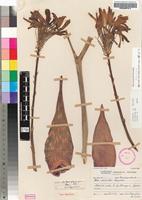
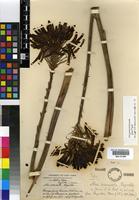
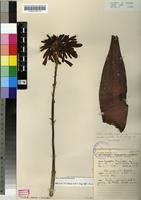
Holotype of Aloe arenicola Reynolds [family ASPHODELACEAE]
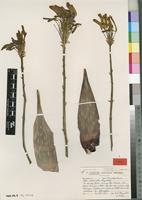
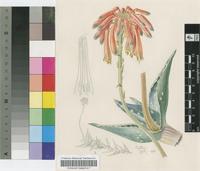
Type of Aloe arenicola Reynolds [family ASPHODELACEAE]
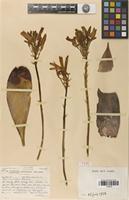
Type of Aloe arenicola Reynolds [family XANTHORRHOEACEAE]
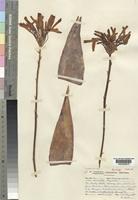
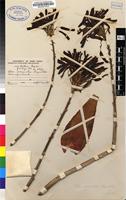
Isotype of Aloe arenicola Reynolds [family ALOACEAE]
Aloe arenicola Reynolds
Isotype of Aloe arenicola Reynolds [family ASPHODELACEAE]
Aloe arenicola Reynolds
Isotype of Aloe arenicola Reynolds [family ASPHODELACEAE]
Filed as Aloe arenicola Reynolds [family ASPHODELACEAE]
Aloe arenicola Reynolds
Isotype of Aloe arenicola Reynolds [family ASPHODELACEAE]
Aloe arenicola Reynolds
Previous
Next

Name

Identification
Aloe arenicola Reynolds [family ASPHODELACEAE ]
Related name
  • Aloe arenicola

Flora

Entry for Aloe arenicola [family ALOACEAE]
Herbarium
South African National Biodiversity Institute, Compton Herbarium, Cape Town (SAM)
Collection
Flora of Southern Africa
Resource Type
Reference Sources
Entry From
Flora of South Africa, (2003) Author: Dr J.P. Roux
Names
Aloe arenicola [family ALOACEAE]
Information
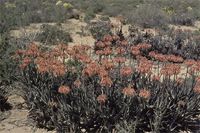
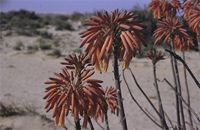
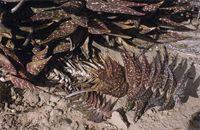
Plants decumbent, 150^-00 mm tall, leaves present in apical 200-300 mm of stems. Leaves ± 20 per stem, broadly deltoid, 120-200 x 35-60 mm, bluish green with scattered white spots, keels rarely dentate. Inflorescence a sim­ple to twice-branched, very dense, capitate raceme, up to 500 mm tall; peduncle with few sterile bracts; bracts ovate, 9-11 x 3-5 mm, 5-nerved. Flowers orange-red, 30-40 mm long; outer segments free for + half their length, inner segments free but adhering to outer for ± half their length; pedicels 35-50 mm long. Anthers exserted up to 3 mm. Ovary 7-8 x 2-3 mm; style exserted up to 6 mm. Fruit not seen. Flowering time October to January.
Habitat
Differences between this species and A. per-foliata (no. 87) are dealt with under that species. The leaves of A. arenicola are similar in size to those of A. meyeri (no. 89), but the two species differ in numerous characters and are difficult to confuse. A. arenicola is decumbent on sand near the coast, with leaves which clothe the elongated stem, whereas A. meyeri is pendent on rocks further inland, and bears its leaves in a distinct rosette. The inflorescences of A. areni­cola are longer than those of A. meyeri, and bear larger flowers on longer pedicels.
Use
88. Aloe arenicola Reynolds in Journal of South African Botany 4: 21 (1938e); Reynolds: 379 (1950); I.Verd.: t. 1467 (1966); Jeppe: 22 (1969); Bornman & D.S.Hardy: 207 (1972); B.-E. van Wyk & G.F.Sm.: 106 (1996). Type: North­ern Cape, near Kleinzee, Reynolds 2574 (PRE, holo.!; BOL!).
Range
Aloe arenicola occurs in the Northern and Western Cape, and grows only on sand within a few hundred metres of the beach, in the winter-rainfall area in coastal fynbos and succulent karoo. Map 64.

Related Materials

  • Terms and Conditions
  • Privacy Policy
  • Cookie Policy
  • Cookie Settings
  • Accessibility
  • Help
  • Contact Us
  • Facebook
  • Twitter
ITHAKA

JSTOR is part of ITHAKA, a not-for-profit organization helping the academic community use digital technologies to preserve the scholarly record and to advance research and teaching in sustainable ways.

©2000-2026 ITHAKA. All Rights Reserved. JSTOR®, the JSTOR logo, JPASS®, Aluka®, and ITHAKA® are registered trademarks of ITHAKA.

╳