JSTOR Global Plants Home
  • Home
  • Browse
  • About
  • Access
  • Account
    • Saved Items
    • Profile
  • Log in

Global Plants

Skip to Main Content
  • JSTOR Global Plants Home
  • Global Plants

    • Browse
    • About
    • Access
    • Account
      • Saved Items
      • Profile
Log in
  • Browse
  • About
  • Access
  • Account
    • Saved Items
    • Profile
Advanced Search

Compilation
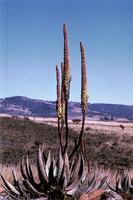
Aloe aculeata

6 Images see all

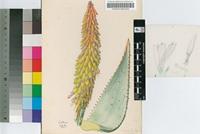
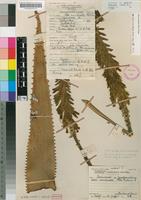
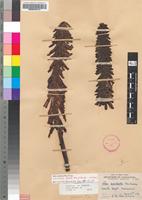
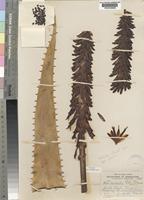
Lectotype of Aloe aculeata Pole-Evans [family ASPHODELACEAE]
Type of Aloe aculeata Pole-Evans [family ALOACEAE]
Aloe aculeata Pole-Evans
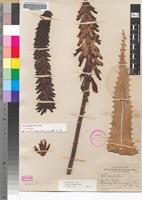
Filed as Aloe aculeata Pole-Evans [family ASPHODELACEAE]
Lectotype of Aloe aculeata Pole-Evans [family ASPHODELACEAE]
Previous
Next

Name

Identification
Aloe aculeata Pole-Evans [family ASPHODELACEAE ]
Related name
  • Aloe aculeata

Flora

Entry for Aloe aculeata [family ALOACEAE]
Herbarium
South African National Biodiversity Institute, Compton Herbarium, Cape Town (SAM)
Collection
Flora of Southern Africa
Resource Type
Reference Sources
Entry From
Flora of South Africa, (2003) Author: Dr J.P. Roux
Names
Aloe aculeata [family ALOACEAE]
Information
Plants stemless, 300-600 mm tall excluding inflorescence, solitary. Leaves ± 30, 250-600 x 50-120 mm, shallowly channelled, grass-green to glaucous, upper surface with few prickles, lower surface with many prickles, these on both surfaces scattered, dark brown, arising from white tubercles. Inflorescence of erect, cylindric, very dense racemes, 2-4-branched, ± 1 m tall; bracts ovate-acuminate, 6-10 x 4-7 mm, many-nerved. Flowers reddish orange to yellow in bud, orange to yellow at flowering, 23-40 mm long, mouth straight; outer segments con­nate for less than half their length, inner seg­ments free; pedicels 2-7 mm long. Anthers exserted 7-15 mm. Ovary 4.0-6.0 x 1.5-3.0 mm, green; style exserted 7-18 mm. Fruit ± 18-10 mm. Flowering time (May to) June to August.
Habitat
Reynolds (1966) states that the Zimbabwe form of this species may be distinguished from the South African form by having leaf prickles arising from white tubercular bases. Plants from the Northern Province (north of the Soutpans-berg) match the Zimbabwean form, both in the field and in cultivation. The presence of irregu­larly scattered prickles, not in a median line, on the leaf surfaces distinguishes this species from all others in the section. A. aculeata differs from A. petricola (no. 106) in having many-nerved, not 3-5-nerved, bracts which are shorter than in the latter species. The pedicels and flowers in A. aculeata tend to be longer than those of A. pet- ricola, though there is overlap in these characters.
Use
105. Aloe aculeata Pole Evans in Transactions of the Royal Society of South Africa 5: 34 (1915); Pole Evans: t. 371 (1930); Reynolds: 447 (1950); Reynolds: 241 (1966); Jeppe: 1 (1969); Bornman & D.S.Hardy: 249 (1972); West: 77 (1974); B.-E. van Wyk & G.F.Sm.: 122 (1996). Lectotype: Northern Province, near Pietersburg, Pole Evans PRE55 (PRE!, designated by Reynolds 1966).
Range
Aloe aculeata occurs in warm parts of the highveld and the Limpopo valley of the Northern Province and Mpumalanga; also in similar parts of southern and central Zimbabwe and Mozambique. Its habitat varies from rocky outcrops in grassland to dry sandy bushveld. Map 76.

Related Materials

  • Terms and Conditions
  • Privacy Policy
  • Cookie Policy
  • Cookie Settings
  • Accessibility
  • Help
  • Contact Us
  • Facebook
  • Twitter
ITHAKA

JSTOR is part of ITHAKA, a not-for-profit organization helping the academic community use digital technologies to preserve the scholarly record and to advance research and teaching in sustainable ways.

©2000-2026 ITHAKA. All Rights Reserved. JSTOR®, the JSTOR logo, JPASS®, Aluka®, and ITHAKA® are registered trademarks of ITHAKA.

╳