

Compilation
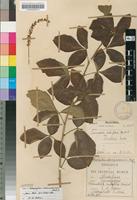
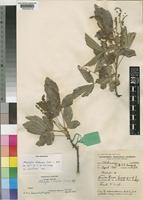
Allophylus cataractarum
2 Images see all
Name
Identification
Allophylus rubifolius (Hochst. ex A.Rich.) Engl. [family SAPINDACEAE ] Allophylus rhodesicus Exell [family SAPINDACEAE ] (stored under name); Verified by Exell, A.W., Allophylus cataractarum Baker f. [family SAPINDACEAE ]
Related name
- Allophylus cataractarum
- Allophylus rubifolius
- Allophylus rhodesicus
- Allophylus africanus
Flora
Entry for Allophylus africanus Beauv. [family SAPINDACEAE]
Herbarium
Royal Botanic Gardens, Kew (K)
Collection
Flora Zambesiaca
Resource Type
Reference Sources
Entry From
FZ, Vol 2, Part 2, page 494, (1966) Author: A. W. Exell
Names
Schmidelia africana Beauv. DC. [family SAPINDACEAE], Prodr. 1: 610 (1824) pro parte. — Bak. in Oliv. F.T.A. 1: 421 (1869) pro parte. Type as above.
Allophylus africanus Beauv. [family SAPINDACEAE], Fl. Owar. & Benin, 2: 75, t. 107 (1819 or 1820). — Sim, For. Fl. Port. E. Afr.: 31 (1909). — R.E.Fr. in Wiss. Ergebn. Schwed. Rhod.-Kongo-Exped. 1: 131 (1914). — Bak. f. in Journ. of Bot. 57: 188 (1919). — Radlk. in Engl., Pflanzenr. IV, 165, 1, 2: 536 (1932). — Burtt Davy & Hoyle, N.C.L.: 69 (1936). — Exell & Mendonça, C.F.A., 2, 1: 77 (1954). — Williamson, Useful Pl. Nyasal.: 16 (1956). — Keay, F.W.T.A. ed. 2, 1, 2: 713 (1958). — Hauman, F.C.B. 9: 291 (1960). — Dale & Greenway, Kenya Trees and Shrubs: 504 (1961). — White, F.F.N.R.: 223 (1962). Type from Nigeria.
Allophylus griseo-tomentosus Gilg [family SAPINDACEAE], in Engl., Bot. Jahrb. 24: 290 (1897). — Bak. f., tom. cit: 189 (1919). — Radlk., tom. cit.: 540 (1932). — Burtt Davy & Hoyle, loc. cit. — Dale & Greenway, op. cit.: 504 (1961). Syntypes from Tanganyika and Nyasaland: Buchanan 377 (B†), 427 (B†), 563 (B†), 573 (B†), 800 (B†).
Allophylus cataractarum Bak. f. [family SAPINDACEAE], tom. cit.: 189 (1919). — Wild, Guide Fl. Vict. Falls: 152 (1952). — White, loc. cit. Type: Victoria Falls, Rogers 5538 (BM, holotype; SRGH).
Allophylus holubii Bak. f. [family SAPINDACEAE], loc. cit. — O.B. Mill., B.C.L.: 36 (1948). Type: Bechuanaland Prot., Leshuma Valley, Holub (K, holotype).
Allophylus spragueanus Burtt Davy [family SAPINDACEAE], in Kew Bull. 1921:280 (1921). Type: S. Rhodesia, Victoria Falls, Allen 143 (K, holotype).
Allophylus melanocarpus [family SAPINDACEAE], sensu Steedman, Trees etc. S. Rhod.: 43, t. 42 (1933). The apparently 5-merous flowers in the plate are wrongly drawn.
Information
Small tree up to 10 m. tall or shrub; branchlets fulvous-tomentose to nearly glabrous. Leaves 3-foliolate; petiole up to 7 cm. long, nearly glabrous to densely pubescent; leaflets subequal or with the terminal one up to 11/2 times as long as the lateral ones; petiolules up to 12 mm. long in the terminal leaflet but rarely exceeding 2 mm. in the sometimes subsessile lateral ones; lamina of terminal leaflet up to 15 × 8 cm. (sometimes larger outside our area) but often much smaller (especially in Groups C and D, q.v.), obovate to elliptic, chartaceous to subcoriaceous, almost glabrous to pubescent above, almost glabrous to tomentose beneath, minutely glandular beneath and sometimes with tufts of hairs in the axils of the lateral nerves, apex acute or rounded and sometimes slightly acuminate, margin shallowly crenate-serrate or shallowly serrate or sometimes subentire, base cuneate to narrowly cuneate (rarely appreciably narrowed except in some possible hybrids); lateral nerves 6–9 pairs. Inflorescence 9–26 cm. long, branched, densely pubescent. Flowers white, cream, yellow or green, in few-flowered subsessile glomerules; pedicels up to 2 mm. long. Outer sepals 1·8 × 1·8 mm., subcircular, inner 1·5 × 1 mm., elliptic, all glabrous to pubescent. Petals 1·2 × 0·9 mm., spathulate. Stamens with filaments 1·5 mm. long; staminodes 0·5 mm. long in male flowers. Ovary 2-lobed; style 1·8 mm. long, 2-fid. Fruit red or orange turning red, 4–6 mm. in diam., subglobose in our area (sometimes ellipsoid elsewhere), sparsely pubescent to pubescent when young, glabrous to pubescent when mature, 1 coccus (rarely 2) developing.
Habitat
Occurring in a wide range of habitats.
Range
Widespread in our area and throughout tropical Africa.
Notes
It seems advisable to avoid creating new names for intraspecific taxa in this complex series as it is difficult to make progress with the classification until the plants have been studied genetically. In our area the species can be divided into 4 moderately distinct groups with some geographical and ecological separation but with considerable intergrading and overlapping. There are also intermediates with A. rubifolius and A. rhodesicus presumably due to past or present hybridization. As some populations are fairly homogeneous and ecologically distinct, I have indicated the epithets which can be applied to them, if desired, within our area.