JSTOR Global Plants Home
  • Home
  • Browse
  • About
  • Access
  • Account
    • Saved Items
    • Profile
  • Log in

Global Plants

Skip to Main Content
  • JSTOR Global Plants Home
  • Global Plants

    • Browse
    • About
    • Access
    • Account
      • Saved Items
      • Profile
Log in
  • Browse
  • About
  • Access
  • Account
    • Saved Items
    • Profile
Advanced Search

Compilation
Allionia melanotricha

10 Images see all

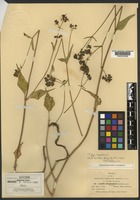
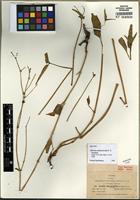
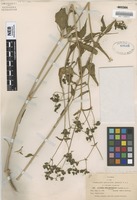
Isotype of Allionia melanotricha Standl. [family NYCTAGINACEAE]
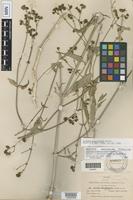
Type of Allionia melanotricha Standl. [family NYCTAGINACEAE]
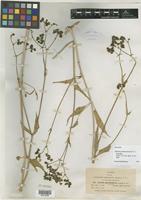
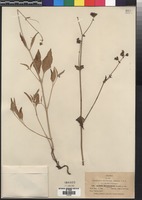
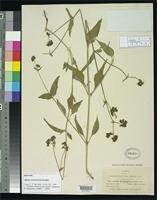
Isotype of Mirabilis oblongifolia (A. Gray) Heimerl [family NYCTAGINACEAE]
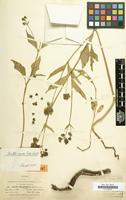
Type of Allionia melanotricha Standley [family NYCTAGINACEAE]
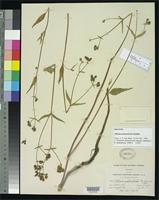
Isotype of Allionia melanotricha Standley, P.C. 1909 [family NYCTAGINACEAE]
Isotype of Allionia melanotricha Standl. [family NYCTAGINACEAE]
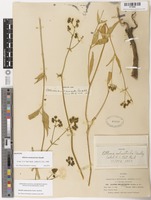
Allionia melanotricha Standl. [family NYCTAGINACEAE]
Isotype of Allionia melanotricha Standley, P.C. 1909 [family NYCTAGINACEAE]
Previous
Next

Name

Identification
Allionia melanotricha Standl. [family NYCTAGINACEAE ] Verified by Not on sheet., Mirabilis comata (Small) Standl. [family NYCTAGINACEAE ] (stored under name); Verified by Not on sheet.,
Related name
  • Mirabilis oblongifolia
  • Allionia melanotricha
  • Mirabilis comata
Common name
  • Mountain four-o’clock, Flora of North America Vol. 4

Flora

Entry for Mirabilis melanotricha (Standley) Spellenberg [family NYCTAGINACEAE]
Herbarium
Flora of North America (FNA)
Collection
Flora of North America
Resource Type
Reference Sources
Entry From
Flora of North America, Vol 4,
Names
Mirabilis melanotricha (Standley) Spellenberg [family NYCTAGINACEAE], Phytologia, 85: 99. 1999
Allionia melanotricha Standley [family NYCTAGINACEAE], Contr. U.S. Natl. Herb., 12: 351. 1909
Treatment Author(s)
Richard W. Spellenberg
Information
Stems erect or strongly ascending, leafy mostly in proximal 2/3 of plant, openly forked distally, 5–12 dm, pubescent basally with minute curved hairs in 2 lines, spreading glandular-pilose distally. Leaves ascending at 10–60°, progressively reduced toward infloresence; petiole 0.8–3 cm; blade bright green, narrowly triangular-ovate to ovate, 3–10 × 0.8–4 cm, ± thin, base acute, obtuse, truncate, or cordate, apex acute to attenuate, or obtuse, often rounded at tip, surfaces glabrous or rarely puberulent. Inflorescences axillary and terminal, few branched, ± evenly forked and open; peduncle 2–9 mm, spreading glandular-villous, crosswalls of hairs dark purple or black; involucres blushed with dark violet or black, at least in median region, widely bell-shaped, 3–6 mm in flower, 4–7 mm in fruit, spreading viscid-villous, 40–50% connate, lobes oblong to ovate, apex broadly acute. Flowers 3 per involucre; perianth bright purple-pink, 0.9–1.2 cm. Fruits dark grayish to blackish brown, sometimes dark, dull, reddish brown, narrowly obovoid, 3–4 mm, spreading-pilose, hairs often apearing loosely shaggy and somewhat tufted, (0.1–)0.2–0.3 mm; ribs ± same color as sulci, low and round, 0.7–1 times width of sulci, 0.5 times as wide as high, slightly rugose or warty; sulci almost smooth to slightly rugose or with very low tubercules.
Phenology
jun-aug (summer), sep-nov (fall)
Altitude range
1900–3000 m;
Distribution
Mexico.USA Ariz.USA Colo.USA N.Mex.USA Tex.
Discussion
The erect habit, bright green and usually glabrous foliage, and dark involucres of Mirabilis melanotricha are distinctive in combination. Once collected and pressed, M. melanotricha becomes yet another “difficult” Mirabilis. In 1911, P. C. Standley noted that this species (as Allionia melanotricha) was one of the most variable in the genus, and in 1918 he submerged it in A. comata, which in the field is a grayish green, clump-forming, glandular-pubescent plant with decumbent-ascending stems. Mirabilis melanotricha occurs in more mesic situations mostly at elevations above M. comata (here in synonymy in M. albida). It intergrades into M. linearis along its northern edge and lower elevations in New Mexico through M. linearis var. decipiens (Standley) S. L. Welsh. In the northeastern portion of its range, it may intergrade with M. nyctaginea; fruits in that region sometimes are slightly more reddish and more tuberculate than usual. Along the eastern portion of its range, it also intergrades into M. albida, as plants become more pubescent and fleshy. B. L. Turner (1993b) noted that M. comata (apparently in the sense of its common usage, as applied to plants here classified as M. melanotricha) might remain distinct from his concept of M. albida, which included C. F. Reed’s (1969) comprehensive M. oblongifolia.

Related Materials

  • Terms and Conditions
  • Privacy Policy
  • Cookie Policy
  • Cookie Settings
  • Accessibility
  • Help
  • Contact Us
  • Facebook
  • Twitter
ITHAKA

JSTOR is part of ITHAKA, a not-for-profit organization helping the academic community use digital technologies to preserve the scholarly record and to advance research and teaching in sustainable ways.

©2000-2026 ITHAKA. All Rights Reserved. JSTOR®, the JSTOR logo, JPASS®, Aluka®, and ITHAKA® are registered trademarks of ITHAKA.

╳