

Compilation
Aleuritopteris centrafricana
3 Images see all
Name
Identification
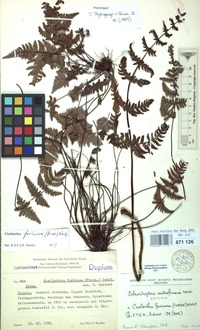
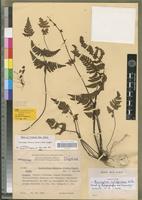
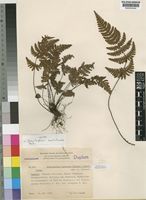
Isotype of Aleuritopteris centrafricana Saiki [family ADIANTACEAE ] Verified by Not on sheet, Cheilanthes farinosa (Forssk.) Kaulf. [family ADIANTACEAE ] (stored under name); Verified by Schelpe E.A.C.L.E., 1967
Related name
- Aleuritopteris centrafricana
- Cheilanthes farinosa
Flora
Entry for CHEILANTHES farinosa (Forssk.) Kaulf. [family ADIANTACEAE]
Herbarium
Royal Botanic Gardens, Kew (K)
Collection
Flora of Tropical East Africa
Resource Type
Reference Sources
Entry From
Flora of Tropical East Africa, page 1, (2002) Author: BERNARD VERDCOURT
Names
CHEILANTHES farinosa (Forssk.) Kaulf. [family ADIANTACEAE], Enum. Fil.: 212 (1824); Hieron. in P.O.A. C: 79 (1895) & in V. E. 2: 41, fig. 33c (1908); Sim, Ferns S. Afr. ed. 2: 235, t. 114 (1915); F.D.-O.A.: 40 (1929); Tardieu in Mém. I.F.A.N. 28: 89 (1953); Alston, Ferns W. Trop Afr.: 43 (1959); Tardieu, Fl. Cameroun 3: 136, t. 18, figs. 1, 2 (1964); Schelpe in Contr. Bolus Herb. 1: 69 (1969) & F. Z., Pterid.: 122 (1970) & Expl. Hydrobiol. Lac Bangweolo & Luapula 8 (3), Ptérid.: 59 (1973) & C.F.A., Pterid.: 99 (1977); W. Jacobsen, Ferns S. Afr.: 247, fig. 177 (1983); Andrews, Rev. Fern Genus Cheilanthes : 19–29 (1986); J.E. Burrows, S. Afr. Ferns: 128, t. 20.1, fig. 26/117 (1990); Schippers in Fern Gaz. 14: 180 (1993); Hepper & Friis, Pl. Pehr Forsskål Fl. Aegypt.-Arab.: 290 (1994); Faden in U.K.W.F. ed. 2: 17, t. 169 (1994); Miller in Miller & Cope, Fl. Arab. Pen. & Socotra 1: 46, fig. 4f (1996); Wood, Handb. Yemen Fl.: 57 (1997). Type: Yemen, Al Hadiyah, Forsskål s.n. (C, missing, LD!, iso.)
Pteris farinosa Forssk. [family ], Fl. Aegypt.-Arab. 187 (1775); Vahl, Symb. Bot. 3: 103, t. 75 (1794)
Pteris decursiva Forssk. [family ], Fl. Aegypt.-Arab.: 186 (1775). Type: Yemen, Al Hadiyah, Forsskål s.n. (C, missing, holo.)
Allosorus farinosus (Forssk.) C. Presl [family ADIANTACEAE], Tent. Pterid.: 153 (1836) & in Abh. Königl. Böhm. Ges. Wiss. ser. 4, 5: 153 (1837)
Cassebeera farinosa (Forssk.) J. Sm. [family ADIANTACEAE], in Hook., Lond. Journ. Bot. 4: 159 (1841)
Aleuritopteris farinosa (Forssk.) Feé [family ADIANTACEAE], Mém. Fam. Foug. 5: 154, t. 12 b, fig. 1 (1852); A.V.P.: 24 (1957); Saiki in J. Phytogeogr. & Taxon. 32: 85 (1984)
Aleuritopteris afra Pic. Serm. [family ADIANTACEAE], in Webbia 27: 415, fig. 8 (1973) (‘1972’); Saiki in J. Phytogeogr. & Taxon. 32: 81 (1984); Schippers in Fern Gaz. 14: 179 (1993). Type: Tanzania, Kilimanjaro, near Bismark Hut, Pichi Sermolli 5164 (Herb. Pic. Ser. 20647 holo., Herb. Pic. Ser. 26285, iso., K!, iso., KYO, iso.)
Cheilanthes sp. A. [family ADIANTACEAE], ; Faden in U.K.W.F.: 37 (1974)
Cheilanthes sp. B [family ADIANTACEAE], ; Faden in U.K.W.F.: 37 (1974)
Aleuritopteris aethiopica Saiki [family ADIANTACEAE], in J. Phytogeogr. & Taxon. 32: 81 (1984). Type: Ethiopia, Shoa, 1 km N of main road bridge, 17 km S of Addis Ababa, F.G. Meyer 7462 (sphalm. 7642) (BOL, holo., K!, iso.)
Aleuritopteris centrafricana Saiki [family ADIANTACEAE], in J. Phytogeogr. & Taxon. 32: 82, fig. 12 (1984). Type: Uganda, Kigezi (sphalm. Kigri) District, Virunga (sphalm. Kringi) Mts, W Muhavura, Stauffer 864 (Z, holo., K!, iso.)
Aleuritopteris decursiva (Forssk.) Saiki [family ADIANTACEAE], in J. Phytogeogr. & Taxon. 32: 85, fig. 4 (1984). Type: Yemen, Al Hadiyah, Forsskål s.n. (C†, holo.) (Saiki states about some cited specimens “Two same numbered specimens of Pappi 4172 are remarkably different from each other” which he attributes to growing stages. A K duplicate of this number bears also a specimen of a young plant of Doryopteris)
Aleuritopteris flava Saiki [family ADIANTACEAE], in J. Phytogeogr. & Taxon. 32: 86, fig. 7 (1984). Type: Tanzania, Uluguru Mts, Schlieben 3223 (Z, holo.)
Aleuritopteris gigantea Saiki [family ADIANTACEAE], in J. Phytogeogr. & Taxon. 32: 86, fig. 8 (1984). Type: Tanzania, Mt Meru, W Engare Narok, Zogg & Gassner 57/2 (Z, holo.)
Aleuritopteris leptophylla Saiki [family ADIANTACEAE], in J. Phytogeogr. & Taxon. 32: 88, fig. 13 (1984). Type: Eritrea, Hamasen, Dongallo, near Ghinda, Pappi 4172 (Z, holo.) (also cited as A. decursiva in same paper on p. 85, possibly because he considered the Z duplicate different)
Aleuritopteris longifrons Saiki [family ADIANTACEAE], in J. Phytogeogr. & Taxon. 32: 88, fig. 10 (1984). Type: Tanzania, Mt Meru, E Arusha Nat. Park, Merekamba, Zogg & Gassner 118/7 (Z, holo.)
Aleuritopteris bullosa [family ADIANTACEAE], sensu Schippers in Fern Gaz. 14: 180 (1993), ? non Kunze
Information
Rhizome shortly creeping, with ovate to lanceolate scales 7–10.5 mm long, up to 1.1 mm wide, brown to golden, with or without a dark stripe, often gland-tipped and with marginal glands. Fronds 3–20, tufted, 6–120 cm high; stipe brown to almost black, shining, longer or shorter than lamina, (2–)5–55 cm long, with brown to golden scales 4–13 mm long, 1.6–4(–6) mm wide, mostly very narrowed to hair-tip, often confined to lower part but sometimes scattered throughout and extending on to rhachis, particularly obvious on stipes of young undeveloped fronds (croziers); lamina lanceolate, ovate, triangular or pentagonal, 12–54 cm long, 5–18 cm wide, pinnate with pinnae deeply pinnatifid or bipinnatifid or in some lower pinnae the pinnules quite separate and lamina partly bipinnate; pinnae in 5–25 pairs, lanceolate or narrowly triangular, 0.5–12 cm long, 0.2–5 cm wide, the lowest pair with first basiscopic pinnule well developed; pinnules/segments linear-oblong to lanceolate, 0.2–2.8 cm long, usually, sometimes very densely, white or pale yellow farinose beneath and with ± sessile glands; venation usually obvious above, sometimes so impressed as to give a bullate effect to the upper surface, visible beneath if farina ± lacking. Sori discrete, appearing continuous at maturity; indusia separate to continuous, entire to lacerate-ciliate. Fig. 7 (p. 30).
Range
DISTR. U 1–3; K 1, 3–7; T 1–4, 6, 7
Altitude range
1400–3950 m
Distribution
KENYA Elgeyo District Cherangani Hills, Arror Valley, 26 Aug. 1969, Mabberley & McCall 240!KENYA Fort Hall District Thika, Blue Posts Hotel, 12 Aug. 1967, Faden 67/583!;KENYA Londiani District Tinderet Forest Reserve, Camp 2, 19 June 1949, Maas Geesteranus 5042!TANZANIA Mbulu District Ngorongoro crater rim near where main road meets it, 2 Mar. 1964, Verdcourt 4025!;TANZANIA Lushoto District W Usambaras, near Magamba, Kosti, 21 Sept. 1981, Mtui & Sigara 66!;TANZANIA Mbeya District Poroto Mts, Kikondo Camp, 19 Jan. 1961, Richards 13959!UGANDA Karamoja District Mt Debasien, Zebiel, 9 Jan. 1937, A.S. Thomas 2219!;UGANDA Kigezi District Kirwa, Dec. 1938, Chandler & Hancock 2536!;UGANDA Mbale District Bugishu, Butandiga, Dec. 1935, Eggeling 2430!
Distribution (external)
; Guinea
Sierra Leone
Nigeria
Cameroon
Zaire
Sudan
Ethiopia
Somalia
Eritrea
Angola
Zambia
Botswana
Malawi
Zimbabwe
Yemen
Socotra
Saudi Arabia
Oman
Notes
The commonly held view that Cheilanthes farinosa is an extremely complicated complex of many different groups seems to me exaggerated. The material from Yemen appears to me undoubtedly conspecific with the African material so we are not concerned with the difficulties in Asia. The various races marked by different spore types, cytology, and different chromatographic analyses do not seem to correlate with the gross morphology and geography. The view is taken that at least in Africa, it is best to retain them under a single wide species, but it is necessary to discuss the work which has been done.Manton et al. (K.B. 18: 553–565 (1966)) recognised groups, three of which occur in E Africa:1) an apogamous triploid with “smooth” spores, having lamina ovate-lanceolate with basal pinnae shorter than the next above, pinnae and pinnules more spaced, lanceolate stipe scales, and dark-striped rhizome scales (this they considered typical C. farinosa matching Vahl’s figure)2) a sexual tetraploid with ‘spinulose’ spores (64 per sporangium) having the lamina more triangular with basal pinnae the longest, pinnae and pinnules more closely spaced, the stipe scales with or without a dark stripe, and3) a group with the ultimate segments with venation impressed above giving a bullate appearance, stipe scales yellowish-brown and broadly ovate and a broad continuous (not lobed) indusium. This was not sampled cytologically.Pichi Sermolli described Aleuritopteris afra from Kilimanjaro with narrowly oblong-lanceolate lamina with two lower pairs of pinnae more or less equal, rhizome scales without black stripes and a continuous erose-margined indusium.Saiki (J. Phytogeogr. & Taxon. 32: 81–90 (1984)) has described several new species based on a few specimens from various herbaria but has not examined the material available at BM, K etc. He gives a key and describes work on the spores and chromatographic analysis (J. Phytogeogr. & Taxon. 32: 91–98 (1984)). It is clear from this there are races within C. farinosa but these appear to be poorly correlated with gross morphology and geography.E. G. Andrews l.c., divides C. farinosa into groups but unfortunately although she lists the sheets of C. farinosa she has seen, she does not assign them to her groups.Group 1. Up to 40 cm tall; lowermost pinnae appearing shorter than pair above; farina yellow-green; stipe densely scaly with scales light brown with darker stripes continuing up the rhachis; rhizome scales darker brown, dark striped; indusia discontinuous, fimbriate-lacerate; 64 spores per sporangium, reticulate-cristate. Restricted to Uluguru Mts.Group 2. Fronds narrowly triangular to lanceolate; lowermost pinnae ± equalling the pair above; farina white; veins not impressed on upper surface; 64 spores per sporangium, reticulate-cristate. High elevations on mountains. This corresponds with C. afra (Pic. Serm.) Kornaś.Group 3. Similar to Group 2 in lamina characters but with veins deeply impressed above (“bullate surface”) rhizome scales rust-coloured, not striped, narrowly lanceolate; stipe scales golden-brown, broader and ovate, restricted to lower part; spores 64 per sporangium, spongy reticulate. On mountains Kilimanjaro, Ruwenzori, Mt. Kenya etc., 2700–3330 m. This is the third group recognised by Manton et al.Group 4. Fronds broader than in groups 2 and 3 with pinnae wider and more closely spaced on the rhachis; farina white; rhizome scales dark-striped or not; stipe scales dark golden brown, ovate to lanceolate, hair-pointed. Indusia continuous and entire, extended from a recurved leaf margin, inconspicuous at maturity. Spores 64 per sporangium, spongy reticulate. Kenya 2670–3600 m. Andrews op. cit., says that this is the least distinct group and appears to be the sexual tetraploid of Manton et al.Group 5. Similar to group 1 but up to 1 m tall and more robust; farina white; stipe scales dark to golden brown sometimes slightly dark striped; no scales on rhachis; indusia continuous or discontinuous; 32 spores per sporangium, various but usually spongy/reticulate. Corresponds with the apogamous triploid of Manton et al. and assumed to be typical C. farinosa (Forssk.) Kaulf. and the same as A. decursiva (Forssk.) Saiki. Andrews states this is the most distinctive of all the groups with its scaly rhachis and yellowish-green farina and seems closely related to Nigerian material determined as C. anceps Blandford by Jarrett and matches its spores. It also corresponds to A. flava Saiki so far as his type Schlieben 3223 is concerned, but Schelpe 3930 (from Victoria Falls) also cited by Saiki has different spores and is a sexual tetraploid (fide Manton et al.). Panigrahi has also reported C. anceps to be a sexual tetraploid but considered it not to occur in Africa. Actually nearly all the material annotated as C. anceps has pure white farina. Schippers (Fern Gaz. 14: 179 (1993)) has cited Schlieben 3223 as C. anceps.