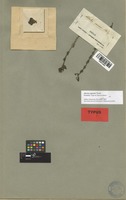
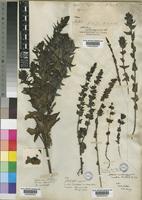
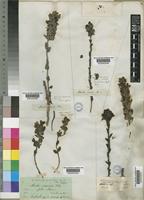
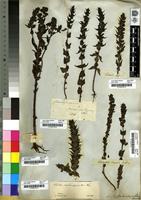
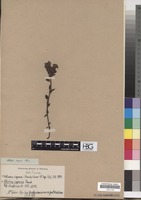
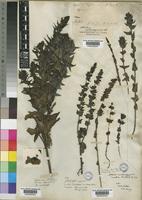
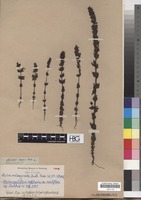
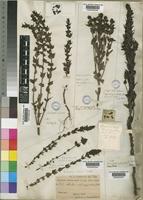
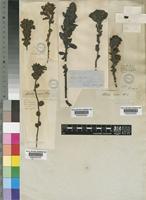
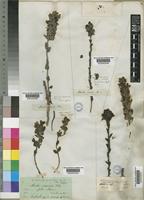
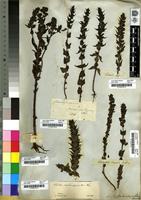
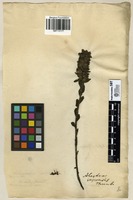
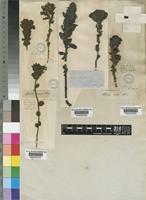
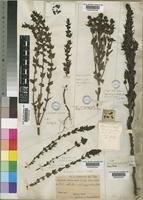
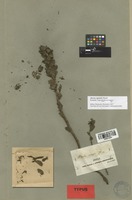
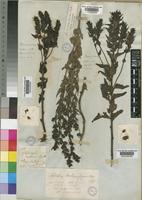
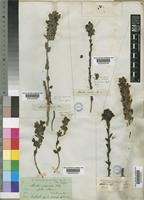
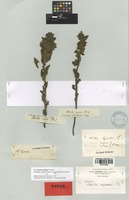
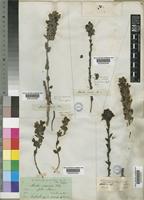
an annual herb, parasitic on the roots of grasses or similar plants which it renders tuberous, greenish-dusky or dusky when dried, scentless; stems erect, with long whitish pubescence, simple or branched below, striate, rigid, leafy, 4–14 in. high; leaves oval, ovate or lanceolate, obtuse, apiculate or the narrow ones subacute, somewhat narrowed at the sessile or subsessile sub-3-nerved base, scabrid-hispid at least on the margin and nerves beneath, entire or sparingly toothed, scattered or subopposite, 1/3–1 in. long, 1/8– 1/2 in. broad, the lowest smaller and scale-like; flowers subsessile, numerous, or rather few, in the upper axils, orange- or golden-yellow, 2/3–1 in. long; spikes dense, terminal, 1–3 in. long, 1–1 1/2 in. broad; bracts like the leaves or narrower, ciliate or hispid above; pedicels 1/8 in. long or less; calyx campanulate, shortly 5-cleft, angular, 10-nerved, delicately veined, 3/8– 5/6 in. long, rather broad and loose, somewhat hispid outside, glabrous within, bibracteolate at the base; lobes triangular-ovate, acute or apiculate, ciliate, 1/6– 1/4 in. long; bracteoles sublinear or narrowly spathulate, pilose on the back, ciliate, glabrous and shining within, about 1/4 in. long; corolla yellow, marked with purple or brown stripes, corrugated; tube glabrous, about as long as the calyx, subcylindrical below, funnel-shaped towards the throat; limb spreading, about 1 in. in diam.; lobes obovate, about 3/8– 1/2 in. long, glabrous, clearly nerved and veined; stamens exserted or nearly so; 2 of the filaments densely bearded along one side; anthers glabrous, oblong-ovoid, obtuse, 1/12– 1/10 in. long; style longer than the stamens, glabrous except the glandular apical part, bent over the anthers; capsule ovoid, about 1/3 in. long, glabrous. null