

Compilation
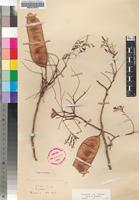
Albizia rogersii
1 Images see all
Name
Identification
Albizia rogersii Burtt Davy [family FABACEAE ] Verified by Not on sheet, Albizia brevifolia Schinz [family FABACEAE ] (stored under name); Verified by Not on sheet,
Related name
- Albizia rogersii
- Albizia brevifolia
Flora
Entry for Albizia brevifolia Schinz [family LEGUMINOSAE]
Herbarium
Royal Botanic Gardens, Kew (K)
Collection
Flora Zambesiaca
Resource Type
Reference Sources
Entry From
FZ, Vol 3, Part 1, (1970) Author: J.P.M. Brenan
Names
Albizia brevifolia Schinz [family LEGUMINOSAE], in Bull. Herb. Boiss, Sér. 2, 2: 945 (1902). — Codd in Bothalia, 7: 69 (1958). — Boughey in Journ. S. Afr. Bot. 30: 158 (1964). Type: Mozambique, Boroma, on the Nhasinde, Menyharth 994 (K; Z, holotype).
Albizia rogersii Burtt Davy [family LEGUMINOSAE], F.P.F.T. 2: xviii, 348 (1932). — O. B. Mill in Journ. S. Afr. Bot. 18: 27 (1952). — F. White, F.F.N.R.: 89, fig. 16 I (1962). Type from the Transvaal.
Albizia parvifolia Burtt Davy [family LEGUMINOSAE], F.P.F.T. 2: xvii, 348 (1932). Type from the Transvaal.
Information
A rounded bush or small tree c. 3-16 m. high, deciduous; bark grey to black, smooth or very shallowly fissured; trunk often forking near the base into several to many ascending branches; young branchlets sparsely to rather densely appressed-grey-puberulous. Leaves: gland on upper side of petiole squat, sessile, c. 0·25 mm. high; pinnae (3)6-10(17) pairs; leaflets 15-30 pairs, 3-9 x 0·75-1·8 mm., narrowly oblong to linear-oblong, symmetric and obtuse to subacute at the apex, glabrous or with margins ± appressed-ciliate; midrib nearly central (except at the base); lateral nerves not distinct beneath. Flowers white to creamy-yellow, 1-1·5 mm. pedicellate; bracteoles very caducous, fallen by flowering time. Calyx 1-1·5 mm. long, glabrous to ± puberulous outside. Staminal tube not or scarcely exserted beyond the corolla; filaments c. 1-1·2 cm. long. Pod apparently indehiscent, 9-27 x 1·8-3·6 cm., linear-oblong, glabrous to finely puberulous, brown. Seeds 8-10 x c. 6·5 mm., flattened.
Habitat
Usually recorded from rocky places, often basalt but also sandstone; also in mopane woodland
Altitude range
130–1000 m.
1000
130
Distribution
Mozambique MS Báruè, between Mandiè and Mungári, fl. & fr. 30.x.1941, Torre 3712 (BM; K; LISC).Zimbabwe S Malipati, Nuanetsi R., fl. 2.xi.1955, Wild 4696 (K; SRGH).Zimbabwe E Melsetter Distr., Hotsprings, fr. 24.ii.1952, Chase 4383 (BM; K; LISC; SRGH).Zimbabwe W Wankie, fl. & fr. 21.x.1951, Lovemore 123 (K; LISC; SRGH).Zambia S Sinazongwe, fr. 27.v.1961, Fanshawe 6620 (K).Mozambique T Mutarara, fr. 15.vi.1949, Andrada 1584 (COI; LISC).Zimbabwe N Urungwe Distr., Kariba, fr. i.1959. Goldsmith 2/59 (BM; K; LISC; LM; SRGH).Zambia C near Feira Boma, fr. 30.v.1952, White 2904 (BM; K).Botswana N Francistown Distr., between Sukwe and Nata, fr. 23.iii.1962, de Beer & Yalala 33 (SRGH).
Distribution (external)
Transvaal
Notes
A. brevifolia is unquestionably closely allied to A. amara, particularly the subsp. amara. The two species have a number of significant characters in common, including the unusual apparently indehiscent pods. A. brevifolia differs from A. amara subsp. amara in having much shorter sparse indumentum on the branchlets, and more glabrous leaflets (usually) and calyx, and in the more stipitate pods (stipe (0·5)1-2·5 cm. as against 0·5-0·8 cm.).