JSTOR Global Plants Home
  • Home
  • Browse
  • About
  • Access
  • Account
    • Saved Items
    • Profile
  • Log in

Global Plants

Skip to Main Content
  • JSTOR Global Plants Home
  • Global Plants

    • Browse
    • About
    • Access
    • Account
      • Saved Items
      • Profile
Log in
  • Browse
  • About
  • Access
  • Account
    • Saved Items
    • Profile
Advanced Search

Compilation
Ageratinastrum palustre

2 Images see all

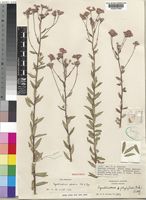
Holotype of Ageratinastrum palustre Wild & G.V.Pope [family COMPOSITAE]
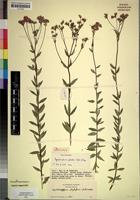
Isotype of Ageratinastrum palustre Wild & G.V.Pope [family COMPOSITAE]
Previous
Next

Name

Identification
Ageratinastrum palustre Wild & G.V.Pope [family COMPOSITAE ] (stored under name); Verified by Wild, H.; Pope, G.V., Ageratinastrum polyphyllum (Baker) Mattf. [family COMPOSITAE ]
Related name
  • Ageratinastrum polyphyllum
  • Ageratinastrum palustre

Flora

Entry for Ageratinastrum palustre Wild & G.V. Pope [family COMPOSITAE]
Herbarium
Royal Botanic Gardens, Kew (K)
Collection
Flora Zambesiaca
Resource Type
Reference Sources
Entry From
FZ, Vol 6, Part 1, (1992) Author: G. V. Pope
Names
Ageratinastrum palustre Wild & G.V. Pope [family COMPOSITAE], in Kirkia10: 326; 358 (1977). TAB.30 fig. B. Type: Zambia, Mbala, Ndundu Swamp, Richards 16151 (K, holotype; M).
Information
An erect stiff perennial herb to c. 1 m. tall, with annual stems from a woody rootstock. Stems many, strict, branching above, densely leafy with internodes less than 2 cm. long, whitish pilose-pubescent, glabrescent below; indumentum of short-stalked flagelliform hairs. Leaves alternate or spirally arranged sometimes opposite or whorled, subsessile or with petioles to c. 2 mm. long; lamina 1–3.3 x 0.4–1.2 cm., narrowly oblong-lanceolate to narrowly ovate, acute mucronulate at the apex, cuneate to rounded below, margins ± revolute, upper surface glabrous or thinly sparsely pilose-puberulous with nerves ± impressed, the lower surface paler and sparsely pilose especially on the nerves, glandular-punctate. Capitula numerous, singly or in 2–10-capitulate clusters at the ends of branches, or capitulum-clusters ± corymbiformly cymose at the stem apex. Involucres 3–4 x 3–4.5 mm., campanulate to subglobose; florets exserted. Phyllaries several-seriate, purple and acute above, tomentellous to woolly outside; the outer phyllaries from c. 1 mm. long, ovate; the inner to c. 4 mm. long, narrowly oblong-lanceolate. Receptacle shallowly alveolate. Corollas mauve, darker in the upper half, 5–6 mm. long, narrowly funnel-shaped, puberulous or thinly pilose outside at least on the lobes, glandular, the lobes purple-tipped. Achenes 1–1.5 mm. long, turbinate, truncate at the apex, 4–5-sided with obscure narrow ribs on the angles, rugose or transversely ridged on the faces between the ribs, glabrous or sparsely setulose, minutely brown gland-dotted; pappus of broad ± united shiny, white brownish or sometimes purplish scales, 0.5–1 mm. long and ± lacerate on the upper margin, occasionally scales ± free and alternating with 1–3 narrow paleaceous setae which ± exceed the scales in length.
Habitat
Swampy or dambo areas with tall grasses.
Range
Not known outside the Flora Zambesiaca area
Distribution
Zambia N Mporokoso-Sanga Hill Road, c. 1350 m., 19.i.1960, Richards 12436 (K; M; SRGH).

Related Materials

  • Terms and Conditions
  • Privacy Policy
  • Cookie Policy
  • Cookie Settings
  • Accessibility
  • Help
  • Contact Us
  • Facebook
  • Twitter
ITHAKA

JSTOR is part of ITHAKA, a not-for-profit organization helping the academic community use digital technologies to preserve the scholarly record and to advance research and teaching in sustainable ways.

©2000-2026 ITHAKA. All Rights Reserved. JSTOR®, the JSTOR logo, JPASS®, Aluka®, and ITHAKA® are registered trademarks of ITHAKA.

╳