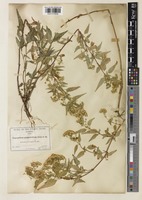
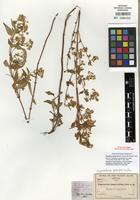
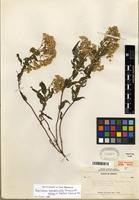
Isotype of Ageratina paupercula(A. Gray) R.M. King & H. Rob. [family ASTERACEAE ] (stored under name); Verified by K. Mauz (ARIZ), Eupatorium pauperculumA. Gray [family ASTERACEAE ] Verified by Not on sheet, Isotype of Eupatorium pauperculumA. Gray [family ASTERACEAE ] Verified by Not on sheet,
Related name
Eupatorium pauperculum
Ageratina paupercula
Piptothrix arizonica
Common name
Santa Rita snakeroot, Flora of North America Vol. 21
Flora
Entry for Ageratina paupercula (A. Gray) R. M. King & H. Robinson [family COMPOSITAE]
Herbarium
Flora of North America (FNA)
Collection
Flora of North America
Resource Type
Reference Sources
Entry From
Flora of North America, Vol 21,
Names
Ageratina paupercula(A. Gray) R. M. King & H. Robinson [family COMPOSITAE], Phytologia, 19: 215. 1970
Perennials or subshrubs, to 100 cm. Stems erect, puberulent to glabrate. Leaves opposite; pet-ioles 3–15 mm; blades narrowly to broadly lanceolate, (2–)3–7 × 0.5–1.5 cm, margins coarsely and remotely serrate, apices long-acuminate, abaxial faces sparsely pubescent. Heads clustered. Peduncles 2–6 mm, puberulent. Involucres 2.5–3 mm. Phyllaries: apices acute, abaxial faces puberulent-hispidulous. Corollas white, lobes sparsely hispid-villous. Cypselae glabrous.
Phenology
mar-may (spring)
Altitude range
1000–1800 m;
Distribution
Mexico.USA Ariz.
Discussion
Ageratina paupercula is recognized by its early spring flowering, relatively small and usually narrowly lanceolate and acuminate leaves, relatively small heads in clusters, and relatively small (1.2–1.4 mm versus mostly 2–3 mm in other species), glabrous cypselae.