JSTOR Global Plants Home
  • Home
  • Browse
  • About
  • Access
  • Account
    • Saved Items
    • Profile
  • Log in

Global Plants

Skip to Main Content
  • JSTOR Global Plants Home
  • Global Plants

    • Browse
    • About
    • Access
    • Account
      • Saved Items
      • Profile
Log in
  • Browse
  • About
  • Access
  • Account
    • Saved Items
    • Profile
Advanced Search

Compilation
Agelanthus irangensis

7 Images see all

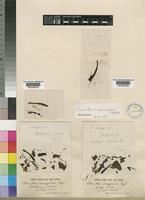
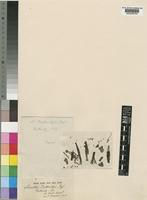
Paratype of Loranthus irangensis Engl. [family LORANTHACEAE]
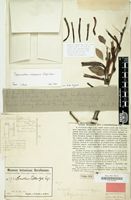
Type of Loranthus prittwitzii Engl. [family LORANTHACEAE]
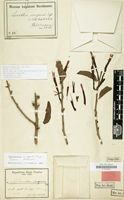
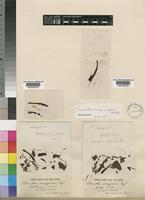
Holotype of Loranthus irangensis Engl. [family LORANTHACEAE]
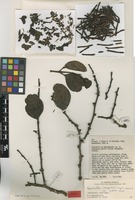
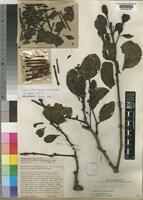
Isotype of Agelanthus validus Polhill & Wiens [family LORANTHACEAE]
Agelanthus irangensis (Engl.) Polhill & Wiens [family LORANTHACEAE]
Agelanthus validus Polhill & Wiens [family LORANTHACEAE]
Holotype of Loranthus irangensis Engl. [family LORANTHACEAE]
Previous
Next

Name

Identification
Loranthus irangensis Engl. [family LORANTHACEAE ] Verified by Gebauer, Agelanthus irangensis (Engl.) Polhill&Wiens [family LORANTHACEAE ] (stored under name); Verified by Not on sheet.,
Related name
  • Loranthus prittwitzii
  • Loranthus irangensis
  • Tapinanthus irangensis
  • Agelanthus irangensis

Flora

Entry for Agelanthus irangensis (Engl.) Polh. & Wiens [family LORANTHACEAE]
Herbarium
Royal Botanic Gardens, Kew (K)
Collection
Flora of Tropical East Africa
Resource Type
Reference Sources
Entry From
Flora of Tropical East Africa, page 1, (1999) Author: POLHILL & D. WIENS
Names
Agelanthus irangensis (Engl.) Polh. & Wiens [family LORANTHACEAE], in Lebrun & Stork, Énum. Pl. Fl. Afr. Trop. 2: 164 (1992) & Mistletoes Afr.: 163 (1998). Type: Tanzania, Kondoa District, W. of Irangi, Stuhlmann 4230 (B!, holo., K!, fragment)
Loranthus irangensis Engl. [family LORANTHACEAE], in E.J. 20: 111 (1894) & P.O.A. C: 166, t. 13E–H (1895) & in E.J. 30: 302 (1901); Sprague in F.T.A. 6(1): 342 (1910); F.D.O.-A. 2: 172 (1932); T.T.C.L.: 290 (1949)
Loranthus prittwitzii Engl. [family LORANTHACEAE], in E.J. 40: 527 (1908); F.D.O-A. 2: 168 (1932). Type: Tanzania, Mbeya District, Utengule, Prittwitz 173 (B!, holo., K!, fragment)
Tapinanthus irangensis (Engl.) Danser [family LORANTHACEAE], in Verh. K. Akad. Wet., sect. 2, 29(6): 113 (1933)
Information
Robust shrub; branchlets soon terete, subpersistently tomentellous. Leaves alternate to subopposite; petiole 2–4 mm. long; lamina coriaceous, green, ovate-elliptic, smaller ones sometimes obovate, 3–6.5 cm. long, 2–3 cm. wide, obtuse to rounded at the apex, obtuse to rounded and attenuate at the base, glabrous to thinly pubescent, with 3–6 pairs of lateral nerves, the second strongly ascending, sometimes inconspicuous. Umbels sessile, with 1–5 flowers in oblique sockets; bract cupular, 3–4.5 mm. long, puberulous. Receptacle 2–3 mm. long; calyx tubular, 7–8 mm. long, shortly toothed, ciliate, circumscissile near the base, free part remaining as a collar around the corolla-tube. Corolla 5.5–7 cm. long, tube red or orange-red, banded green at top, lobes yellow around vents, red-maroon at tip, without an apical swelling in bud; basal swelling slight, 6 mm. long, 3 mm. in diameter; lobes 14–17 mm. long, the upper two-thirds linear-oblanceolate. Filaments inflexed, the distal 2–3 mm. hardened and thickened; tooth 0.8–1 mm. long; anthers 3.5–5 mm. long. Style slender, slightly expanded opposite the filaments, narrowed to a neck 3.5–4 mm. long; stigma capitate, 0.8–1 mm. across. Berry not seen.
Range
DISTR. T 5, 7 not known elsewhere
Altitude range
1000–1650 m.
Distribution
TANZANIA Dodoma District 18 km. E. of Itigi station, 11 Apr. 1964, Greenway & Polhill 11504!;TANZANIA Mpwapwa District near Kibakwe village, 10 Apr. 1988, Bidgood, Mwasumbi & Vollesen 992!;TANZANIA Iringa District Iringa–Ruaha National Park road, Iringa side of Ilusi bridge, 1986, Congdon 123!
Notes
A spectacular plant in flower but not often collected.

Related Materials

  • Terms and Conditions
  • Privacy Policy
  • Cookie Policy
  • Cookie Settings
  • Accessibility
  • Help
  • Contact Us
  • Facebook
  • Twitter
ITHAKA

JSTOR is part of ITHAKA, a not-for-profit organization helping the academic community use digital technologies to preserve the scholarly record and to advance research and teaching in sustainable ways.

©2000-2026 ITHAKA. All Rights Reserved. JSTOR®, the JSTOR logo, JPASS®, Aluka®, and ITHAKA® are registered trademarks of ITHAKA.

╳