JSTOR Global Plants Home
  • Home
  • Browse
  • About
  • Access
  • Account
    • Saved Items
    • Profile
  • Log in

Global Plants

Skip to Main Content
  • JSTOR Global Plants Home
  • Global Plants

    • Browse
    • About
    • Access
    • Account
      • Saved Items
      • Profile
Log in
  • Browse
  • About
  • Access
  • Account
    • Saved Items
    • Profile
Advanced Search

Compilation
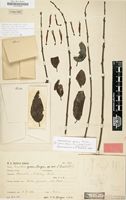
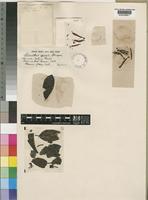
Agelanthus igneus

2 Images see all

Holotype of Loranthus igneus Sprague [family LORANTHACEAE]
Agelanthus igneus (Danser) Polhill & Wiens [family LORANTHACEAE]
Previous
Next

Name

Identification
Loranthus igneus Sprague [family LORANTHACEAE ] Verified by Gebauer, Agelanthus igneus (Danser) Polhill&Wiens [family LORANTHACEAE ] (stored under name); Verified by Not on sheet.,
Related name
  • Loranthus igneus
  • Agelanthus igneus

Flora

Entry for Agelanthus igneus (Danser) Polh. & Wiens [family LORANTHACEAE]
Herbarium
Royal Botanic Gardens, Kew (K)
Collection
Flora of Tropical East Africa
Resource Type
Reference Sources
Entry From
Flora of Tropical East Africa, page 1, (1999) Author: POLHILL & D. WIENS
Names
Agelanthus igneus (Danser) Polh. & Wiens [family LORANTHACEAE], in Lebrun & Stork, Énum. Pl. Fl. Afr. Trop. 2: 164 (1992) & Mistletoes Afr.: 178 (1998). Type: Tanzania, Lindi District, Cheminda to Bakari-Rondo, Braun in Herb. Amani 1169 (B!, holo., EA, iso., K!, fragment)
Loranthus igneus Sprague [family LORANTHACEAE], in K.B. 1912: 232 (1912) & in F.T.A. 6(1): 1034 (1913); F.D.O.-A. 2: 175 (1932); T.T.C.L.: 287 (1949), nom. illegit., non (Scheff.) Benth. & Hook.f. (1880)
Tapinanthus igneus Danser [family LORANTHACEAE], in Verh. K. Akad. Wet., sect. 2, 29(6): 113 (1933). Based on L. igneus Sprague
Information
Well-branched shrub with relatively short lateral branches; branchlets compressed at first with scurfy puberulence only on first 1–2 internodes, soon terete, brown turning grey, fissured and prominently lenticellate. Leaves opposite to subopposite; petiole 5–12 mm. long; lamina dull green, thinly coriaceous, linear-lanceolate to lanceolate or elliptic-lanceolate, 4–12 cm. long, 1–3.5 cm. wide, pointed at the apex, glabrous, with up to 8 pairs of main lateral nerves, lower ones strongly ascending. Umbels 6–8-flowered; peduncle 2–3 mm. long, puberulous; pedicels 4–5 mm. long, puberulous; bract-limb ovate-triangular, pointed to truncate, 1–1.5 mm. long. Receptacle 1.5–2 mm. long, glabrous to scurfy puberulous; calyx 0.5 mm. long, broadly toothed. Corolla 3.5–3.8 cm. long, deep orange to pinkish red or fiery red, yellow around vents, darker red-brown at tip, subglabrous with minute scurfy puberulence on the lobe-tips and ± some small hairs on the tube; apex of buds oblong, subacute, 3–4 mm. long, 2 mm. in diameter; basal swelling ovoid-globular, 3.5–5 mm. long, 3–4 mm. in diameter, narrowly constricted for 3–4 mm. above; lobes erect, 6–8 mm. long, the upper hardened part linear-lanceolate, 3–4 mm. long, hardened inside, rounded outside. Stamens inflexed; tooth minute; anthers 1.5–2.5 mm. long. Style with a neck 1.5–2.5 mm. long; stigma capitate, 0.8 mm. across. Berry not seen.
Range
DISTR. T ?6 (see note), 8 N. Mozambique south to the Zambezi
Altitude range
800 m.
Distribution
TANZANIA Lindi District Rondo Plateau, 7 Apr. 1998, Congdon 509! & Cheminda to Bakari-Rondo, 12 June 1906, Braun in Herb. Amani 1169!
Notes
Closely related to A. scassellatii and A. transvaalensis (Sprague) Polh. & Wiens, but easily recognised by the lack of distinct keels to the back of the corolla-lobes.Peter (1932) also records the species from Mafia I., but the specimen, Braun in Herb. Amani 3615, has not been seen.

Related Materials

  • Terms and Conditions
  • Privacy Policy
  • Cookie Policy
  • Cookie Settings
  • Accessibility
  • Help
  • Contact Us
  • Facebook
  • Twitter
ITHAKA

JSTOR is part of ITHAKA, a not-for-profit organization helping the academic community use digital technologies to preserve the scholarly record and to advance research and teaching in sustainable ways.

©2000-2026 ITHAKA. All Rights Reserved. JSTOR®, the JSTOR logo, JPASS®, Aluka®, and ITHAKA® are registered trademarks of ITHAKA.

╳