JSTOR Global Plants Home
  • Home
  • Browse
  • About
  • Access
  • Account
    • Saved Items
    • Profile
  • Log in

Global Plants

Skip to Main Content
  • JSTOR Global Plants Home
  • Global Plants

    • Browse
    • About
    • Access
    • Account
      • Saved Items
      • Profile
Log in
  • Browse
  • About
  • Access
  • Account
    • Saved Items
    • Profile
Advanced Search

Compilation
Agelanthus atrocoronatus

5 Images see all

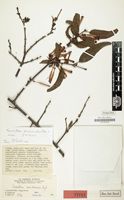
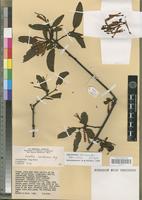
Isotype of Loranthus sansibarensis Engl. [family LORANTHACEAE]
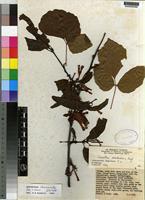
Isotype of Agelanthus atrocoronatus Poih. & Wiens [family LORANTHACEAE]
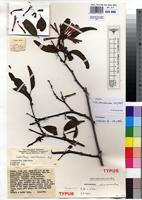
Isotype of Agelanthus atrocoronatus Polhill & Wiens [family LORANTHACEAE]
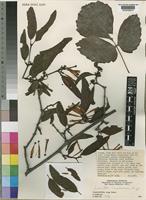
Agelanthus atrocoronatus Polhill & Wiens [family LORANTHACEAE]
Isotype of Agelanthus atrocoronatus Polhill&Wiens [family LORANTHACEAE]
Previous
Next

Name

Identification
Isotype of Loranthus sansibarensis Engl. [family LORANTHACEAE ] Verified by Polhill, R.M., Agelanthus atrocoronatus Polhill&Wiens [family LORANTHACEAE ] (stored under name); Verified by Not on sheet.,
Related name
  • Agelanthus atrocoronatus
  • Loranthus sansibarensis

Flora

Entry for Agelanthus atrocoronatus Polh. & Wiens [family LORANTHACEAE]
Herbarium
Royal Botanic Gardens, Kew (K)
Collection
Flora of Tropical East Africa
Resource Type
Reference Sources
Entry From
Flora of Tropical East Africa, page 1, (1999) Author: POLHILL & D. WIENS
Names
Agelanthus atrocoronatus Polh. & Wiens [family LORANTHACEAE], Mistletoes Afr.: 179, photo. 71 (1998). Type: Tanzania, Iringa, Polhill & Paulo 1694 (K!, holo., B!, BR!, EA!, P!, SRGH!, iso.)
Information
Shrub to 1 m., flowering mostly on relatively short lateral branches; branchlets glabrous to minutely puberulous with short stiff spreading hairs. Leaves mostly subopposite, but smaller, more obovate and more crowded at the base of lateral shoots; petiole 8–15 mm. long; lamina lanceolate to oblong-elliptic, 5–10 cm. long, 1.5–4 cm. wide, acute or obtuse at the apex, cuneate or rounded at the base, glabrous, with 6–8 pairs of lateral nerves, the lower ones sometimes strongly ascending. Umbels 6–8-flowered; peduncle 3–6 mm. long, puberulous; pedicels 2–5 mm. long, puberulous; bract-limb ovate-triangular, 1.5–2 mm. long, pointed or truncate. Receptacle 1.5–2 mm. long, thinly puberulous; calyx 0.3–0.5 mm. long, broadly toothed. Corolla 3.5–3.8 cm. long, tube red, lobes yellow with purple-brown tips, puberulous on head of bud (lobes), sparsely hairy on tube (the longest hairs on the constriction and basal swelling reddish and deflexed); apical swelling of bud cylindrical, 4–4.5 mm. long, 2 mm. in diameter, with flattened thumb-like appendages from near the top of each lobe giving the form of a crown; basal swelling ovoid-globose, 3.5–4 mm. across, narrowed for 3–5 mm. above; lobes erect, 7 mm. long, the upper expanded part lanceolate, 4–4.5 mm. long, 1 mm. wide, hardened inside and slightly thickened towards the base, spurred outside. Stamens pink, inflexed; tooth 0.5 mm. long; anthers 2 mm. long. Style purplish opposite vents, with a 2 mm. long neck above; stigma capitate, 0.8 mm. across. Berry not seen.
Range
DISTR. T 7 known only from the Iringa plateau
Altitude range
1650–1900 m.
Distribution
TANZANIA Iringa District Dabaga Highlands, Kilolo, 10 Feb. 1962, Polhill & Paulo 1420! & 29 km. SE. of Tanzam highway on W. loop road to Dabaga, 29 Jan. 1986, Wiens & Frank 6598! & Mufindi, Lugoda golf course, 26 Feb. 1987, Lovett 1604!
Notes
The strikingly crowned corolla-buds are an unusual feature for species of this genus which have vents, compared to the heads typical of Tapinanthus. M.G. Gilbert has noticed in Ethiopia that A. heteromorphus (A. Rich.) Polh. & Wiens (a close ally of A. musozensis ) tends to have flowers opened by birds squeezing the heads rather than slitting the corolla open through the vents, and similar signals may be given by this species.

Related Materials

  • Terms and Conditions
  • Privacy Policy
  • Cookie Policy
  • Cookie Settings
  • Accessibility
  • Help
  • Contact Us
  • Facebook
  • Twitter
ITHAKA

JSTOR is part of ITHAKA, a not-for-profit organization helping the academic community use digital technologies to preserve the scholarly record and to advance research and teaching in sustainable ways.

©2000-2026 ITHAKA. All Rights Reserved. JSTOR®, the JSTOR logo, JPASS®, Aluka®, and ITHAKA® are registered trademarks of ITHAKA.

╳