JSTOR Global Plants Home
  • Home
  • Browse
  • About
  • Access
  • Account
    • Saved Items
    • Profile
  • Log in

Global Plants

Skip to Main Content
  • JSTOR Global Plants Home
  • Global Plants

    • Browse
    • About
    • Access
    • Account
      • Saved Items
      • Profile
Log in
  • Browse
  • About
  • Access
  • Account
    • Saved Items
    • Profile
Advanced Search

Compilation
Agathosma pubescens

3 Images see all

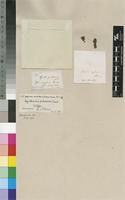
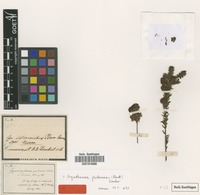
Isotype of Agathosma pubescens Sond. [family RUTACEAE]
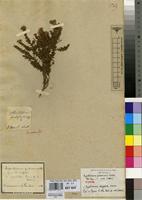
Type of Agathosma pubescens (Bartl.) Sond. [family RUTACEAE]
Previous
Next

Name

Identification
Agathosma pubescens (Bartl.) Sond. [family RUTACEAE ] (stored under name); Verified by Not on sheet,
Related name
  • Agathosma pubescens
  • Gymnochium not on sheet
  • Agathosma elegans
  • Gymnonychium pubescens

Flora

Entry for AGATHOSMA pubescens Sond. [family RUTACEAE]
Herbarium
Royal Botanic Gardens, Kew (K)
Collection
Flora Capensis
Resource Type
Reference Sources
Entry From
Flora Capensis, Vol 1, page 369, (1894) Author: (By W. SONDER.)
Names
AGATHOSMA pubescens Sond. [family RUTACEAE]
Gymnonychium pubescens Bartl. [family ], Linn. 17. p. 354, cum icone.
Information
twigs. leaves, peduncles and calyx hairy; leaves spreading, lanceolate, sub-obtuse, sub-cordate at base, with revolute impresso-glanded margins; calyx-lobes keeled, obtuse; petals downy at base; sterile filaments little longer than the calyx, cylindrical-filiform, glabrous, pilose towards the base. Very like A. blaerioides, and perhaps merely a variety. It differs in the longer, lanceolate-attenuate lower leaves, sub-cordate at base, and destitute of stalked marginal glands, or having them very rarely on the uppermost leaves. It agrees in all other respects. Leaves 2 1/2–4 lines long, rarely sub-opposite.
Distribution
SOUTH AFRICA Interior regions, Niven! (Herb. Bartling).

Related Materials

  • Terms and Conditions
  • Privacy Policy
  • Cookie Policy
  • Cookie Settings
  • Accessibility
  • Help
  • Contact Us
  • Facebook
  • Twitter
ITHAKA

JSTOR is part of ITHAKA, a not-for-profit organization helping the academic community use digital technologies to preserve the scholarly record and to advance research and teaching in sustainable ways.

©2000-2026 ITHAKA. All Rights Reserved. JSTOR®, the JSTOR logo, JPASS®, Aluka®, and ITHAKA® are registered trademarks of ITHAKA.

╳