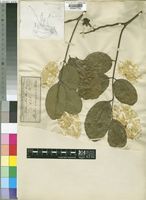
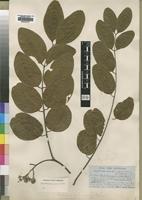
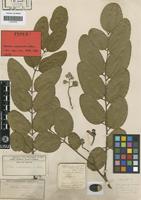
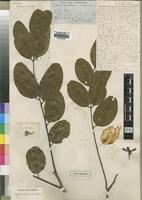
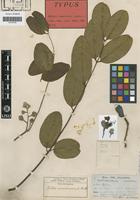
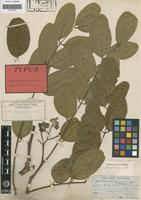
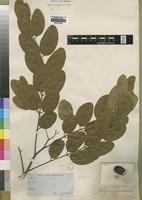
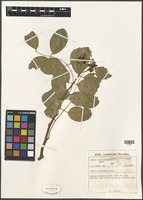
Specimens of an Afzelia, probably specifically distinct, in fruit only, with unfolding leaves and young buds are in the Kew Herbarium, collected by Dr. Kirk on the Rovuma. It differs from the Zambesi plant in its smaller growth and larger flowers, according to Dr. Kirk. The leaflets also appear longer and more ovate. The legumes are very thick and woody, about 6 in. long, 2 1/2 in. broad, 8–9-seeded, broadly oblong or elliptic-oblong, rounded and gibbous at the base, projecting upon the oblique insertion of the stout peduncle. Afzelia attenuata, Klotzsch, also described in the work cited from very fragmentary specimens, cannot be certainly identified. An authentic specimen, however, kindly lent by the Berlin Museum for comparison at Kew, agreed, so far as it went, with the above. (Afzelia? Pancovia, DC. Prod. ii. 507 [Pancovia bijuga, Willd.], M. Baillon informs me is a Sapindacea.) With our specimens of Afzelia are sorted away specimens, in leaf and fruit only, of a leguminous tree or shrub from the Batoka country (Dr. Kirk), which may or may not belong to the genus. The young extremities and rachis of the leaves more or less tawny-pubescent, or pilose-tomentose; leaflets in 3–4 pairs, very coriaceous, elliptic-oblong, obtuse, or emarginate, finely reticulate, at length glabrescent, sparingly pubescent on midrib beneath, 2–2 1/2 in. long. Legume flat, obliquely and narrowly obovate-cuneate or oblanceolate-cuneate, 3–5 in. long, 1 1/2–2 in. broad near the extremity, narrowed with but slightly curved sides to the obtuse base; valves clothed with a deciduous, patchy, ferruginous tomentum. Seeds few, compressed, elliptical, smooth, dark-brown, 1 in. long, exarillate, exalbuminous. In the Herbarium of the British Museum are insufficient specimens of perhaps 2 species from Sierra Leone, probably belonging to this genus.