

Compilation
Aeschynomene grandistipulata
1 Images see all
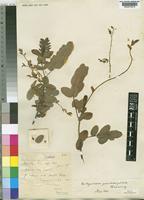
Name
Identification
Aeschynomene grandistipulata Harms [family LEGUMINOSAE-PAPILIONOIDEAE ] (stored under name);
Related name
- Aeschynomene grandistipulata
Flora
Entry for Aeschynomene grandistipulata Harms [family LEGUMINOSAE]
Herbarium
Royal Botanic Gardens, Kew (K)
Collection
Flora Zambesiaca
Resource Type
Reference Sources
Entry From
FZ, Vol 3, Part 6, (2000) Author: B. Verdcourt
Names
Aeschynomene grandistipulata Harms [family LEGUMINOSAE], in Repert. Spec. Nov. Regni Veg. 8: 355 (1910). —Eyles in Trans. Roy. Soc. South. Africa 5: 377 (1916). —E.G. Baker, Legum. Trop. Africa: 291 (1929). —Drummond in Kirkia 8: 216 (1972). —Verdcourt in Kirkia 9: 398 (1974). —Lock, Leg. Afr. Check-list: 104 (1989). Type: Mozambique, Chimanimani Mts., Moribane, W.H. Johnson 232 (K, holotype).
Information
Shrub 1.2–3 m tall. Young stems dark purplish-brown, often glaucous, glabrous or with dense to scattered tubercular-based hairs on some or all internodes, the older ones appearing jointed at the nodes due to the scars formed by the deciduous stipules, glabrous. Leaves rather fleshy, often glaucous, (8)14–22-foliolate; leaflets 1.2–3 × 0.6–2 cm, elliptic, oblong-elliptic or elliptic-ovate, rounded but mucronulate at the apex, obliquely rounded to cordate at the base, entire or sometimes ciliolate when young, glabrous; venation reticulate beneath; petiole and rhachis together (3)7–12 cm long, glabrous or rarely densely covered with tubercular-based hairs; petiolules distinct, c. 1 mm long; stipules large and conspicuous, 1.5–3.7 × 1.3–3 cm, ovate-elliptic, glabrous, reticulately veined, eventually deciduous. Inflorescences axillary, many-flowered, often branched, 7–15 cm long, the rhachis densely covered with tubercular-based hairs or glabrescent; peduncle 1.5–7 cm long; pedicels 3–7 mm long, all with similar hairs; bracts 7–13 × (3)4–8 mm, ovate or lanceolate, glabrous, deciduous; bracteoles 4–6 × 1.5–2.5 mm, lanceolate, glabrous, deciduous. Calyx glabrous, 2-lipped; lips 8–12 × (3.5)4–5.5 mm, oblong, one entire and the other obscurely 3-fid, practically entire. Standard yellow or orange-yellow with purple veins and a reddish basal patch inside, 11–13 × 7–8 mm, elliptic; wings and keel yellow or orange, the former free, the latter purplish at the tip. Fruit of 3 articles joined by very narrow necks, each article semicircular, 7–8 × 5 mm, compressed, glabrous or very sparsely ciliate, smooth. Seeds not seen.
Habitat
Bracken scrub, sandstone crags, quartzite rocks
Range
Confined to the Chimanimani Mts
Altitude range
1200–2100 m.
2100
1200
Distribution
Mozambique MS Chimanimani Mts., Moribane, fl. 10.x.1907, W.H. Johnson 232 (K).Zimbabwe E Chimanimani Mts., Stonehenge, fl. 9.v.1958, Chase 6915 (K; LISC; PRE; SRGH).
Notes
The holotype exhibits an interesting abnormality, in two cases opposite leaflets having become partially joined. Verboom has collected what appears to be a variant of this species on top of the Mafinga Mts. (Zambia N: fl. 20.x.1958, Verboom LK 98) but it differs in having up to 32 more oblong leaflets 2 × 1 cm, and very short internodes. More material is needed to assess its status.