

Compilation
Aerva edulis
1 Images see all
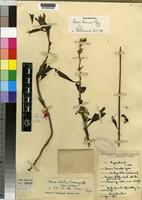
Name
Identification
Aerva edulis Suess. [family AMARANTHACEAE ] (stored under name); Verified by Munchen SK, 1949 Aerva leucura Moq. [family AMARANTHACEAE ] Verified by Munchen SK, 1949
Related name
- Aerva leucura
- Aerva edulis
Flora
Entry for Aerva leucura Moq. [family AMARANTHACEAE]
Herbarium
Royal Botanic Gardens, Kew (K)
Collection
Flora Zambesiaca
Resource Type
Reference Sources
Entry From
FZ, Vol 9, Part 1, page 28, (1988) Author: C. C. Townsend
Names
Aerva leucura Moq. [family AMARANTHACEAE], in DC., Prodr. 13, 2: 302 (1849).—Baker & Clarke in F.T.A. 6 , 1: 39 (1909).—Schinz in Engl. & Prantl Pflanzenfam. ed. 2, 16 C : 52 (1934).—Hauman in F.C.B. 2 : 58 (1951).—Podlech & Meeuse in Merxm. Prodr. Fl. SW. Afr. 33: 5 (1966); in J.H. Ross Fl. Natal: 159 (1973).—Townsend in Kew Bull. 29 : 461 (1974). TAB. 21 fig. A. Type from S. Africa.
Aerva leucura var. lanatoides Suesseng. [family AMARANTHACEAE], in Mitt. Bot. Staatss. München 1 : 67 (1950). Type from Tanzania.
Aerva ambigua Moq. [family AMARANTHACEAE], in DC., Prodr. 13, 2: 302 (1849). Type from S. Africa.
Aerva edulis Suesseng. [family AMARANTHACEAE], in Mitt. Bot. Staatss. München 1 : 1 (1950). Type: Malawi, Barker 414 (EA, holotype).
Information
Perennial herb (apparently sometimes flowering in the first year), frequently woody below, erect or low-spreading to prostrate or occasionally more or less scrambling, 0.5–1.2 (1.5) m., with numerous stems arising from the base, stems simple or branched with short or long, ascending, slender branches. Stem and branches terete, striate, more or less densely tomentose or lanate with whitish hairs. Leaves alternate, broadly elliptic to linear-oblanceolate, those of the main stem c. 1.6–10 × 0.5–3 (3.6) cm., shortly cuneate to attenuate and more or less petiolate at the base with a petiole up to c. 1.5 cm. long, rather obtuse to very acute at the apex, moderately to thinly pilose on both surfaces or more sparsely so above, leaves of the branches and inflorescence reducing upwards. Inflorescence variable; always with a leafless lax or compact terminal panicle of simple or branched, sessile or pedunculate spikes, the upper leaf axils for a variable length of the stem with similar pedunculate panicles, or these reduced to a sessile, simple sometimes lobed spike or spikes. Ultimate spikes white, dense or occasionally laxer and more elongate, 0.6–5 (8) × 0.4–1.2 cm., divergent or ascending; bracts 1.25–1.75 mm. long, deltoid-ovate to oblong-ovate, hyaline with a short or longer arista formed by the excurrent midrib, pilose, persistent; bracteoles similar or slightly smaller, also persistent. Flowers hermaphrodite, female or functionally male. Tepals more or less densely lanate dorsally, more or less similar in all types of flower; outer 2 tepals hyaline, elliptic-oblong, (1.5) 2–2.5 mm. long, with a sharp mucro formed by the excurrent nerve; inner 3 tepals slightly shorter and narrower, acute with a central green vitta which extends for about three-quarters the length of each tepal and is often more or less furnished with a thickened border. Female flowers with linear stigmas somewhat shorter than or subequalling the style, divergent or suberect; anthers absent, filaments reduced. Male flowers with the stigmas very reduced or absent and only the truncate apex of the style slightly papillose, occasionally with short and apparently receptive stigmas but setting no seed; anthers longer. Hermaphrodite flowers with stigmas usually (but not invariably) shorter than the females, and anthers often somewhat smaller than in the males. Capsule and seeds as in A. lanata.
Habitat
In a large variety of habitats, frequently in bush along rivers, at edges of pans, dry patches in swamps and dambos, on termite mounds, in mopane forest, along roadsides, in grassland, dry rocky hillsides, waste ground and abandoned cultivation; in Kalahari Sand and other sandy soil, laterite, cultivated black soil, black basalt and on serpentine
Altitude range
100–1520 m.
1520
100
Distribution
Mozambique N E. coast of Lake Malawi, 22.ix.1900, Johnson 17 (K).Malawi N Mzimba District, S. side of Lale Kazuni, 1080 m., 20.v.1970, Brummitt 10941 (K; LISC; MAL; PRE; SRGH; UPS)Zimbabwe N Gokwe Distr., near Gwaye R., 16.iv.1962, Bingham 231 (K; SRGH).Zambia B Siwelewele, 8.viii.1952, Codd 7445 (K; PRE).Botswana N near Nata R. delta, 14.iv.1976, Ngoni 496 (K; SRGH).Mozambique M Maputo, Porto Henrique, 17.iv.1948, Torre 7642 (LISC; PRE).Mozambique T 17 km. from Mágoè near Mágoè Velho, 2.iii.1970, Torre & Correia 18152 (LISC).Mozambique MS Beira Distr., Gorongosa Nat. Park, Chilengo area, viii.1970, Tinley 1982 (K; SRGH).Mozambique Z De Mupeia near Aguas Quentes, 4.viii.1942, Torre 4490 (BR; EA; J; LISC; LUAI; M).Malawi S 5 km. NW. of Nsanje, near Nyamadzere Rest House, 180 m., 28.v.1970, Brummitt 11144 (K; LISC; MAL; SRGH).Malawi C Lilongwe, by Kandolo store, 1050 m., 26.vi.1970, Brummitt 11695 (K; MAL; SRGH).Zimbabwe S Gwanda Distr., Doddieburn Ranch, Umzingwane R., c. 720 m., 5.v.1972, Pope 646 (K; SRGH).Zimbabwe E Mutare, Main Street, 31.v.1967, Chase 8452 (K).Zimbabwe C Marondera 10.v.1951, Wild 3930 (K; SRGH).Zimbabwe W Hwange, Denda Farm, 945 m., 20.iii.1974, Gonde 77/74 (K; SRGH).Zambia S Livingstone Distr., Katambora, 7.vi.1954, Gilges 624 (K; SRGH).Zambia E Lundazi Distr., Lukusuzi Nat. Park, 800 m., 12.iv.1971, Sayer 1173 (K; PRE; SRGH).Zambia C Kabwe Distr., Kamaila Forest Station, 36 km. N. of Lusaka, 9.ii.1975, Brummitt, Hooper & Townsend 14285 (K; LUS; NDO)Zambia W Ndola, 23.vii.1953, Fanshawe 167 (K; NDO).Zambia N Mbala, Kali Dambo near Kawimbi Mission, 1520 m., 6.v.1952, Richards 1621 (K; SRGH).Botswana SE Boteti delta area NE. of Mopipi, 17.iv.1973, 850 m., Fry 4 (K; SRGH).Botswana SW 35 km. S. of Takatshwane Pan, 21.ii.1960, Wild 5105 (K; SRGH).
Distribution (external)
Uganda
Kenya
Tanzania
Zaire
Angola
Namibia
Notes
One herbarium sheet ( Mundy 3171) notes that the leaves of this species are used as a vegetable; another ( Brummitt 11144) observes that a rest house cook gave the information that it is used, presumably the soft inflorescences, for stuffing pillows.