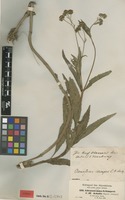
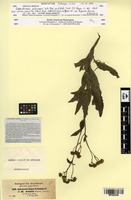
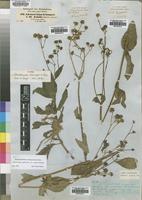
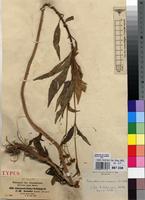
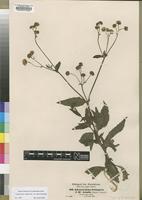
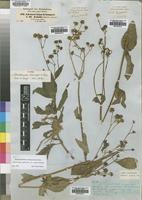
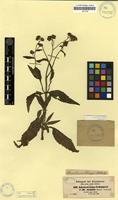
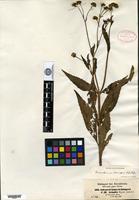
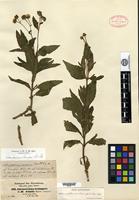
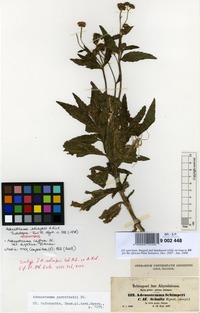
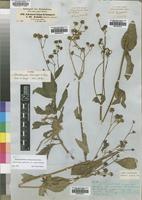
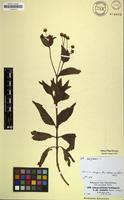
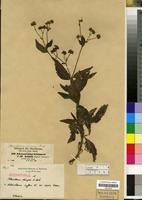
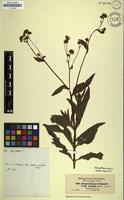
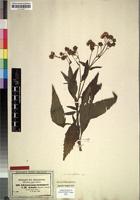
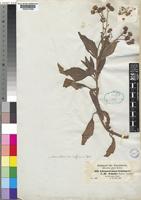
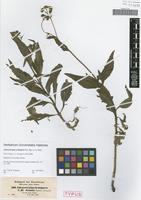
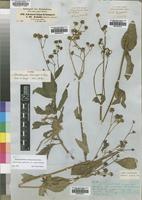
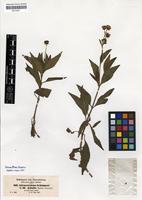
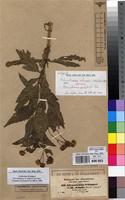
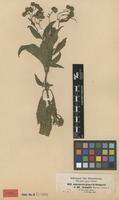
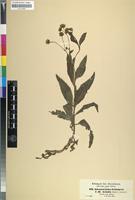
Entry for Adenostemma caffrum Brenan var. asperum [family COMPOSITAE]
Entry From
Flora of Tropical East Africa, Part Part 3, page 547, (2005) Author: H. Beentje, C. Jeffrey & D.J.N. Hind
Names
Adenostemma caffrum Brenan var. asperum [family COMPOSITAE], in Mem. N.Y. Bot. Gard. 8: 462 (1954). Type: Malawi, Kota-kota District, Nchisi Mt, Brass 16979 (K, holo., lost?, NY, para.)
Adenostemma schimperi A.Rich. [family COMPOSITAE], Tent. Fl. Abyss. I: 382 (1848). Type: Ethiopia, near Adoua, Quartin Dillon s.n. & Schimper 112 (?P, SYN., BM!, isoSYN.)
Adenostemma viscosum [family COMPOSITAE], [sensu Oliv. & Hiern in F.T.A. 3: 299 (1877) pro parte, non J.R. Forst. & G. Forst.]
Distribution
KENYA Trans-Nzoia District Kitale, Prison dam, Oct. 1969, Tweedie 3722! & Mt Elgon, 22 Mar. 1931, E.J. & C. Lugard 574!KENYA Uasin Gishu District Kipkarren, no date, Brodhurst-Hill 151!TANZANIA Ufipa District Tatanda mission, near Zambian frontiers on Mbala–Sumbawanga road, 9 June 1980, Hooper, Townsend & Mwasumbi 1918!TANZANIA Iringa District Mufindi, W side of Lake Ngwazi, 16 Feb. 1986, Bidgood & Lovett 6!TANZANIA Songea District 2 km E of Songea by Nonganonga stream, 27 Apr. 1956, Milne-Redhead & Taylor 9836!UGANDA Kigezi District Kanungu, 7 June 1952, Lind 58!UGANDA Toro District Nyakasura, on hill near crater, 7 Jan. 1936, Hancock 113/36!UGANDA Masaka District NW side of lake Nabugabo, 9 Oct. 1953 Drummond & Hemsley 4681!
Notes
USES.Minor medicinal for chest diseases (Brodhurst-Hill)CONSERVATION Least concern (LC)Variation. The number of pegs forming the pappus appears to be far more variable as a character than previously recognised. The predominant number is 3 but up to 5 have been recorded. This variability can be seen within a capitulum. The presence of tubercles and/or glands on the achenes is considered a reliable character for identifying species of Adenostemma, but there is a collection from Iringa district, Black Camp Bay, Lake Ngwazi (Renvoize & Car 1970) which on first inspection appears to be close to A. caffrum var. asperum but has completely glabrous achenes. Brenan described var. asperum from Malawi on the basis of stronger denser indumentum of leaves and stem, and lanceolate to ovate-lanceolatae leaves with shallower marginal serrations than the typical var. described from South Africa. Material at Kew from South Africa, Malawi and Tropical East Africa shows a huge range of variation in indumentum, and I can find no correlation between indumentum and leaf shape or serration. However var. asperum is upheld here on the basis of leaf shape and margins type alone. The leaves of East African material differs from the typical variety in that they tend to be lanceolate or ovate-lanceolate, not triangular to triangular-ovate, and the margins are entire to serrate or crenulate and not sharply dentate. There are a couple of Tanzanian specimens with leaves approaching the typical variety in shape, but not margins type (Ufipa District: Malonje Plateau, near Molo village, Richards 15855; Iringa District: 30 km from Mafinga [Sao Hill] on Mbeya Road, Bidgood, Mwasumbi & Vollesen 806). Generally it appears that var. caffrum is a South African taxon, creeping up into Angola, Zambia & Malawi, and these two Tanzanian specimens may represent var. caffrum at its most northern limit. Alternatively, they may be intermediates. Likewise, var. asperum is a more northern taxon, being well represented in West, central and tropical S Africa. There are a few specimens from South Africa which resemble var. asperum in leaf shape, or margins type, and these may represent the southernmost limit of the distribution, or may be intermediates.