JSTOR Global Plants Home
  • Home
  • Browse
  • About
  • Access
  • Account
    • Saved Items
    • Profile
  • Log in

Global Plants

Skip to Main Content
  • JSTOR Global Plants Home
  • Global Plants

    • Browse
    • About
    • Access
    • Account
      • Saved Items
      • Profile
Log in
  • Browse
  • About
  • Access
  • Account
    • Saved Items
    • Profile
Advanced Search

Compilation
Adenodolichos rupestris

3 Images see all

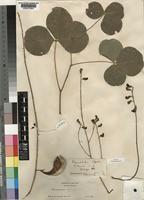
Isotype of Adenodolichos rupestris Verdc. [family LEGUMINOSAE-PAPILIONOIDEAE]
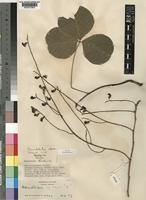
Isotype of Adenodolichos rupestris Verdc. [family LEGUMINOSAE-PAPILIONACEAE]
Previous
Next

Name

Identification
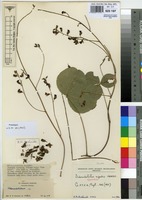
Isotype of Adenodolichos rupestris Verdc. [family LEGUMINOSAE-PAPILIONACEAE ] (stored under name); Verified by Not on sheet,
Related name
  • Adenodolichos rupestris

Flora

Entry for Adenodolichos rupestris Verdc. [family LEGUMINOSAE]
Herbarium
Royal Botanic Gardens, Kew (K)
Collection
Flora Zambesiaca
Resource Type
Reference Sources
Entry From
FZ, Vol 3, Part 5, (2001) Author: B. Mackinder, R. Pasquet, R. Polhill and B. Verdcourt
Names
Adenodolichos rupestris Verdc. [family LEGUMINOSAE], in Kew Bull. 25: 69, fig. 2 (1971); in F.T.E.A., Leguminosae, Pap.: 706 (1971). —Lock, Leg. Afr. Check-list: 388 (1989). Type: Zambia, Mbala Distr., Kalambo Falls, Richards 11322 (K, holotype and isotype).
Information
Trailing woody herb, c. 1 m long from a woody rootstock. Stems somewhat angular, at first appressed pubescent, later glabrescent. Leaves alternate, held horizontally; leaflets 3, 4.3–10 × 3.4–12 cm, broadly elliptic, obovate or almost round, broadly rounded or slightly to very distinctly broadly emarginate at the apex, narrowed to a rounded base, glabrous on upper surface, sparsely pubescent and with scattered orange-red glands beneath; nerves visible beneath but neither prominent nor reticulate; petiole 6–12 cm long; rhachis obsolete; petiolules 2.5–5 mm long; stipules 6 mm long, lanceolate, deciduous. Racemes held erect, sometimes sparsely branched, pubescent and glandular; rhachis 8–20 cm long; peduncles c. 6 cm long; pedicels 4–6 mm long; bracts 4 mm long, ovate, acuminate, deciduous; bracteoles 3.5 mm long, linear, ultimately deciduous. Calyx pubescent and glandular; tube 3–3.5 mm long; lobes 5.5–10 mm long, lanceolate, the upper pair joined for about three-quarters of their length. Standard carmine, purple or bluish-purple, 1.3 × 1.2 cm, obovate; keel often pale. Pods 5.2 × 1.6 cm, oblanceolate-falcate, with somewhat raised venation, covered with fine white pubescence and glands. Seeds brown, densely mottled with blackish on the faces, c. 6 mm in diameter, 2 mm thick, irregularly discoid, compressed; hilum short; aril obsolete.
Habitat
Brachystegia woodland on stony soil, also clay soils by roadsides etc.
Range
Known only from the Mbala area, including the Tanzanian side of the Kalambo Falls
Altitude range
900–1500 m.
1500
900
Distribution
Zambia N Mbala Distr., Kalambo Falls, fl. & fr. 21.iv.1959, McCallum-Webster 878 (K).
Notes
It may eventually be necessary to consider this a variety of Adenodolichos huillensis, some specimens of which have the leaf rhachis obsolete and leaflets approaching those of Adenodolichos rupestris. The Mbala population is so characteristic that I have left it as a very locally endemic species. Much more information is needed about the genus in Zambia, Angola and southern Dem. Rep. Congo before a satisfactory arrangement of this group of taxa can be made.

Related Materials

  • Terms and Conditions
  • Privacy Policy
  • Cookie Policy
  • Cookie Settings
  • Accessibility
  • Help
  • Contact Us
  • Facebook
  • Twitter
ITHAKA

JSTOR is part of ITHAKA, a not-for-profit organization helping the academic community use digital technologies to preserve the scholarly record and to advance research and teaching in sustainable ways.

©2000-2026 ITHAKA. All Rights Reserved. JSTOR®, the JSTOR logo, JPASS®, Aluka®, and ITHAKA® are registered trademarks of ITHAKA.

╳