JSTOR Global Plants Home
  • Home
  • Browse
  • About
  • Access
  • Account
    • Saved Items
    • Profile
  • Log in

Global Plants

Skip to Main Content
  • JSTOR Global Plants Home
  • Global Plants

    • Browse
    • About
    • Access
    • Account
      • Saved Items
      • Profile
Log in
  • Browse
  • About
  • Access
  • Account
    • Saved Items
    • Profile
Advanced Search

Compilation
Adenocline stricta

3 Images see all

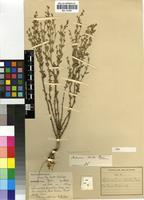
Syntype of Adenocline stricta Prain [family EUPHORBIACEAE]
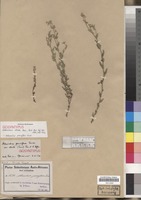
Isosyntype of Adenocline pauciflora Turcz. var. stricta (Prain) Pax & K. Hoffm. [family EUPHORBIACEAE]
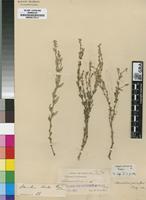
Isosyntype of Adenocline stricta Prain [family EUPHORBIACEAE]
Previous
Next

Name

Identification
Adenocline stricta Prain [family EUPHORBIACEAE ] Verified by Not on sheet, Adenocline pauciflora Turcz. [family EUPHORBIACEAE ] (stored under name); Verified by Not on sheet,
Related name
  • Adenocline stricta
  • Adenocline pauciflora

Flora

Entry for ADENOCLINE stricta Prain [family EUPHORBIACEAE]
Herbarium
Royal Botanic Gardens, Kew (K)
Collection
Flora Capensis
Resource Type
Reference Sources
Entry From
Flora Capensis, Vol 5, Part 2, page 216, (1925) Author: (By N. E. BROWN, J. HUTCHINSON and D. PRAIN.)
Names
ADENOCLINE stricta Prain [family EUPHORBIACEAE], in Kew Bulletin, 1912, 338;—Prain in Ann. Bot. xxvii. 406.
Information
a diœcious herb, woody below, strictly virgately branching upwards, 8–9 in. high; internodes 1/3– 1/2 in. long; leaves alternate, sessile, firmly membranous, oblong to oblong-lanceolate, acute, base broad confluent with the stipules, margin sharply serrate, 1/3– 1/2 in. long, 1/5– 1/4 in. wide; stipules like the leaves but slightly smaller, 1/5– 1/4 in. long, 1/6– 1/5 in. wide; male flowers not seen; female flowers solitary, leaf-opposed, their pedicels abruptly reflexed; calyx-segments 5, their margins serrate; ovary glabrous; capsule 1 1/2 lin. wide, 3-dymous, smooth. null
Distribution
COAST REGION Bredasdorp Div.; Reit Fontein Poort, 100–200 ft., Bolus, 8603! Schlechter, 9694!
Notes
A remarkably distinct species.

Related Materials

  • Terms and Conditions
  • Privacy Policy
  • Cookie Policy
  • Cookie Settings
  • Accessibility
  • Help
  • Contact Us
  • Facebook
  • Twitter
ITHAKA

JSTOR is part of ITHAKA, a not-for-profit organization helping the academic community use digital technologies to preserve the scholarly record and to advance research and teaching in sustainable ways.

©2000-2026 ITHAKA. All Rights Reserved. JSTOR®, the JSTOR logo, JPASS®, Aluka®, and ITHAKA® are registered trademarks of ITHAKA.

╳