JSTOR Global Plants Home
  • Home
  • Browse
  • About
  • Access
  • Account
    • Saved Items
    • Profile
  • Log in

Global Plants

Skip to Main Content
  • JSTOR Global Plants Home
  • Global Plants

    • Browse
    • About
    • Access
    • Account
      • Saved Items
      • Profile
Log in
  • Browse
  • About
  • Access
  • Account
    • Saved Items
    • Profile
Advanced Search

Compilation
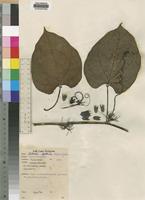
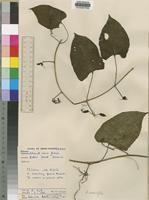
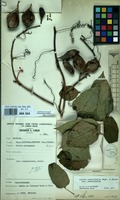
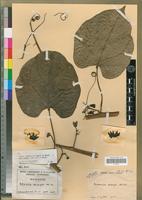
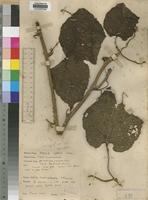
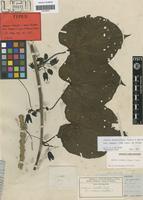
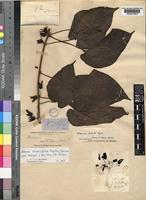
Adenia rumicifolia

18 Images see all

[family ]
[family ]
Filed as Adenia rumicifolia Engl. & Harms var. rumicifolia [family PASSIFLORACEAE]
Adenia rumicifolia
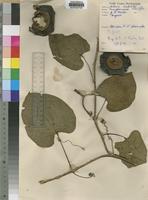
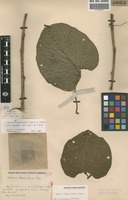
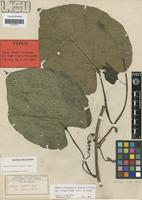
Lectotype of Adenia rumicifolia Engl. var. rumicifolia Engl.&Harms [family PASSIFLORACEAE]
Type of Adenia lobata (Jacq.) Engl. var. elegans [non (P.Beauv.) Mast.] Mast. [family PASSIFLORACEAE]
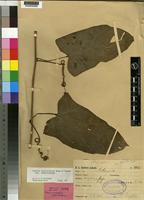
Holotype of Adenia miegei Aké Assi [family PASSIFLORACEAE]
[family ]
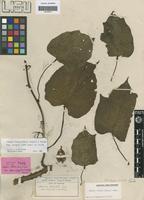
Type of Adenia lobata (Jacq.) Engl. var. elegans [non (P.Beauv.) Mast.] Mast. [family PASSIFLORACEAE]
Adenia rumicifolia unrecorded var. miegei (Aké Assi) W.J. de Wilde [family PASSIFLORACEAE]
Adenia rumicifolia
Adenia rumicifolia
[family ]
Adenia rumicifolia
Filed as Adenia rumicifolia Engl. & Harms var. miegei (Ake Assi) W.J.de Wilde [family PASSIFLORACEAE]
Adenia rumicifolia
Adenia rumicifolia
Type of Adenia lobata (Jacq.) Engl. var. elegans [non (P.Beauv.) Mast.] Mast. [family PASSIFLORACEAE]
Previous
Next

Name

Identification
Adenia rumicifolia Engl. [family PASSIFLORACEAE ] (stored under name); Verified by de Wilde J, 1979
Related name
  • Modecca unrecorded
  • Adenia lobata
  • `
  • Adenia miegei
  • Adenia rumicifolia
Common name
  • abueutcheutcheu (Oldeman) (IVORY COAST, AKYE), Burkill, H.M. 1985. The useful plants of west tropical Africa, Vol. 4

Flora

Entry for ADENIA rumicifolia Engl. [family PASSIFLORACEAE]
Herbarium
Royal Botanic Gardens, Kew (K)
Collection
Flora of Tropical East Africa
Resource Type
Reference Sources
Entry From
Flora of Tropical East Africa, page 1, (1975) Author: W. J. J. O. de Wildem (Rijksherbarium, Leiden)
Names
ADENIA rumicifolia Engl. [family PASSIFLORACEAE], ,V.E. 3(2) : 603 (1921); Harms in N.B.G.B. 8 : 296 (1923); de Wilde in Acta Bot. Neerl. 17 : 292 (1968) & in C.F.A. 4 : 221 (1970) & in Meded. Landbouwhogeschool Wageningen 71–18 : 154 (1971) & in U.K.W.F. : 165 (1974). Type : Tanzania, Lushoto District, Gonja, Engler 3362 (B, holo.†, EA, iso. !)
ADENIA megalantha Harms [family PASSIFLORACEAE], in P.O.A. A : 92 (1895), nom. nud.
ADENIA lobata [family PASSIFLORACEAE], [sensu Engl., P.O.A. B : 216 (1895); R. E. Fries, Wiss. Ergebn. Schwed. Rhod.-Kongo-Exped. : 157 (1914); A. & R. Fernandes in Garcia de Orta 6 : 257, 659 (1958), pro parte; F.F.N.R. : 268 (1962), non (Jacq.) Engl.]
ADENIA lobata R. E. Fries var. grandiflora [family PASSIFLORACEAE], Wiss. Ergebn. Schwed. Rhod.-Kongo-Exped. : 157 (1914); Engl., V.E. 3(2) : 604 (1921). Type : Zambia, Northern Province, Lake Bangweulu, Fries 1048 (UPS, holo. !)
ADENIA miegei Aké Assi [family PASSIFLORACEAE], in B.J.B.B. 31 : 311, t. 1 (1961); de Wilde in Acta Bot. Neerl. 16 : 233, fig. 1 (1967). Type : Ivory Coast, Aké Assi 5977 (P, holo. !, BR, iso. !)
Information
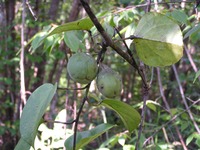
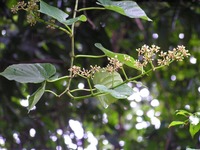
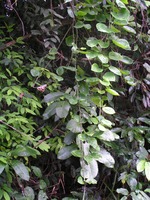
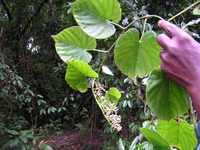
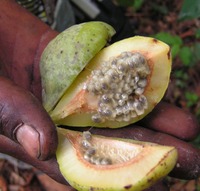
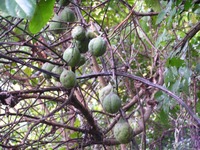
Medium-sized to robust liana up to 20 (in W. and equatorial Africa up to 45) m., glabrous; older stems terete, 3–5-winged or with 5 rows of coarse fleshy tubercles, up to 10 cm. thick at base. Leaf-blades not punctate, entire or more rarely shallowly 3(–5)-lobed or coarsely sinuate, ovate to obovate, or orbicular to oblong, base acute to deeply cordate, or hastate, top acute to rounded, up to 2 cm. acuminate, 3.5–25 by 2.5–20 cm., pinninerved with 5–7 stronger nerves from near base; margin entire; petiole 1.5–15 cm. Glands at blade-base 2, in 2 ± hollowed auricles 1.5–6 mm. in diameter lateral at the top of the petiole; blade-glands submarginal, 0–6 on either half of the blade. Stipules triangular, 0.5–1 mm., withering. Inflorescences peduncled for up to 12 cm., often sessile or subsessile on the lower part of the branches, up to 30-flowered in ♂, 1–6-flowered in ♀; tendril (0–)1, up to 20 cm., in sessile inflorescences tendril mostly absent; sterile tendrils simple or 3-fid, up to 25 cm. Male flowers broadly tubiform-campanulate, including the 0.5–2 mm. long stipe 16–37 mm.; hypanthium saucer-shaped, ± 5-saccate, 2.5–5 by 10–18 mm.; calyx-tube (5–)7–15 mm.; calyx-lobes ± elongate-triangular, subobtuse to acute, crenulate-laciniate, 7–14 mm.; petals mostly broadly spathulate, long-clawed, or elliptic-oblong, 4–13 by 2.5–5 mm., 3–5-nerved, lacerate-fimbriate, inserted at the same level as the corona; filaments 2–6 mm., connate 0.5–1.5 mm., inserted at the base of the hypanthium; anthers (6–)7–12 mm., acute, apiculate; septa 0.5–1.5 mm. high; corona consisting of woolly hairs 1–2 mm.; disk glands 2–3 mm. Female flowers broadly tubiform-campanulate, resembling ♂ flowers, including the ± 0.5 mm. long stipe 12–25(–30) mm.; hypanthium flattish, 2–3 by 7–15 mm.; calyx-tube (4–)5–10 mm.; calyx-lobes 7–16 mm.; petals linear to spathulate, subobtuse, (4–)5–9 mm., 1–3(–5)-nerved, laciniate-fimbriate, inserted at the same level as the corona; staminodes 3–6 mm.; septa, corona and disk glands as in ♂; gynophore (0.5–)1–2.5 mm.; ovary ovoid to ellipsoid, (3.5–)4–8 mm.; styles free or connate for up to 2 mm., style-arms 1.5–5 mm.; stigmas reniform, woolly-papillate, each 2.5–5 mm. in diameter. Fruits 1–4 per inflorescence, pear-shaped (obovate, tapering into the gynophore), obtuse, excluding the 1–5 mm. long gynophore 3–8 by 1.5–4.5 cm.; pericarp coriaceous outside, firmly fleshy inside, 4–10 mm. thick, smooth. Seeds 40–150 per capsule, ellipsoid to suborbicular, 3.5–5(–6) mm. Fig. 7.
Range
DISTR. U2, 4; K4, 5, 7; T1–4, 6, 7; Z tropical Africa from Senegal east to S. Ethiopia, south to Angola and Mozambique
Altitude range
0–1800 m.
Distribution
KENYA Embu District Chuka, 26 Feb. 1922, Fries 1958a !KENYA N. Kavirondo District Kakamega Forest, 27 Nov. 1969, Faden 69/2051 !KENYA Kwale District Makadara Forest, July 1939, F. G. van Someren 97 !TANZANIA Buha District Kasakela Reserve, 18 Nov. 1962, Verdcourt 3356 !TANZANIA Morogoro District Chigurufumi Forest Reserve, Mar. 1955, Semsei 2038 !TANZANIA Rungwe District Rutenganio [Rutangamio] Mission, Oct. 1910, Stolz 402 !TANZANIA Zanzibar I., Kidichi, 6 Dec. 1963, Faulkner 3324 !UGANDA Ankole District Ruizi R., Dec. 1950, Jarrett 131 !UGANDA Mengo District Kajansi Forest, Oct. 1937, Chandler 1997 ! & Mulange Hill, Nov. 1920, Dummer 4449 !
Notes
In my monograph (de Wilde, 1971) I have recognized two not strictly segregated varieties. Var. miegei (Aké Assi) de Wilde is more robust, with long-pyriform fruits (3.5–)5–8 cm., the attenuated part occupying at least one-third of the total length of the fruit, and occurs in rain-forests and clearings in west and central Africa. The type variety is less robust, and has short-pyriform fruits, 3–5 cm., the attenuated part occupying one-third or less of the total length of the fruit; this variety occurs predominantly in eastern equatorial Africa. In central Africa more or less intermediate forms are quite often found, and these are sometimes difficult to determine, especially when mature fruits are lacking. For this reason I have refrained from distinguishing varieties in the present treatment.

Related Materials

  • Terms and Conditions
  • Privacy Policy
  • Cookie Policy
  • Cookie Settings
  • Accessibility
  • Help
  • Contact Us
  • Facebook
  • Twitter
ITHAKA

JSTOR is part of ITHAKA, a not-for-profit organization helping the academic community use digital technologies to preserve the scholarly record and to advance research and teaching in sustainable ways.

©2000-2026 ITHAKA. All Rights Reserved. JSTOR®, the JSTOR logo, JPASS®, Aluka®, and ITHAKA® are registered trademarks of ITHAKA.

╳