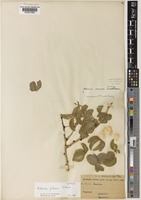
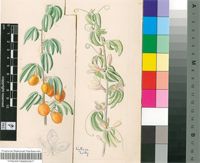
Climber, sometimes shrub-like, up to 3·5 m. high, with the basal part c. 1 × 0·4 m. above ground, thickened and ± fleshy, emitting numerous stems up to 3 m. long. Leaf-lamina 2–12 ×2·5–12 cm., 5-partite to the base, suborbicular in outline, membranous to coriaceous, greyish, glaucous or purplish-grey, sometimes punctate, with 5 main nerves from the base; petiole (0·5)1–5 cm. long; leaf-segments 1–7 × 0·5–3·5(4·5) cm., ovate to oblong, obtuse, sometimes retuse at the apex, margin entire, acute or subacute at the base, with 4–8 pairs of lateral nerves and rather distinct reticulation. Glands of the lamina-base 2, 1–2 mm. in diameter, contiguous, on two ± connate, ± fleshy, brownish auricles; lamina-glands 1–3(5), c. 0·25 mm. in diameter, apical or subapical at the extremities of the nerves. Stipules 1–1·5 mm. long, triangular, acute. Sterile tendrils up to 10 cm. long. Cymes 2–5-flowered in male, 1–3-flowered in female; peduncles 1(2) cm. long. Bracts and bracteoles 0·5–2 mm. long, triangular. Pedicels 2–20 mm. long. Tendrils (0)1, 2–6 cm. long. male flower: (13)15–30 × 2–4 mm. (incl. the 3–7 mm. long stipe), infundibuliform; hypanthium (1)2–4 × 2–3 mm.; calyx-tube 0; sepals (8)10–18(20) mm. long, lanceolate, obtuse, entire; petals 5(6), 6–11 × 1·5–2·5 mm., lanceolate, acute to obtuse at the apex, narrowed to the base, 1–3-nerved, serrulate; corona a fringe of fairly thick hairs 0·5–1 mm. long; stamen-filaments (3)4·5–7 mm. long, ± long-connate at the base, inserted at the base of the hypanthium; anthers 3–5·5 × 1 mm., apiculate; disk-glands 0; vestigial ovary 0·5–1·25 mm. long (incl. the gynophore). female flower: (9)10–15 × 2–3 mm. (incl. the 1·5–4 mm. long stipe), tubular-infundibuliform; hypanthium 1·5–2 mm. long; calyx-tube 0; sepals 7–9 mm. long, lanceolate, obtuse, subentire; petals 4–5 × 0·5–1 mm., lanceolate, acute, 1-nerved, irregularly serrulate at the apex; corona of sparse thick hairs; staminodes 2–3·5 mm. long, connate at the base; disk-glands 0; pistil 6–8 mm. long; gynophore 1–2 mm. long; ovary 2·5–4·5 × 2·5–4 mm., subglobose; styles shortly connate at the base, with the arms 1–1·5 mm, long; stigmas c. 1·5 mm. in diameter, subglobose, papillate. Capsule 1·8–2·5 × 1·5–2 cm., ellipsoid, with the pericarp thickly coriaceous, 3–5-seeded. Seeds 5·5–7·5 × 5·5–7·5× 2·5–3 mm., orbicular, pitted.