

Compilation
Acrostichum siliquosum
1 Images see all
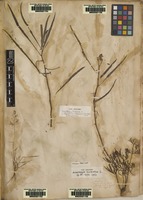
Name
Identification
Acrostichum siliquosum L. [family PTERIDACEAE ] (stored under name); Ceratopteris thalictroides (L.) Brogn. [family PTERIDACEAE ] Verified by Henry Trimen,
Related name
- Acrostichum siliquosum
- Ceratopteris thalictroides
Flora
Entry for CERATOPTERIS thalictroides (L.) Brongn. [family PARKERIACEAE]
Herbarium
Royal Botanic Gardens, Kew (K)
Collection
Flora of Tropical East Africa
Resource Type
Reference Sources
Entry From
Flora of Tropical East Africa, page 1, (1999) Author: B. VERDCOURT, B.Sc., Ph.D.
Names
CERATOPTERIS thalictroides (L.) Brongn. [family PARKERIACEAE], in Bull. Sci. Soc. Philom. Paris, sér. 3, 1821: 186, tt. 3–4 (1821); Carruth. in Cat. Afr. Pl. Welw. 2: 269 (1901); V.E. 2: 60, fig. 58 (1908); Sim, Ferns S. Afr. ed. 2: 294, t. 109/3 (1915); F.D.-O.A.: 18 (1929); Pic. Serm. in Webbia 12: 648, t. 1 (1957); Ballard in Fl. Iraq 2: 70, t. 7 (1966); Schelpe in Contr. Bolus Herb. 1: 46 (1969) & F.Z., Pterid.: 102 (1970); R.M. Lloyd in Brittonia 26: 148, fig. 1, 2, 7/a–c (1974); Schelpe, C.F.A., Pterid.: 82, t. 15 (1977); Schelpe & Diniz, Fl. Moçamb., Pterid.: 101, t. 9 (1979); Schelpe & N.C. Anthony, F.S.A., Pterid.: 95, fig. 28, map 73 (1986); Johns, Pterid. Trop. E. Afr.: 15, fig. 5.1 (1991). Type: Sri Lanka, Hermann 3/42 (BM-HERM!, holo., G-BURM, iso.)
Acrostichum thalictroides L. [family PTERIDACEAE], Sp. Pl. 2: 1070 (1753)
Acrostichum siliquosum L. [family PTERIDACEAE], Sp. Pl. 2: 1070 (1753). Type: Sri Lanka, Hermann 2/59 (BM- HERM!, holo.)
Pteris thalictroides (L.) Sw. [family ], in J. Bot. (Schrad.) 1800 (2): 65 (1801)
Pteris siliquosum (L.) P. Beauv. [family ], Fl. Owar. 1: 63 (1809)
Pteris cornuta P. Beauv. [family ], Fl. Owar. 1: 63, t. 37/2 (1809). Type: Nigeria, Oware, Beauvois (P, holo.)
Ceratopteris gaudichaudii Brongn. [family PARKERIACEAE], in Bull. Sci. Soc. Philom. Paris, sér. 3, 1821: 187 (1821). Type: Mariana Is, Guam, Agaña R., Gaudichaud (FT, holo.)
CERATOPTERIS cornuta (P. Beauv.) Lepr. [family PARKERIACEAE], in Ann. Sci. Nat., sér. 1, 19: 103, t. 4/A (1830); Tardieu in Mém. I.F.A.N. 28: 31, t. 2/3 (1953); Alston, Ferns W.T.A. 38, fig. 9 (1959); Tardieu, Fl. Cameroun 3, Ptérid.: 129 t. 18/6–9 (1964) & Fl. Gabon 8, Ptérid.: 99, tt. 2/2–3, 16/4–7 (1964); Lawalrée, F.C.B., Parkeriaceae: 2, tt. 1, 2 (1969); R.M. Lloyd in Brittonia 26: 154, fig. 3, 4, 8/a–b (1974); Kornaś, Distr. Ecol. Pterid. Zambia: 44, fig. 23a (1979); Pic. Serm. in B.J.B.B. 53: 241 (1983); W. Jacobsen, Ferns S. Afr.: 218, fig. 153, map 48 (1983); J.E. Burrows, S. Afr. Ferns: 112, fig. 25/113, t. 17/3, (1990)
CERATOPTERIS siliquosa (L.) Copel. [family PARKERIACEAE], in Phil. Journ. Sci. 56: 107 (1935)
CERATOPTERIS thalictroides Schelpe var. thalictroides [family PARKERIACEAE], in Contr. Bolus Herb. 1: 46 (1969)
CERATOPTERIS thalictroides (P. Beauv.) Schelpe var. cornuta [family PARKERIACEAE], in Contr. Bolus Herb. 1: 47 (1969)
Information
Fronds pale green. Sterile fronds: stipe 8–25 cm long; limb ovate to triangular, 20–40 cm long, 7–30 cm wide, pinnate or 2–3-pinnatifid or pinnatifid with crenate lobes, ultimate lobes in more finely divided fronds triangular to lanceolate, obtuse or acute, glabrous. Fertile fronds: stipe up to 40 cm long; limb up to 24–50 cm long, 12–30 cm wide, 2–4-pinnate with linear ultimate divisions up to 4 cm long, 1–2 mm wide, glabrous; sporangia borne sparsely on veins, the pseudo-indusium marginal, entire and membranous. Initial young sterile fronds ovate and simple, 2–6 cm long, 1–4 cm wide. Fig. 1.
Range
DISTR. U 1, 2; K 7; T 3–7; Z
Altitude range
0–1100 m
Distribution
UGANDA Acholi District Gulu, Patiko, 12 Nov. 1941, A.S. Thomas 4015!;KENYA Kwale District Gazi-Ramisi road, stream crossing about 1.5 km N of Msambweni, 1 Aug. 1970, Faden et al. 70/412!;KENYA Mombasa, Wakefield !;TANZANIA Tanga District 8 km SE of Ngomeni, 29 July 1953, Drummond & Hemsley 3535!;UGANDA Bunyoro District Budongo Forest, Sonso R., Nov. 1935, Eggeling 2280!KENYA Lamu District Mkune, Mar. 1957, Rawlins 347!TANZANIA Ufipa District Lake Rukwa, 13 June 1956, Robinson 1641!;TANZANIA Uzaramo District near Dar es Salaam, Lake Mbagala, Sept. 1926, Peter 44940!;TANZANIA Zanzibar Zingwe-Zingwe, 21 Jan. 1929, Greenway 1091!
Distribution (external)
; Cape Verde Is
Senegal
Sierra Leone
Liberia
Ivory Coast
Ghana
Togo
Nigeria
Cameroon
Gabon
Congo (Kinshasa)
Burundi
Sudan
Ethiopia
Socotra
Angola
Zambia
Mozambique
Zimbabwe
South Africa
Madagascar
Seychelles
widespread in Asia
Australia
Notes
C. thalictroides and C. cornuta have usually been distinguished by having the sterile fronds bipinnatifid or pinnatifid with crenate lobes respectively, the former being more or less East African and the latter West African. Schelpe in 1969 treated them as varieties, one from Sudan to Zimbabwe, Mozambique and Angola and the other from Senegal to the Cameroons but added that even varietal status might have to be given up. Pichi Sermolli (1957) was inclined to regard C. cornuta as a distinct West African species. He also considered C. gaudichaudii distinct with its sterile fronds only 6–8 cm long and narrowly divided, and fertile fronds 15–16 cm long. He had no doubt that all East African material was conspecific with Sri Lankan material and should be called C. thalictroides, and specifically states he had seen no material referable to C. cornuta. R.M. Lloyd has recently extensively reviewed the genus again and records both species from East Africa, but most specimens are referred to C. cornuta. The distinctions he gives are not convincing and many specimens have been annotated C. sp. aff. cornuta but this is I think an error for cf. cornuta when material is considered inadequate; it does not indicate that he thinks a third species occurs in East Africa. He has annotated Richards 10153 (Ufipa District, Kasanga, Kawa R., 18 June 1957) as C. thalictroides yet Last s.n. (Zanzibar) with 3-pinnatifid sterile fronds with narrow segments as aff. cornuta. He has also named one specimen from Sierra Leone and another from Mali as C. richardii Brongn., a South American species of identical facies but differing in having 16 spores per sporangium rather than 32. I have decided that all African material is best considered conspecific with the Asian C. thalictroides. Peter (F.D.-O.A: 18 (1929)) gives a reference (L.) Brongn. in Dict. Sci. Nat. 3: 350 (1816) but this is erroneous.Schelpe (1969) gives a full synonymy.