JSTOR Global Plants Home
  • Home
  • Browse
  • About
  • Access
  • Account
    • Saved Items
    • Profile
  • Log in

Global Plants

Skip to Main Content
  • JSTOR Global Plants Home
  • Global Plants

    • Browse
    • About
    • Access
    • Account
      • Saved Items
      • Profile
Log in
  • Browse
  • About
  • Access
  • Account
    • Saved Items
    • Profile
Advanced Search

Compilation
Acrostichum ilvense

3 Images see all

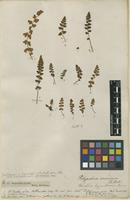
Filed as Woodsia hyperborea R.Br. [family DRYOPTERIDACEAE]
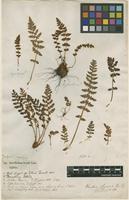
Filed as Woodsia ilvensis (L.) R.Br. [family DRYOPTERIDACEAE]
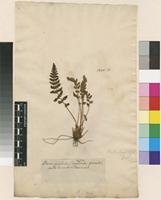
Lectotype of Acrostichum ilvense L. [family PTERIDACEAE]
Previous
Next

Name

Identification
Acrostichum ilvense L. [family PTERIDACEAE ] (stored under name); Verified by Not on sheet, Woodsia ilvensis (L.) R.Br. [family DRYOPTERIDACEAE ] Verified by Not on sheet,
Related name
  • Woodsia hyperborea
  • Polypodium arvonicum
  • Acrostichum ilvense
  • Woodsia ilvensis
Common name
  • Rusty cliff fern, Flora of North America Vol. 2
  • woodsie de l'île d'Elbe, Flora of North America Vol. 2

Flora

Entry for Woodsia ilvensis (Linnaeus) R. Brown [family WOODSIACEAE]
Herbarium
Flora of North America (FNA)
Collection
Flora of North America
Resource Type
Reference Sources
Entry From
Flora of North America, Vol 2,
Names
Woodsia ilvensis (Linnaeus) R. Brown [family WOODSIACEAE], Trans. Linn. Soc. London, Bot., 11: 173. 1813
Acrostichum ilvense Linnaeus [family PTERIDACEAE], Sp. Pl., 2: 1071. 1753
Treatment Author(s)
Michael D. Windham
Information
Stems compact, erect to ascending, with abundant persistent petiole bases of ± equal length; scales uniformly brown, lanceolate. Leaves 4.5--25 × 1.2--3.5 cm. Petiole usually brown or dark purple when mature, articulate above base at swollen node, relatively brittle and easily shattered. Blade narrowly lanceolate, usually 2-pinnate proximally, lacking glands, never viscid; rachis usually with abundant hairs and scales. Pinnae ovate-lanceolate to deltate, longer than wide, abruptly tapered to a rounded or broadly acute apex; largest pinnae with 4--9 pairs of pinnules; abaxial surface with mixture of hairs and linear-lanceolate scales, adaxial surface with multicellular hairs concentrated along midrib. Pinnules entire or crenate, rarely shallowly lobed; margins nonlustrous, thin, ciliate with multicellular hairs, lacking translucent projections. Vein tips frequently enlarged to form whitish hydathodes visible adaxially. Indusia of narrow, hairlike segments, these uniseriate throughout, composed of cells many times longer than wide, usually surpassing mature sporangia. Spores averaging 39--46 µm. 2 n = 82.
Phenology
Sporulating summer--early fall
Altitude range
0--1500 m
Distribution
Greenlandn Eurasia.USA AlaskaUSA Conn.USA Ill.USA IowaUSA MaineUSA Md.USA Mass.USA Mich.USA Minn.USA N.H.USA N.J.USA N.Y.USA N.C.USA OhioUSA Pa.USA R.I.USA Vt.USA Va.USA W.Va.USA Wis.Canada Alta.Canada B.C.Canada Man.Canada N.B.Canada Nfld.Canada N.W.T.Canada N.S.Canada Ont.Canada Que.Canada Sask.Canada Yukon
Discussion
Although generally separable by the characters given in the key, shade forms of Woodsia ilvensis with a reduced number of scales and hairs are occasionally misidentified as W . alpina . The morphologic distinctions between these species are further blurred by natural hybridization, which produces the intermediate triploid known as W . × gracilis . Some of the best characters for distinguishing these taxa are spore size and morphology. Spores average less than 46 µm in W . ilvensis , more than 46 µm in W . alpina , and are malformed and abortive in W . × gracilis . Woodsia ilvensis also hybridizes with W . oregana subsp. cathcartiana to form the sterile triploid W . × abbeae (F. S. Wagner 1987).

Related Materials

  • Terms and Conditions
  • Privacy Policy
  • Cookie Policy
  • Cookie Settings
  • Accessibility
  • Help
  • Contact Us
  • Facebook
  • Twitter
ITHAKA

JSTOR is part of ITHAKA, a not-for-profit organization helping the academic community use digital technologies to preserve the scholarly record and to advance research and teaching in sustainable ways.

©2000-2026 ITHAKA. All Rights Reserved. JSTOR®, the JSTOR logo, JPASS®, Aluka®, and ITHAKA® are registered trademarks of ITHAKA.

╳