JSTOR Global Plants Home
  • Home
  • Browse
  • About
  • Access
  • Account
    • Saved Items
    • Profile
  • Log in

Global Plants

Skip to Main Content
  • JSTOR Global Plants Home
  • Global Plants

    • Browse
    • About
    • Access
    • Account
      • Saved Items
      • Profile
Log in
  • Browse
  • About
  • Access
  • Account
    • Saved Items
    • Profile
Advanced Search

Compilation
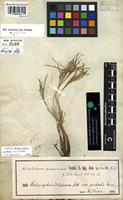
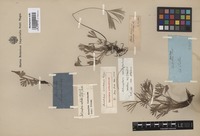
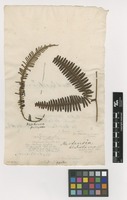
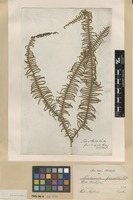
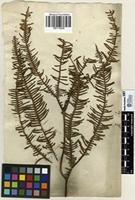
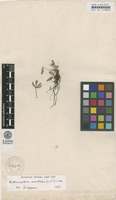
Acrostichum dichotomum

13 Images see all

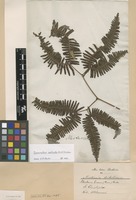
Filed as Gleichenella pectinata (Willd.) Ching [family GLEICHENIACEAE]
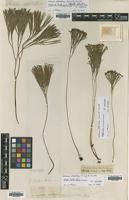
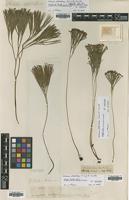
Filed as Schizaea dichotoma (L.) Sm. [family SCHIZAEACEAE]
Filed as Gleichenella pectinata (Willd.) Ching [family GLEICHENIACEAE]
Original material of Acrostichum dichotomum Forssk. [family PTERIDACEAE]
Filed as Acrostichum furcatum L. [family GLEICHENIACEAE]
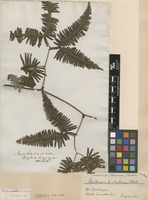
Filed as Sticherus bifidus (Willd.) Ching [family GLEICHENIACEAE]
Filed as Schizaea dichotoma (L.) Sm. [family SCHIZAEACEAE]
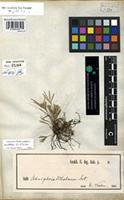
Filed as Actiniopteris radiata (Swartz) Link [family ACTINIOPTERIDACEAE]
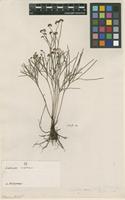
Filed as Schizaea indet. [family SCHIZAEACEAE]
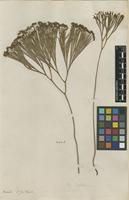
Filed as Mertensia furcata Willd. [family BORAGINACEAE]
Filed as Asplenium radiatum Sw. [family PTERIDACEAE]
Previous
Next

Name

Identification
Schizaea dichotoma (L.) Sm. [family SCHIZAEACEAE ] (stored under name); Verified by Jacques Florence, Acrostichum dichotomum L. [family SCHIZAEACEAE ] Schizaea forsteri Spreng. [family SCHIZAEACEAE ]
Related name
  • Schizaea forsteri
  • Acrostichum australe
  • Schizaea indet.
  • Actiniopteris australis
  • Acrostichum dichotomum
  • Schizaea dichotoma
  • Actiniopteris radiata

Flora

Entry for ACTINIOPTERIS radiata (Sw.) Link [family ACTINIOPTERIDACEAE]
Herbarium
Royal Botanic Gardens, Kew (K)
Collection
Flora of Tropical East Africa
Resource Type
Reference Sources
Entry From
Flora of Tropical East Africa, page 1, (1999) Author: B. Verdcourt, B.Sc., Ph.D.
Names
ACTINIOPTERIS radiata (Sw.) Link [family ACTINIOPTERIDACEAE], Fil. Sp.: 80 (1841); Hook., Ic. Pl. 10: t. 975, fig. 2–3 (1854); F.D.-O.A.: 45 (1929), pro parte; Tardieu, Fl. Madag. 5(1): 81, t. 16/7–9 (1958); Alston, Ferns W.T.A.: 44 (1959); Pic. Serm. in Webbia 17: 8, fig. 1/a–f (1962) & Webbia 17: 318, fig. 1/a–f (1963); Tardieu, Fl. Cameroun 3, Ptérid.: 150, t. 20/3–4 (1964); Lawalrée, F.C.B., Actiniopteridaceae: 3, map 1 (1969); Schelpe in Contr. Bolus Herb. 1: 85 (1969) & F.Z., Pterid.: 138, t. 42/C (1970); Faden in U.K.W.F.: 43 (1974); Schelpe, C.F.A., Pterid.: 111 (1977); Kornaś, Distrib. Ecol. Pterid. Zambia: 46, map 24b (1979); W. Jacobsen, Ferns S. Afr.: 291, fig. 207, map 86 (1983); Schelpe & N.C. Anthony, F.S.A. Pterid.: 148, fig. 45/2, map 125 (1986); J.E. Burrows, S. Afr. Ferns: 180, t. 29/1, fig. 178 (1990); Faden in U.K.W.F., ed. 2: 17 (1994). Type: India, Coromandel, Koenig (Herb. Montin S-PA, lecto.)
Acrostichum dichotomum [family PTERIDACEAE], [sensu Forssk., Fl. Aegypt.-Arab.: 184 (1775), non L.]
Asplenium radiatum Sw. [family ASPLENIACEAE], in J. Bot. (Schrader) 1800 (2): 50 (1801)
Acrostichum radiatum (Sw.) Poir. [family PTERIDACEAE], Encycl. Méth. Bot. Suppl. 1: 128 (1810)
Acropteris radiata (Sw.) Link [family ASPLENIACEAE], Hort. Berol 2: 56 (1833)
Pteris radiata (Sw.) Bojer [family ], Hort. Maurit.: 399 (1837)
Asplenium polydactylon Webb [family ASPLENIACEAE], Spic. Gorgon. in Hook. Niger Fl.: 193 (1849). Type: Cape Verde Is., Webb (? FI, holo.)
Actiniopteris australis [family ACTINIOPTERIDACEAE], [sensu Sim, Ferns S. Afr. ed. 2: 250, t. 34/2 (1915), non (L.f.) Link]
Actiniopteris australis (Sw.) C. Chr. var. radiata [family ACTINIOPTERIDACEAE], in Dansk Bot. Arkiv. 7: 125 (1932)
Information
Scales of the rhizome with a broad thick black shining central stripe and narrow light chestnut edges. Fertile and sterile fronds similar, after their death becoming dry and having the lamina reflexed downward owing to an abrupt bend in its basal part, and forming with the stipe a narrow V-shaped angle or even adherent to it. Fertile fronds (5–) 12–18(–26) cm long with stipe 3–5 times as long as the lamina, more scaly in the upper part than elsewhere. Lamina flabellate with edges forming an angle of 150–180°, or sometimes very broadly flabellate with edges forming an angle of up to 270°, cut into two symmetrical halves by a clearly evident median deep notch, and consisting of a 5–6 times dichotomous branch system. Branches of the first dichotomy equal (1.8 mm), forming an angle of about 90°; branches of the second dichotomy unequal, the inner (3.5 mm) longer than the outer (± 2 mm); the last dichotomy being in the upper half of the frond. Segments of the blade 32–48, linear, slightly and gradually broadening upwards, with apex divided into 2–6 hardened acute points. Basal part of the lamina and adjacent upper part of the stipe covered with short rounded pluricellular small hairs above and with abundant persistent scales beneath. Scales light fulvous sometimes with a short black stripe in the upper part, strongly falcate to tortuous, ovate-lanceolate, irregularly lobate to coarsely dentate at the bases, tapering upwards and ending in a long hair. Fig. 1/5–6.
Range
DISTR. U 1; K 1–4, 6, 7; T 1–4, 6–8 throughout tropical Africa to Cape Verde Is (only Nigeria in West Africa), Namibia and South Africa and east to Arabia, India and Ceylon
Altitude range
(30–)500–2100 m
Distribution
UGANDA Acholi District Ukuti, Chua, Dec. 1935, Eggeling 2414! & Agoro Rest Camp, Dec. 1932, Eggeling 832!KENYA Kitui District 15 km from Mutomo on Kibwezi road, 23 Nov. 1979, Gatheri et al. 79/158!;TANZANIA Musoma District Naabi, S slope, 14 Feb. 1968, Greenway et al. 13193!;KENYA Masai District Olorgesailie, 10 Apr. 1960, Verdcourt 2642!;KENYA Teita District Tsavo West National Park, Kevas Hill, 10 Apr. 1967, V.C. Gilbert 1311!TANZANIA Lushoto District W Usambaras, Mazumbai–Mashewa, Apr. 1916, Peter 16578!;TANZANIA Morogoro District Uluguru Mts, lower hills, 3 Jan. 1938, Schlieben 3197!;TANZANIA Iringa District Ruaha National Park, NE slopes of Kimiramatonge, 20 Apr. 1971, Bjørnstad 855!

Related Materials

  • Terms and Conditions
  • Privacy Policy
  • Cookie Policy
  • Cookie Settings
  • Accessibility
  • Help
  • Contact Us
  • Facebook
  • Twitter
ITHAKA

JSTOR is part of ITHAKA, a not-for-profit organization helping the academic community use digital technologies to preserve the scholarly record and to advance research and teaching in sustainable ways.

©2000-2026 ITHAKA. All Rights Reserved. JSTOR®, the JSTOR logo, JPASS®, Aluka®, and ITHAKA® are registered trademarks of ITHAKA.

╳