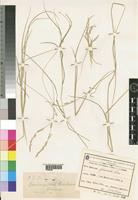
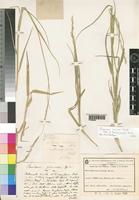
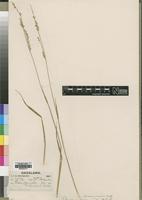
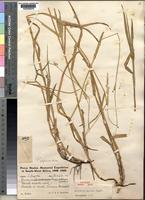
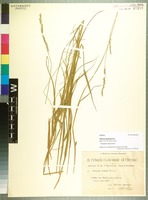
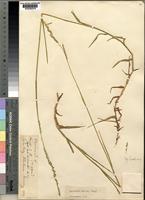
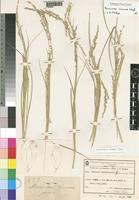
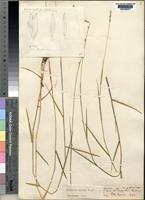
Perennial, up to over 2 ft. high from a slender creeping rhizome with extravaginal innovations. Culms slender, ascending, or prostrate at the base and covered there with short papery to membranous cataphylls and the remains of half-decayed sheaths or bared at length by their decay, above this base 6- to many-noded, sparingly branched, the upper internodes long-exserted, all terete, prominently striate, glabrous and smooth. Leaf-sheaths subherbaceous, terete, moderately tight, ciliate, otherwise quite glabrous, or pubescent with minutely tubercle-based hairs, smooth; ligules reduced to a ciliolate rim sometimes quite obscure; blades linear from a slightly rounded to subcordate and semiamplexicaul base, tapering to a slender subcallous point, 2 1/2–8 in. by 1/2–4 lin., or the lower sometimes still shorter, flat, subsucculent, somewhat rigid (at least the upper), obliquely erect, very pale green, glabrous or rigidly ciliate at the rounded base, rarely loosely pubescent, margins finely cartilaginous, smooth below, rough upwards, or smooth almost throughout, midrib and primary lateral nerves (3–4 on each side) fine, distinct only below, with 3–4 secondary nerves in the intervals, cross-veins short, sometimes very obscure. Panicle long-exserted, scanty, up to 8 in. long, of 5–1 erect or spreading spiciform secund branches, widely distant on a very slender subterete or towards the lower nodes semiterete and channelled or in the upper part triquetrous and scabrid common axis or the inflorescence reduced to a single interrupted spiciform raceme; branches villosulous at their insertion, the longest up to 2 1/2 in. long, triquetrous at least upwards, with scaberulous or downwards smooth angles and a flat or convex back, 1/5– 1/4 lin. wide, and an acutely keeled face, bearing at the nodes (2–4 lin. distant) from the base (rarely from some distance above it) mostly paired spikelets; pedicels stiff, angular, scaberulous, appressed, with truncate tips, one very short, the other up to 1–2 lin. long. Spikelets oblong, shortly and bluntly apiculate, 2–2 1/4 lin. long, pale green with darker tips, quite glabrous. Glumes thinly membranous, finely nerved; lower ovate-lanceolate, 3-nerved, middle-nerve raised towards the tip into a more or less bluntly ending keel; upper glume as long as the spikelet, oblong, 5-nerved, shortly keeled at the tip, the keel produced into a small short blunt appendage. Lower floret ♂: valve very like the upper glume; valvule almost as long as the valve, narrowly oblong, minutely truncate, keels scaberulous, flaps reversedly ciliate upwards; anthers up to 1 1/2 lin. long. Upper floret hermaphrodite, oblong, bluntly apiculate, 2–2 1/4 lin. long, whitish, smooth; valve and valvule coriaceous, apiculus of valve roundish, very short, of valvule minutely and bluntly 2-toothed and slightly recurved.