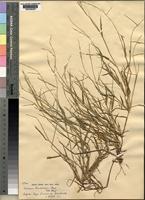
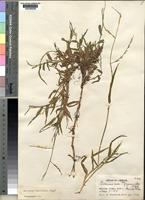
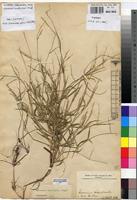
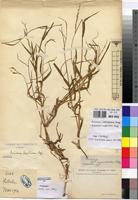
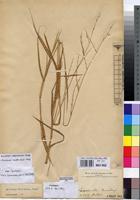
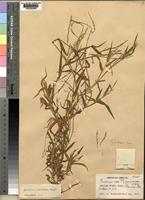
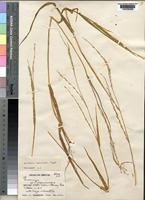
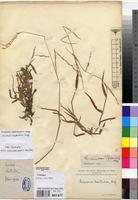
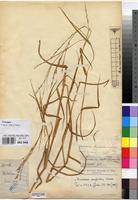
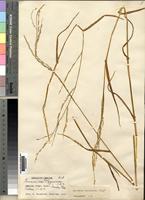
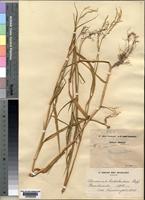
Annual, up to 2 1/2 ft. high, from a long prostrate much-branched base, forming loose leafy tufts from which the flowering culms rise. Culms quite glabrous and smooth, slender, terete, weak, many-noded, the prostrate base bare owing to the early decay of its sheaths, its internodes 1–2 in. long, copiously rooting from the nodes, the numerous branches ascending, of very variable height, from a few inches to 2 1/2 ft. long, apparently all flowering, their lower internodes sheathed, short to very short at the base, increasing upwards in long culms to 5 in. and more, and then long-exserted. Leaf-sheaths subherbaceous, soft, loose or the upper tight, terete, ciliate, otherwise glabrous and smooth; ligule none or represented by an obscure minutely ciliolate line; blades linear-lanceolate to linear from a rounded semi-amplexicaul base, tapering to an acute point, 1–3 in. by 2–3 1/2 lin. or the upper of the longest culms linear and up to 6 in. by 2 lin., flat, flaccid, green, glabrous, margins cartilaginous, smooth below, scaberulous upwards, midrib very fine, primary lateral nerves about 3 on each side, faintly distinct on the lower side only, with 3 secondary nerves between them connected by mostly very inconspicuous cross-veins. Panicles erect, straight, those of the longest culms long-exserted, 3 to over 9 in. long, of 2–5, rarely more, straight usually much spreading secund often interrupted spiciform branches, very distant on a very slender semiterete smooth or upwards more or less triquetrous and scaberulous or scabrid common axis; branches subvillosulous at the very base, the longest from half to two-thirds the length of the panicle, triquetrous, with scaberulous or downwards almost smooth angles, a flat or subconvex back, up to 1/4 lin. wide, and an acutely keeled face, bearing at the nodes (4–6 lin. distant) from the base, more rarely from above it, mostly paired spikelets; pedicels stiff, angular, scaberulous, with truncate tips, one very short, the other 2–3 lin. long. Spikelets appressed to the rhachis, linear-lanceolate, subulate-apiculate, 2 1/2 lin. long, pale green with darker tips, quite glabrous. Glumes thinly membranous, finely or obscurely nerved; lower lanceolate to lanceolate-oblong, 3-nerved, middle-nerve suddenly widened towards the tip into an acutely ending keel; upper as long as the spikelet, oblong, acuminate, 5-nerved, apiculus laterally compressed, oblong, obtuse, very minutely scaberulous. Lower floret barren: valve very similar to upper glume; valvule linear, almost as long as or distinctly shorter than the valve, subacute, with scaberulous keels. Upper floret hermaphrodite, linear to linear-oblong, bluntly apiculate, 2 1/2 lin. by slightly over 1/2 lin., whitish, smooth: valve and valvule coriaceous, apiculus of valve short, obtuse, of valvule slightly recurved and subacute or 2-toothed; anthers 1 1/4 lin. long.