

Compilation
Acokanthera rhodesica
3 Images see all
Name
Identification
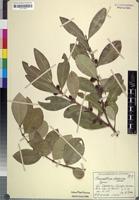
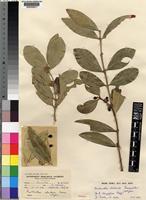
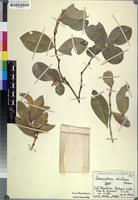
Acokanthera longiflora Stapf [family APOCYNACEAE ] Acokanthera oppositifolia (Lam.) Codd [family APOCYNACEAE ] (stored under name); Isotype of Acokanthera rhodesica Merxm. [family APOCYNACEAE ]
Related name
- Acokanthera oppositifolia
- Acokanthera rhodesica
- Acokanthera longiflora
Flora
Entry for Acokanthera oppositifolia Lam. Codd [family APOCYNACEAE]
Herbarium
Royal Botanic Gardens, Kew (K)
Collection
Flora Zambesiaca
Resource Type
Reference Sources
Entry From
FZ, Vol 7, Part 2, (1985) Author: A. J. M. Leeuwenberg and F. K. Kupicha et al.
Names
Acokanthera oppositifolia Lam. Codd [family APOCYNACEAE], in Bothalia 7: 448 (1961); in Fl. Southern Afr. 26: 247, fig. 36, 1 (1963). — Fanshawe, Check List Woody Pl. Zambia: 2 (1973). — R. B. Drumm. in Kirkia 10: 268 (1975). Kupicha in Kew Bull. 37: 53 (1982). TAB. 91. Type from Africa (origin uncertain).
Acokanthera venenata var. scabra Sond. Markgraf [family APOCYNACEAE], tom. cit.: 470 (1923). Lectotype as for Toxicophlaea thunbergii var. scabra.
Cestrum venenatum Thunb. [family APOCYNACEAE], Prodr.: 36 (1794), nom. illegit. Type from S. Africa.
Cestrum oppositifolium Lam. [family APOCYNACEAE], Tabl. Encycl. Méth., Bot. tom. 1 vol. 1 part 2: t. 112, fig. 2 (1792); torn. 2 vol. 3 part 1: 5(1794). Type as for Acokanthera oppositifolia.
Acokanthera lamarckii G. Don [family APOCYNACEAE], Gen. Syst. 4: 485 (1838), nom. superfl. illegit. Type as for Acokanthera oppositifolia.
Toxicophlaea thunbergii Harv. [family APOCYNACEAE], in Hook., Journ. Bot. Lond. 1: 24 (1842), nom. nov. pro Cestrum venenatum Thunb. non Burm. f.
Toxicophlaea cestroides A. DC. [family APOCYNACEAE], in DC., Prodr. 8: 336 (1844), nom. superfl. illegit. Type as for Acokanthera oppositifolia.
Toxicophlaea thunbergii var. scabra Sond. [family APOCYNACEAE], in Linnaea 23: 79 (1850). Lectotype from S. Africa (Natal).
Pleiocarpa hockii De Wild. [family APOCYNACEAE], in Fedde, Repert. 13: 109 (1914). Lectotype from Zaire (Shaba).
Acokanthera longiflora Stapf [family APOCYNACEAE], in Kew Bull. 1922: 28 (1922). — Markgraf in Notizbl. Bot. Gart. Berl. 8: 468, fig. 6 (1923). — Dale & Greenway, Kenya Trees & Shrubs: 43 (1961). Lectotype from Tanzania.
Carissa acokanthera Pichon [family APOCYNACEAE], in Mém. Mus. Hist. Nat. Paris, N.S. 24: 132 (1948), nom. superfl. illegit. — F. White, F.F.N.R.: 347 (1962). Type as for Cestrum venenatum Thunb.
Carissa oppositifolia Lam. Pichon [family APOCYNACEAE], in Bull. Jard. Bot. Brux. 22: 109 (1952). Type as for Acokanthera oppositifolia.
Acokanthera rhodesica Merxm. [family APOCYNACEAE], in Mitt. Bot. Staatss. München 1: 201 (1953). Type from Zimbabwe, Rusape Distr., fl. & fr. 15.x.1952, Dehn 36/52 (SRGH, isotype).
Garcinia sciura Spirlet [family APOCYNACEAE], in Bull. Jard. Bot. Brux. 29: 327 (1959). Type from Zaire (Shaba).
Carissa longiflora Stapf Lawrence [family APOCYNACEAE], in Baileya 7: 90 (1959). Lectotype as for Acokanthera longiflora.
Acokanthera venenata [family APOCYNACEAE], auct. mult., non G. Don. (1838).
Information
A much-branched evergreen shrub, sometimes scrambling, or small tree, 1–6 m. high; bark brown, deeply fissured; slash cream turning olive green. Young branches with reddish tinge, glabrous, conspicuously angled and ribbed. Leaves coriaceous, glabrous, smooth or occasionally slightly scabrid; petiole 2–6(7) mm. long; lamina 4·6–10·6 x 1·8–6·7 cm., usually obovate, occasionally elliptic, the apex acute, cuspidate or obtuse, with hard mucro, the base cuneate or rounded; upper surface glossy, with midrib impressed and lateral nerves strongly raised; lower surface mat, all nerves raised, the proximal lateral nerves characteristically reaching the margin without looping to join neighbouring nerves; midrib of lower surface and petiole wrinkled. Inflorescences very plentiful, dense, contracted, many-flowered axillary cymes; flowers fragrant, with pink or reddish corolla tube and white lobes. Calyx 2–3 mm. long, lobes ovate to lanceolate, weakly imbricate, dorsally pilose and ciliate or glabrous. Corolla tube 9–13·5 mm. long, pubescent or hispid on external surface or rarely glabrous, pilose within above the middle and wrinkled below; lobes ovate-cuspidate, 2–4·6 mm. long, pubescent or glabrous on either side, usually ciliate. Anthers 1·1–1·4 mm. long, visible in the mouth of the corolla tube at anthesis. Ovary 0·6–1 mm. long, ellipsoid, smooth. Fruit an ellipsoid berry 12–20 mm. long (dry), purple when ripe; seeds 6·5–10 mm. long.
Habitat
In riverine vegetation in shade of taller trees, and also often on termitaria.
Range
distributed in eastern Africa from the Cape Prov. to Zaire (Shaba), Tanzania and Kenya
Distribution
Mozambique M Maputo (Lourenco Marques), fl. 11.viii. 1920, Borle 545 (K; PRE; SRGH).Zimbabwe S Masuingo (Fort Victoria, Nyanda) near Great Zimbabwe (Zimbabwe ruins), fr. 7.xii.1961, Leach 11301 (K; LISC; PRE; SRGH).Zimbabwe E Mutare (Umtali) Distr., Commonage, fr. 12.i.1949, Chase 1580 (BM; COI; LISC; K; SRGH).Zimbabwe C Enterprise Distr., by Umwindsi R., fl. 14.vii.1946, Wild 1175 (K; PRE; SRGH).Zimbabwe W Bulawayo, fl. vi.1898, Rand 572 (BM).Mozambique GI Gaza, Muchopes, 25 km. from Manjacaze, road by Chidenguele, fr. 17.iii.1948, Torre 7508 (C;LISC;LMA;MO;WAG).Malawi N Ekwendeni, near KasituR., fl. 13.vi.1954, Jackson 1338 (BR; FHO; K; MAL).Zimbabwe N Urungwe Reserve, fr. 27.ix.1952, Phelps 28 (LISC; K; SRGH).Zambia W Ndola Distr., near Mwekera Rest House near Nkana, fl. 27.ix.1947, Brenan & Greenway in Brenan 7982 (BM, BR; FHO; K; PRE).
Notes
Fanshawe (loc. cit.) records A. oppositifolia also from Zambia (B and E), but I have seen no specimens from these areas. Specimens of A.. oppositifolia from Mozambique often have leaves rather different from those in the rest of the species’ range: the lamina tends to be elliptic rather than obovate, and to have looping lower lateral veins. In the vegetative state, such specimens are difficult to distinguish from A. oblongifolia from the same area; the only differences remaining between the leaves of the two species are the longer petioles and less prominent venation of A. oblongifolia. However, flowering and fruiting material of these species is easily separated, A. oblongifolia having distinctly longer flowers and larger fruits than A. oppositifolia.