JSTOR Global Plants Home
  • Home
  • Browse
  • About
  • Access
  • Account
    • Saved Items
    • Profile
  • Log in

Global Plants

Skip to Main Content
  • JSTOR Global Plants Home
  • Global Plants

    • Browse
    • About
    • Access
    • Account
      • Saved Items
      • Profile
Log in
  • Browse
  • About
  • Access
  • Account
    • Saved Items
    • Profile
Advanced Search

Compilation
Achyropsis oxyuris

5 Images see all

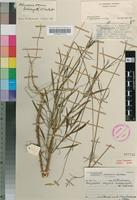
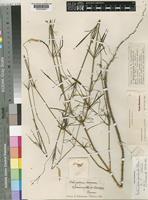
Isotype of Achyropsis oxyuris Suess. & Overkott [family AMARANTHACEAE]
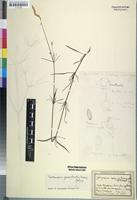
Centemopsis gracilenta (Hiern) Schinz [family AMARANTHACEAE]
Previous
Next

Name

Identification
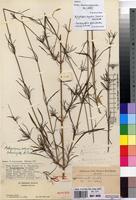
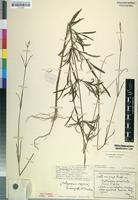
Isotype of Achyropsis oxyuris Suess. & Overkott [family AMARANTHACEAE ] Verified by Not on sheet, Centemopsis gracilenta (Hiern) Schinz [family AMARANTHACEAE ] (stored under name); Verified by Not on sheet,
Related name
  • Achyropsis gracilenta
  • Centemopsis gracilenta
  • Achyropsis oxyuris

Flora

Entry for Centemopsis gracilenta Hiern Schinz [family AMARANTHACEAE]
Herbarium
Royal Botanic Gardens, Kew (K)
Collection
Flora Zambesiaca
Resource Type
Reference Sources
Entry From
FZ, Vol 9, Part 1, page 28, (1988) Author: C. C. Townsend
Names
Centemopsis gracilenta Hiern Schinz [family AMARANTHACEAE], in Viert. Nat. Ges. Zürich 57: 547 (1913).—Hauman in F.C.B. 2: 42 (1951). Type from Angola.
Centema gracilenta Hiern [family AMARANTHACEAE], Cat. Afr. Pl. Welw. 1: 890 (1900). Type as above.
Psilotrichum gracilentum Hiern C.B. Clarke [family AMARANTHACEAE], in F.T.A. 6, 1: 59 (1909). Type as above.
Centemopsis myurus Suesseng. [family AMARANTHACEAE], in Bull. Jard. Bot. Brux. 15: 61 (1938). Type: Zimbabwe, R. Kafue, Lynes 63b (BR, holotype).
Achyropsis oxyuris Suesseng. & Overk. [family AMARANTHACEAE], in Bot. Archiv 41: 74 (1940). Type: Zambia, near source of R. Isongailu, Mwinilunga, Milne-Redhead 3896 (K, holotype).
Information
Annual herb (or probably short-lived perennial in undisturbed ground), erect, mostly 0.5–1.6 m. Stem wiry and tough, strongly striate with pale ridges, smooth and glabrous throughout or more commonly with whitish multicellular hairs about the somewhat swollen nodes, rarely slightly scabrid on the ridges below the nodes, much-branched and bushy from near the base upwards, the branches divaricate-ascending and frequently with sterile, axillary short shoots. Leaves linear to linear-filiform, 1.5–9.5 cm. × 0.5–3 (4) mm., glabrous to sparingly pilose (especially when young), occasionally slightly scabrid on the pale and prominent lower surface of the midrib and on the revolute margins, sessile, sharply mucronate at the apex. Inflorescence carmine to pink or whitish, spiciform, 1.2–4 × 0.6–1 cm. in flower, rounded or conical at the apex, elongating in fruit to as much as 20 cm.; axis very densely white-lanate, strongly furrowed but not becoming honeycombed with pits after fruit-fall, densely clad with the persistent bracts. Bracts 1.25–1.5 mm. long, lanceolate to ovate-lanceolate, membranous with a dark brown, shortly excurrent midrib, glabrous or more commonly basally pilose and sparingly ciliate. Bracteoles deltoid-ovate, 1.25–1.75 mm. long, membranous with a distinctly excurrent brownish or red midrib, glabrous or sparingly pilose. Flowers solitary in the axils of the bracts. Tepals 2.5–3(4) mm. long, oblong; outer 2 at anthesis firm centrally with a slender, slightly excurrent midrib and 2 pairs of slender lateral nerves (these often branching above), glabrous, increasingly hyaline-margined upwards with the margins inflexed; inner 3 similar but slightly less firm, at least the innermost usually with only one pair of lateral nerves. Tepals slightly indurate and the outer especially somewhat more prominently 3-nerved in fruit, but never strongly ribbed as in that stage with C. kirkii, nor with the inflorescence appearing spiky. Filaments very slender, 1.5–3 mm. long, the pseudostaminodes finally c. three quarters the length of the filaments, oblong, fimbriate around the apex. Ovary ellipsoid with a dense beard of hairs around the middle, glabrous below and more thinly hairy above. Style slender, 1.25–2 mm. long, not asymmetrically placed on the ripe capsule, glabrous. Capsule 2.25–2.5 mm. long, pyriform, compressed. Seed compressed-ovoid, brown, 2–2.25 mm. long, shining, finely reticulate.
Habitat
On Kalahari Sand or other sand, or sandy loam, commonly along tracks in Brachystegia/Uapaca/Isoberlinia and Cryptosepalum woodland in grassland, also by roads, in bushland, on termitaria, or on dry rocky hills
Altitude range
450–1680 m.
1680
450
Distribution
Mozambique N back of Mendone (?), iv.1921, Johnson 315 (K).Malawi S Ntcheu Hills, 1060 m., 12.v.1937, Lawrence 414 (K).Zimbabwe S Devuli R. on Gutu to Buhera Rd., 18.i.1973, Cannell 550 (K; SRGH).Zimbabwe E Mutare Gimbokki Farm, 27.iv.1976. Meara 324 (K; SRGH).Zimbabwe W Gwampa Forest Reserve, v.1956. Goldsmith 103/56 (K; LISC; SRGH).Zambia S Zimba, 9.viii.1909, Rogers 8276 (K; SRGH).Zambia E Chipata, 15.iv.1951, Gilges 61 (SRGH).Zambia C 8 km. E. of Chiwefwe, 1370 m. 15.vii.1930, Hutchinson & Gillett 15730 (K).Zambia W Ndola, 16.v.1953, Fanshawe 11 (K; NDO).Mozambique MS c.20 km. W. of Dombe between Mucrera and Mevumosi Rivers, SE. foothills of Chimanimani Mts., c. 450 m., 23.iv.1974, Pope & Müller 1269 (K; SRGH).Malawi C Lilongwe Distr., Dzalanyama Forest Reserve, 1280 m., 26.iii.1977, Brummitt, Seyani & Patel 14936 (K; MAL; SRGH).Zimbabwe N E. side of Umvukwe Mts. near Dawsons, 28/29.iv.1948, Rodin 4465 (K; UC).Zambia N Track off Rd. to Koa near Mbala, 1520 m., 6.iv.1955, Richards 5333 (K).
Distribution (external)
Kenya
Tanzania
Angola
Zaire

Related Materials

  • Terms and Conditions
  • Privacy Policy
  • Cookie Policy
  • Cookie Settings
  • Accessibility
  • Help
  • Contact Us
  • Facebook
  • Twitter
ITHAKA

JSTOR is part of ITHAKA, a not-for-profit organization helping the academic community use digital technologies to preserve the scholarly record and to advance research and teaching in sustainable ways.

©2000-2026 ITHAKA. All Rights Reserved. JSTOR®, the JSTOR logo, JPASS®, Aluka®, and ITHAKA® are registered trademarks of ITHAKA.

╳