

Compilation
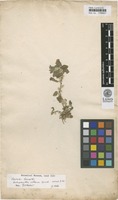
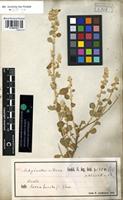
Achyranthes villosa
2 Images see all
Name
Identification
Aerva lanata (L.) Juss. [family AMARANTHACEAE ] (stored under name); Verified by Not on Sheet, Achyranthes villosa Forssk. [family AMARANTHACEAE ] Verified by P. Ascherson, 1881
Related name
- Aerva lanata
- Achyranthes villosa
Flora
Entry for Aerva lanata L. Juss. ex J.A. Schultes [family AMARANTHACEAE]
Herbarium
Royal Botanic Gardens, Kew (K)
Collection
Flora Zambesiaca
Resource Type
Reference Sources
Entry From
FZ, Vol 9, Part 1, page 28, (1988) Author: C. C. Townsend
Names
Aerva lanata L. Juss. ex J.A. Schultes [family AMARANTHACEAE], Syst. Veg. ed. 16, 5: 564 (1819).—Baker & Clarke in F.T.A. 6, 1: 39 (1909).—Schinz in Engl. & Prantl Pflanzenfam. ed. 2, 16 C : 52 (1934).—Hauman in F.C.B 2: 57 (1951).—Cavaco in Mém. Mus. Hist. Nat. Paris Sér. B, 13: 103 (1962).—J.H. Ross Fl. Natal: 159 (1973).—Townsend in Kew Bull. 29 : 461 (1974). Type, Linnean specimen 290/6 (LINN, lectotype).
Achyranthes lanata L. [family AMARANTHACEAE], Sp. Pl.: 204 (1753). Type as above.
Illecebrum lanatum L. L. [family AMARANTHACEAE], Mant. Alt.: 344 (1771). Type as above.
Achyranthes villosa Forssk. [family AMARANTHACEAE], Fl. Aegypt.-Arab.: 48 (1775). Type from Egypt.
Aerva mozambicensis Gandoger [family AMARANTHACEAE], in Bull. Soc. Bot. Fr. 66: 233 (1919). Type: Mozambique (no further details), Carvalho s.n. (LY, holotype; COI, isotype).
Aerva lanata var. citrina Suesseng. [family AMARANTHACEAE], in Mitt. Bot. Staatss. München 1: 66 (1950). Type: Zimbabwe, Mutare, Chase 176 (K; M; SRGH, isotype).
Aerva lanata var. intermedia Suesseng. [family AMARANTHACEAE], in Bull. Jard. Bot. Brux. 15: 57 (1938). Type from Zaire.
Aerva lanata var. leucuroides Suesseng. [family AMARANTHACEAE], loc. cit. Type from Zaire.
Aerva sansibarica Suesseng. [family AMARANTHACEAE], in Kew Bull. 1949 : 475 (1950). Type from Zanzibar.
Aerva lanata var. leucuroides Suesseng. [family AMARANTHACEAE], in Mitt. Bot. Staatss. München 1 : 70 (1951) nom. illegit. Type: Zimbabwe, Marondera Wild 3304 (K, isotype).
Information
Perennial herb, sometimes flowering in the first year, frequently more or less woody and suffrutescent below, erect to prostrate, decumbent or occasionally somewhat scandent, stiff or weak and straggling, (0.1) 0.3–2 m., with numerous stems from the base and these frequently also branched above. Stem and branches terete, striate, more or less densely lanate with whitish or yellowish, more or less shaggy hairs, more rarely tomentose or canescent. Leaves alternate, orbicular (not seen in the Flora Zambesiaca area) to lanceolate, spathulate or elliptic-ovate, shortly or more longly cuneate at the base with petioles from c. 2 cm. to obsolete, rounded and apiculate to acute at the apex, commonly densely lanate or canescent on the inferior surface and more thinly so above, rarely glabrous or (not seen in Flora Zambesiaca area) thickly lanuginose, those of the main stems c. 10–50 × 5–35 mm., those of the branches and inflorescence reducing and frequently becoming very small. Spikes sessile, solitary or usually in axillary clusters on the main stems or long to very short axillary branches, 0.4–1.5(2) × 0.3–0.4 cm., divergent, more or less cylindrical, silky, white to creamy, forming a long inflorescence which is leafy to the extreme apex and forms no terminal panicle even on the main stems; bracts (0.75) 1–1.25 mm., deltoid-ovate to oblong-ovate, hyaline with a short but distinct arista formed by the excurrent midrib, pilose, persistent; bracteoles similar or slightly smaller, also persistent. Flowers female, male or hermaphrodite. Tepals more or less densely lanate dorsally. Hermaphrodite flowers: outer 2 tepals hyaline, elliptic-oblong, more or less abruptly contracted at the apex to a distinct mucro formed by the excurrent nerve, 1–1.75(2) mm. long; inner 3 slightly shorter and narrower, acute with a broad central green vitta which extends for about three quarters the length of each tepal and is usually furnished with a thickened border; style short; stigmas short, patent or divergent; anthers perfect. Male flowers similar but the stigmas reduced and capitate or obsolete, scarcely papillose. Female flowers also similar, or commonly with the tepals longer and narrower, tapering above, the outer to c. 2.25 mm. long; stigmas longer and frequently equalling the style, linear, divergent or suberect; filaments reduced, anthers absent. Capsule c. 1 mm. long, circular, compressed; seed c. 0.6–0.8 mm. long, reniform, black, shining, the testa almost smooth in the centre, faintly reticulate around the margin.
Habitat
In the Flora Zambesiaca area in open forest on mountain slopes, on waste and disturbed ground, deserted cultivation and coastal scrub
Range
Widespread in the tropics and subtropics of the Old World. In Africa from Sierra Leone across to Egypt, S. to S. Africa (rare) and Madagascar.; in Asia from Arabia E. to Malaysia, the Philippines and New Guinea
Altitude range
sea-level–1490 m.
1490
0
Distribution
Mozambique M Bay of Maputo s.d., Junod 364 (BM; G).Mozambique MS mountain slope beyond Penhalonga border, 1490 m., 8.ix.1957, Chase 6710 (K; SRGH).Mozambique Z Quelimane Distr., Namagoa, v–vii.? Faulkner K13 (K).Malawi S Little Malosa R. near, foot of Mulanje Mt., 15.viii.1971, Leach, Rich & Whellan 14812 (K; SRGH).Mozambique N Goa Isl., 5.v.1947, Gomes e Sousa 3510 (K).Malawi N Mzimba Distr., Mzuzu, Marymount, 1365 m., 3.viii.1974, Pawek 8876 (UC; K; MO; SRGH; MA).Zimbabwe E Chimanimani c. 8 km. from Haroni-Lusitu confluence upstream of Lusitu R., 22.xi.1967, Ngoni 30 (K; LISC; SRGH).
Distribution (external)
Seychelles, Chagos Archipelago etc