JSTOR Global Plants Home
  • Home
  • Browse
  • About
  • Access
  • Account
    • Saved Items
    • Profile
  • Log in

Global Plants

Skip to Main Content
  • JSTOR Global Plants Home
  • Global Plants

    • Browse
    • About
    • Access
    • Account
      • Saved Items
      • Profile
Log in
  • Browse
  • About
  • Access
  • Account
    • Saved Items
    • Profile
Advanced Search

Compilation
Achlys triphylla

4 Images see all

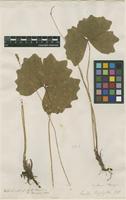
Holotype of Leontice triphylla Sm. [family BERBERIDACEAE]
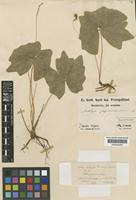
Achlys triphylla (Sm.) DC. subsp. japonica (Maxim.) Kitam. [family BERBERIDACEAE]
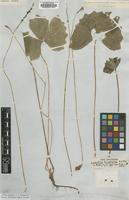
Type of Leontice triphylla Sm. [family BERBERIDACEAE]
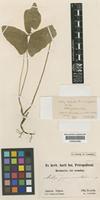
Achlys triphylla (Sm.) DC. subsp. japonica (Maxim.) Kitam. [family BERBERIDACEAE]
Previous
Next

Name

Identification
Achlys triphylla (Sm.) DC. [family BERBERIDACEAE ] (stored under name); Leontice triphylla Sm. [family BERBERIDACEAE ]
Related name
  • Achlys japonica
  • Achlys triphylla
  • Leontice triphylla
Common name
  • Deer-foot, Flora of North America Vol. 3
  • vanilla-leaf, Flora of North America Vol. 3

Flora

Entry for Achlys triphylla (Smith) de Candolle [family BERBERIDACEAE]
Herbarium
Flora of North America (FNA)
Collection
Flora of North America
Resource Type
Reference Sources
Entry From
Flora of North America, Vol 3,
Names
Achlys triphylla (Smith) de Candolle [family BERBERIDACEAE], Syst. Nat., 2: 35. 1821
Leontice triphylla Smith [family BERBERIDACEAE], in A. Rees, Cycl., 20: [5]. 1812
Information
Plants, 2-4 dm. Leaves: petiole 1-3 cm. Central leaflet blade 4-11 × 4-8 cm, proximal margins entire, distal margins (1-)3-4(-8)-lobed. Inflorescences 2.5-5 cm excluding peduncle. Flowers: stamens 3-4 mm; ovaries 1-1.5 mm. Follicles red-purple, 3-4.5 mm. 2n = 12.
Phenology
Flowering spring-summer (Apr-Jul)
Altitude range
0-1500 m
Distribution
USA Calif.USA Oreg.USA Wash.Canada B.C.
Discussion
Medicinally, Native Americans used preparations of the leaves of Achlys triphylla to treat tuberculosis, for a hair wash, and as an emetic (D. E. Moermann 1986).

Related Materials

  • Terms and Conditions
  • Privacy Policy
  • Cookie Policy
  • Cookie Settings
  • Accessibility
  • Help
  • Contact Us
  • Facebook
  • Twitter
ITHAKA

JSTOR is part of ITHAKA, a not-for-profit organization helping the academic community use digital technologies to preserve the scholarly record and to advance research and teaching in sustainable ways.

©2000-2026 ITHAKA. All Rights Reserved. JSTOR®, the JSTOR logo, JPASS®, Aluka®, and ITHAKA® are registered trademarks of ITHAKA.

╳