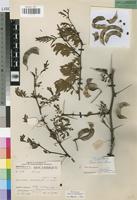
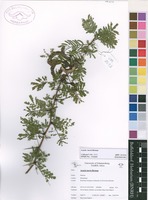
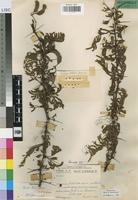
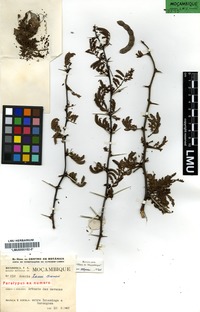
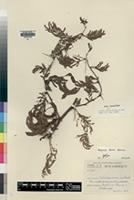
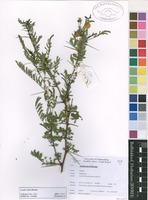
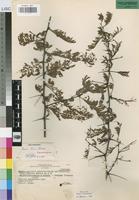
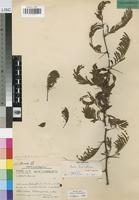
Entry for Acacia torrei Brenan [family LEGUMINOSAE]
Herbarium
Royal Botanic Gardens, Kew (K)
Collection
Flora Zambesiaca
Resource Type
Reference Sources
Entry From
FZ, Vol 3, Part 1, (1970) Author: J.P.M. Brenan
Names
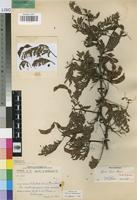
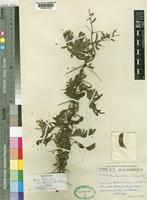
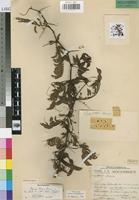
Acacia torreiBrenan [family LEGUMINOSAE], in Kew Bull. 21: 480 (1968). Type: Mozambique, between Inhaminga and Rio Urema, Torre 4068 (K; LISC, holotype; PRE).
Information
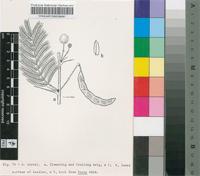
Shrub 1-2 m. high (? taller and up to 5 m.); young branchlets with numerous conspicuous dark sessile pustular glands, sometimes also with a very few inconspicuous hairs up to 0·5 mm. long. Stipules spinescent, up to 5 cm. long, sometimes rather thicker than in related species, brownish to whitish, often somewhat deflexed; “ant-galls” and other prickles absent. Leaves with a small sessile gland at the junction of each of the top 1-2 pairs of pinnae, often also with a similar gland on the upper side of the petiole, and in addition pubescent and with numerous smaller dark scattered glands; pinnae 7-13(20) pairs; leaflets 6-15 pairs, (2)3-6·5 x 1-2(3) mm., ciliate on the margins, otherwise glabrous, eglandular except often for a few inconspicuous glands on the margin near the apex, spinulose-mucronate at the apex; lateral nerves invisible beneath. Flower-colour uncertain, probably yellow. Calyx c. 2 mm. long. Corolla only known withered and torn. Pods dehiscent, 3-6 x 0·8-1 cm., falcate, constricted (often irregularly) or not between the seeds, with numerous conspicuous dark sessile pustular glands over the surface, as well as numerous spreading setiform hairs up to c. 1 mm. long. Seeds olive-brown, c. 6 x 6 mm., subcircular, compressed; areole 3-3·5 x 2·5-3 mm.
Habitat
Gregarious in savanna.
Range
Apparently endemic to Mozambique
Distribution
Mozambique MS between R. Urema and Inhaminga, fr. 16.v.1942, Torre 4068 (BM; K; LISC; PRE).