JSTOR Global Plants Home
  • Home
  • Browse
  • About
  • Access
  • Account
    • Saved Items
    • Profile
  • Log in

Global Plants

Skip to Main Content
  • JSTOR Global Plants Home
  • Global Plants

    • Browse
    • About
    • Access
    • Account
      • Saved Items
      • Profile
Log in
  • Browse
  • About
  • Access
  • Account
    • Saved Items
    • Profile
Advanced Search

Compilation
Acacia rehmanniana

7 Images see all

Acacia rehmanniana Schinz
[family ]
Acacia rehmanniana Schinz
Acacia siberiana DC var. villosa A. Chev. [family LEGUMINOSAE-MIMOSOIDEAE]
[family ]
Previous
Next

Name

Identification
Acacia rehmanniana Schinz [family FABACEAE ]
Related name
  • Acacia rehmanniana
Common name
  • a-ndiidììn (JB; K&A) (SENEGAL, BASARI), Burkill, H.M. 1985. The useful plants of west tropical Africa, Vol. 3
  • katanyako (A.Chev.) moga (A.Chev.) (SENEGAL, ‘CASAMANCE’), Burkill, H.M. 1985. The useful plants of west tropical Africa, Vol. 3
  • (Senegal) hahìlèc (Aub.; JB) (SENEGAL, ARABIC), Burkill, H.M. 1985. The useful plants of west tropical Africa, Vol. 3
  • (Hassaniya) hahìlèc (Aub.) (MAURITANIA, ARABIC), Burkill, H.M. 1985. The useful plants of west tropical Africa, Vol. 3
  • alluki (auctt.) barêsańé (JB; K&A) buldi (JB) burli (SENEGAL, FULA-PULAAR (Senegal)), Burkill, H.M. 1985. The useful plants of west tropical Africa, Vol. 3
  • African laburnum (Ainslie); white thorn (Percival, McIntosh)., Burkill, H.M. 1985. The useful plants of west tropical Africa, Vol. 3

Flora

Entry for Acacia rehmanniana [family FABACEAE]
Herbarium
South African National Biodiversity Institute, Compton Herbarium, Cape Town (SAM)
Collection
Flora of Southern Africa
Resource Type
Reference Sources
Entry From
Flora of South Africa, (2003) Author: Dr J.P. Roux
Names
Acacia rehmanniana [family FABACEAE]
Information
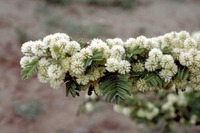
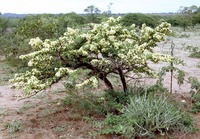
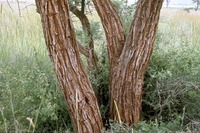
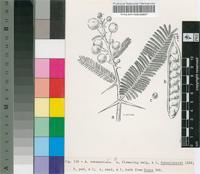
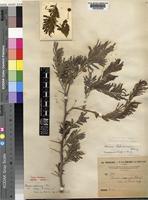
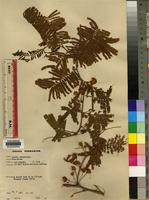
Shrub or tree to 10 m high with a some­what flattened spreading crown. Bark red­dish-brown to black, rough; young branchlets clothed with dense spreading hairs, the hairs golden at first but turning greyish-white, sometimes becoming glabrescent with age, the epidermis later peeling or flaking off to reveal a rusty-red inner layer. Stipules spinescent, in pairs, 0,5-5,4 cm long, straight or almost so, sparingly to densely pubescent with spreading hairs especially basally, becoming glabrescent with age; other prickles absent. Leaves densely clothed with spreading hairs, at first golden but turning greyish-white, sometimes becoming glabrescent: petiole 0,1-0,5 mm long, adaxial gland present, yellowish to reddish-brown, oval, somewhat flattened, up to 1,5(3) x 1(2) mm; rhachis 2,4-12 cm long, a small gland usually, at the junction of the top 1-3 and bottom 1-6 pinnae pairs, sometimes present between each pinna pair or absent from some; well-developed leaves of mature shoots with 15-44 pinnae pairs (reduced leaves with as few as 8 pinnae pairs are sometimes also present); rhachillae 0,6-2,8 cm long; leaflets 24-48 pairs per pinna, 1,2-2,8 x 0,4-0,9 mm, linear to linear-oblong, apex rounded to acute, margins with conspicuous spreading hairs especially apically. Inflores­cences capitate, on axillary peduncles, solitary or more usually fascicled, aggregated into a terminal "raceme", each fascicle of heads subtended by young to scarcely developed leaves. Flowers white or cream, sessile; peduncles 0,5-2 cm long, clothed with dense spreading hairs, the hairs golden at first but soon turning greyish-white, eglandular; in-volucel below the middle of the peduncle. Calyx sparingly to densely pubescent towards the apices of the lobes, sometimes a small basal tuft of hairs also present, tube 1,6-2,2 mm long, lobes up to 0,7 mm long. Corolla glabrous apart from the sparingly to densely pubescent lobes, tube 2-2,8 mm long, lobes up to 1,2 mm long. Stamen-filaments free, up to 7 mm long; anthers with a deciduous apical gland. Ovary up to 1,6 mm long, sessile, sparingly to densely pubescent. Pods grey- or reddish-brown to olive, (2,9) 7-10(14) x 1,1-1,8(2,2) cm, linear-oblong, straight or almost so, longitudinally dehis­cent, flattened, not constricted between the seeds, slightly venose, glabrous to sparingly pubescent. Seeds olive- or reddish-brown, 4,5-8 x 4-7 mm, ellipsoid to suborbicular, scarcely compressed; areole 2,5-4,5 x 1,25-2,8 mm, completely closed.
Habitat
A. rehmanniana has been often confused with A. sieberana DC. in the past. However, A. rehman­niana is a distinctive species, easily separated from A. sieberana by the more numerous pairs of closely arranged pinnae, the much smaller and thinner textured pods, the involucels in the lower half of the peduncle, and the way in which the capitula are clustered in the axils and aggregated into terminal "racemes".
Use
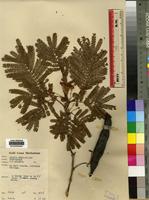
40. Acacia rehmanniana Schinz in Bull. Herb. Boiss. 6 : 525 (1898); Burtt Davy in Kew Bull. 1908 : 159 (1908); Glover in Ann. Bolus Herb. 1 : 151 (1915); Eyles in Trans. Roy. Soc. S. Afr. 5 : 362 (1916); Bak.f., Leg. Trop. Afr. 3 : 838 (1930); Burtt Davy, Fl. Transv. 2 : 343 (1932); O.B. Miller, Checklist Bech. Prot. 20 (1948); in J.S. Afr. Bot. 18 : 24 (1952); Pardy in Rhod. Agric. J. 51 : 376 (1954); F. White, For. Fl. N. Rhod. 86, fig. 18i (1962); Von Breitenbach, Indig. Trees S. Afr. 2 : 304 (1965); Brenan in F.Z. 3,1 : 99 (1970); Palmer & Pitman, Trees S. Afr. 2 : 783 (1973). Type: Transvaal, Streydpoort, Makapansberge, Rehmann 5517 (Z, holo.!).
Range
Found in southern Zambia, northern Botswana, Rhodesia and the Transvaal. Occurs in wooded grassland and bushveld; sometimes near rivers or streams.

Related Materials

  • Terms and Conditions
  • Privacy Policy
  • Cookie Policy
  • Cookie Settings
  • Accessibility
  • Help
  • Contact Us
  • Facebook
  • Twitter
ITHAKA

JSTOR is part of ITHAKA, a not-for-profit organization helping the academic community use digital technologies to preserve the scholarly record and to advance research and teaching in sustainable ways.

©2000-2026 ITHAKA. All Rights Reserved. JSTOR®, the JSTOR logo, JPASS®, Aluka®, and ITHAKA® are registered trademarks of ITHAKA.

╳