JSTOR Global Plants Home
  • Home
  • Browse
  • About
  • Access
  • Account
    • Saved Items
    • Profile
  • Log in

Global Plants

Skip to Main Content
  • JSTOR Global Plants Home
  • Global Plants

    • Browse
    • About
    • Access
    • Account
      • Saved Items
      • Profile
Log in
  • Browse
  • About
  • Access
  • Account
    • Saved Items
    • Profile
Advanced Search

Compilation
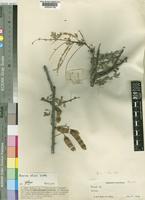
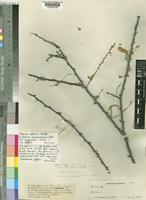
Acacia oliveri

3 Images see all

Acacia oliveri Vatke [family LEGUMINOSAE-MIMOSOIDEAE]
Acacia oliveri Vatke
Previous
Next

Name

Identification
Acacia oliveri Vatke [family FABACEAE ]
Related name
  • Acacia oliveri

Flora

Entry for ACACIA senegal (L.) Willd. [family LEGUMINOSAE-MIMOSOIDEAE]
Herbarium
Royal Botanic Gardens, Kew (K)
Collection
Flora Somalia
Resource Type
Reference Sources
Entry From
Flora Somalia, Vol 1, (1993) Author: by M. Thulin (Acacia by M. Thulin, A. S. Hassan & B. T. Styles) [updated by M. Thulin 2008]
Names
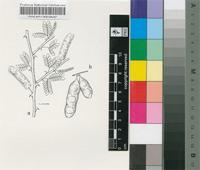
ACACIA senegal (L.) Willd. [family LEGUMINOSAE-MIMOSOIDEAE], (1806). Fig. 197 D.
ACACIA oliveri Vatke [family LEGUMINOSAE-MIMOSOIDEAE], (1880).
ACACIA unispinosa (Fiori) Chiov. [family LEGUMINOSAE-MIMOSOIDEAE], (1929).
ACACIA oxyosprion Chiov. [family LEGUMINOSAE-MIMOSOIDEAE], (1932);. type: C2, “El Meghet”, Senni 651 (FT holo.).
ACACIA senegal Chiov. var. platyosprion [family LEGUMINOSAE-MIMOSOIDEAE], Fl. Somala 2: 187 (1932);. types: S Somalia, Senni 87, 116, 191, 201, Gorini 421 (FT syn.) & Guidotti 3 (not seen).
ACACIA senegal Chiov. var. pseudoglaucophylla [family LEGUMINOSAE-MIMOSOIDEAE], Result. Sci. Miss. Stefanini-Paoli: 72 (1916);. type: S2, Mogadishu, Paoli 83 (FT lecto.).
ACACIA pseudoglaucophylla (Chiov.) Chiov. [family LEGUMINOSAE-MIMOSOIDEAE], (1916);. type: S2, Mogadishu, Paoli 83 (FT lecto.).
Information
Shrub or tree up to 10(–15) m high; bark greyish, rough; branchlets subglabrous to densely pubescent, internodes less than 3 cm long. Prickles in threes, the central one hooked downwards and the two laterals ± curved upwards, or solitary. Leaves: petiole usually with a distinctly raised gland; pinnae (1–)3–8 pairs; leaflets (4–)7–25 pairs, c. 1–5 x 0.5–1.75 mm, pubescent or glabrous. Flowers white or cream, in up to 12 cm long, more than 20-flowered spikes. Calyx 2–3 mm long. Corolla 2.75–4 mm long. Pods straight, dehiscent, 4–10 x (1.2–)1.5–3.4 cm, yellowish brown to brown, veined, densely to sparsely appressed pubescent. Seeds subcircular, 8–12 mm in diam.; areole 2.5–6 x 2.5–5 mm.
Range
N1–3; C1, 2; S1–3 widespread in tropical Africa, also extending to India.
Altitude range
0–1340 m.
Distribution
SOMALIA Hansen 4308; Hansen & Heemstra 6173; Thulin & Warfa 4579.
Notes
Adad, adat, cadaad, idaad (Som.). A. senegal is very variable in Somalia. Normally the species is a small tree with pods rounded at the apex. Shrubby plants, branching from near the base, are often distinguished as var. kerensis in recent literature, but the variation is continuous and this variety is omitted here. Plants with acute or acuminate pods are sometimes called var. rostrata Brenan (the type of A. oxyosprion is such a form). Var. rostrata was originally described from southern Africa, outside the range of typical A. senegal. In Somalia the variation in pod shape is continuous and a separation of individuals with ± acute pods does not seem meaningful. A. oliveri (syn. A. unispinosa) has been distinguished from A. senegal by having leaves with only 1–2 pairs of pinnae. I now believe that this is no more than another form of A. senegal in N Somalia and N. Ethiopia. Intermediate forms are frequent also in this case. The entities “ A. sp. near A. senegal ” and “ A. sp. near A. somalensis ” in Ross (1979) both seem to consist of such intermediates. The perhaps most extreme form here included in A. senegal is represented by Bally & Melville 15541, a prostrate plant 10–15 cm tall and more than 5 m in diam. with very short internodes, growing on limestone cliffs in “Wadi Nogal” near Eyl.

Related Materials

  • Terms and Conditions
  • Privacy Policy
  • Cookie Policy
  • Cookie Settings
  • Accessibility
  • Help
  • Contact Us
  • Facebook
  • Twitter
ITHAKA

JSTOR is part of ITHAKA, a not-for-profit organization helping the academic community use digital technologies to preserve the scholarly record and to advance research and teaching in sustainable ways.

©2000-2026 ITHAKA. All Rights Reserved. JSTOR®, the JSTOR logo, JPASS®, Aluka®, and ITHAKA® are registered trademarks of ITHAKA.

╳