JSTOR Global Plants Home
  • Home
  • Browse
  • About
  • Access
  • Account
    • Saved Items
    • Profile
  • Log in

Global Plants

Skip to Main Content
  • JSTOR Global Plants Home
  • Global Plants

    • Browse
    • About
    • Access
    • Account
      • Saved Items
      • Profile
Log in
  • Browse
  • About
  • Access
  • Account
    • Saved Items
    • Profile
Advanced Search

Compilation
Acacia melanoxylon

19 Images see all

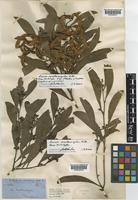
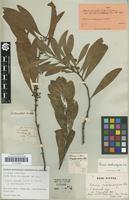
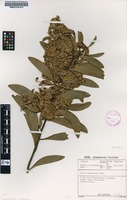
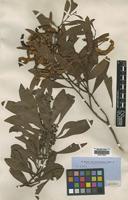
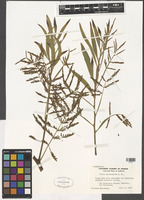
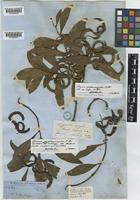
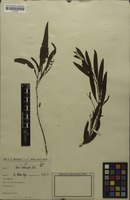
Paratype of Acacia melanoxylon R.Br. [family LEGUMINOSAE-MIMOSOIDEAE]
Filed as Acacia melanoxylon R.Br. ex W.T.Aiton [family LEGUMINOSAE]
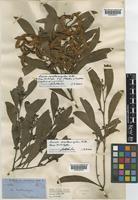
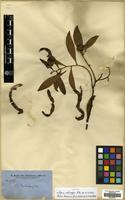
Isotype of Acacia arcuata Sieber ex Spreng. [family LEGUMINOSAE-MIMOSACEAE]
Acacia melanoxylon R.Br. var. [family LEGUMINOSAE-MIMOSOIDEAE]
Type of Acacia arcuata Sieber ex Spreng. 1826 [family FABACEAE]
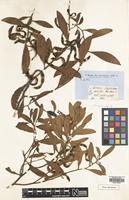
Holotype of Acacia brevipes A.Cunn. [family LEGUMINOSAE-MIMOSOIDEAE]
Filed as Acacia melanoxylon R.Br. [family FABACEAE]
Acacia melanoxylon R.Br. [family LEGUMINOSAE-MIMOSOIDEAE]
Filed as Acacia melanoxylon R.Br. [family FABACEAE]
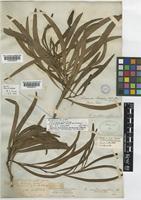
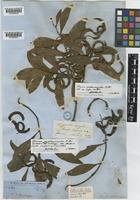
Isolectotype of Acacia melanoxylon R.Br. [family LEGUMINOSAE-MIMOSOIDEAE]
Lectotype of Acacia melanoxylon R.Br. [family LEGUMINOSAE]
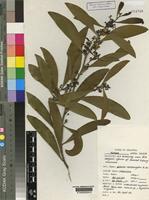
Acacia melanoxylon R.Br. [family FABACEAE]
Acacia melanoxylon R.Br.
Syntype of Acacia melanoxylon R.Br. [family LEGUMINOSAE]
Isotype of Acacia melanoxylon R.Br. ex W.T.Aiton [family LEGUMINOSAE]
Acacia melanoxylon R.Br.
Filed as Acacia melanoxylon R.Br. [family MIMOSACEAE]
Acacia melanoxylon R. Br. [family FABACEAE]
Paratype of Acacia melanoxylon R.Br. [family LEGUMINOSAE-MIMOSOIDEAE]
Previous
Next

Name

Identification
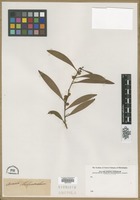
Acacia melanoxylon R.Br. [family FABACEAE ]
Related name
  • Acacia melanoxylon

Flora

Entry for Acacia melanoxylon [family FABACEAE]
Herbarium
South African National Biodiversity Institute, Compton Herbarium, Cape Town (SAM)
Collection
Flora of Southern Africa
Resource Type
Reference Sources
Entry From
Flora of South Africa, (2003) Author: Dr J.P. Roux
Names
Acacia melanoxylon [family FABACEAE]
Information
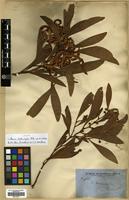
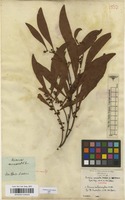
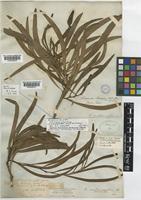
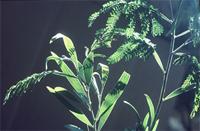
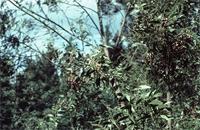
Unarmed tree up to 20 m high; young branchlets angular, glabrous or the young shoots minutely pubescent. Leaves phyllodic, apparently simple, glabrous, mostly 6—12 x 0,6-1,2(2,5) cm, linear-lanceolate to ob-lanceolate or narrowly obovate, straight to falcate, narrowed basally, with 3-7 promi­nent longitudinal nerves and a conspicuous reticulate venation between the longitudinal nerves (on young plants bipinnate leaves are sometimes produced at the apex of the phyl-lode). Inflorescences globose, solitary or in short axillary racemes. Flowers pale yellowish-white; peduncles up to 6 mm long. Calyx more than half as long as the corolla. Corolla glabrous. Pods brown, 5-15 x 0,6-0,8 cm, oblong, falcate or variously coiled or spirally twisted, flattened, margins thickened, not constricted between the seeds, dehiscing longitudinally along both margins. Seeds dark brownish-black, 4-5 x ±2,5 mm, smooth, compressed; areole ±3x1 mm; funicle very long, thickened, almost encircling the seed in a double fold. Introduced from Australia.
Habitat
A. melanoxylon, the well-known Blackwood, yields a good timber which is used in the manufacture of furniture. Like several of the other introduced Australian species, A. melanoxylon is also invading and displacing the indigenous vegetation in some areas.
Use
59. Acacia melanoxylon R.Br, in Ait.f. Hort. Kew ed. 2,5 : 462 (1813); Benth. in Fl. Austral. 2 : 388 (1864); in Trans. Linn. Soc. Lond. 30 : 481 (1875); J. Phillips in Mem. Bot. Surv. S. Afr. 14 : 291 (1931); Salter in Adamson & Salter, Fl. Cape Penins. 454 (1950); Beadle, Evans & Carolin, Handb. Vase. PI. Sydney Distr. & Blue Mts. 227 (1962); Court in Willis, Handb. PI. Victoria 2 : 236 (1972); Beadle, Evans & Carolin, Fl. Sydney Region 270 (1972); Ross, Fl. Natal 193 (1973); in Bothalia 11 : 468 (1975). Type: Tasmania, Port Dalrymple, R. Brown (BM, holo.!).
Range
Introduced from Australia.
Related Materials

  • Terms and Conditions
  • Privacy Policy
  • Cookie Policy
  • Cookie Settings
  • Accessibility
  • Help
  • Contact Us
  • Facebook
  • Twitter
ITHAKA

JSTOR is part of ITHAKA, a not-for-profit organization helping the academic community use digital technologies to preserve the scholarly record and to advance research and teaching in sustainable ways.

©2000-2026 ITHAKA. All Rights Reserved. JSTOR®, the JSTOR logo, JPASS®, Aluka®, and ITHAKA® are registered trademarks of ITHAKA.

╳