JSTOR Global Plants Home
  • Home
  • Browse
  • About
  • Access
  • Account
    • Saved Items
    • Profile
  • Log in

Global Plants

Skip to Main Content
  • JSTOR Global Plants Home
  • Global Plants

    • Browse
    • About
    • Access
    • Account
      • Saved Items
      • Profile
Log in
  • Browse
  • About
  • Access
  • Account
    • Saved Items
    • Profile
Advanced Search

Compilation
Acacia manubensis

2 Images see all

Acacia manubensis Ross
Acacia manubensis J.H.Ross [family LEGUMINOSAE-MIMOSOIDEAE]
Previous
Next

Name

Identification
Acacia manubensis Ross [family FABACEAE ]
Related name
  • Acacia manubensis

Flora

Entry for ACACIA manubensis J. H. Ross [family LEGUMINOSAE-MIMOSOIDEAE]
Herbarium
Royal Botanic Gardens, Kew (K)
Collection
Flora Somalia
Resource Type
Reference Sources
Entry From
Flora Somalia, Vol 1, (1993) Author: by M. Thulin (Acacia by M. Thulin, A. S. Hassan & B. T. Styles) [updated by M. Thulin 2008]
Names
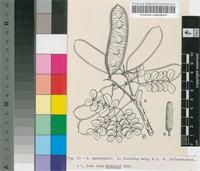
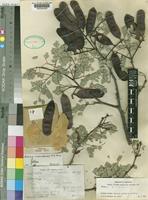
ACACIA manubensis J. H. Ross [family LEGUMINOSAE-MIMOSOIDEAE], (1974);. type: N3, “Manub”, Newbould 1080 (K holo.). Fig. 204.
Information
Tree to 5 m tall; bark yellowish, papery, peeling; young branchlets puberulous. Prickles in pairs, short. Leaves: pinnae 1–4 pairs; leaflets 2–7 pairs, 7–15 x 3.5–11 mm, obovate-elliptic, glaucous, appressed puberulous on both surfaces. Flowers ?white, in spikes 1.8–3.5 cm long. Calyx 2–2.5 mm long. Corolla 3–4 mm long. Pods purplish-brown, straight or slightly curved, 5.8–8 x 1.7–2 cm, finely transversely veined, puberulous.
Range
N3 (“Al Miskat Mts”) not known elsewhere.
Altitude range
900–1340 m.
Distribution
SOMALIA Thulin & Warfa 6027; Gillett & Watson 23487.
Notes
Ankokib, xankokib (Som.). A. manubensis produces an edible gum like A. ankokib, and their Somali name is the same. The two species are ecologically distinct, A. manubensis occurring at higher altitudes.

Related Materials

  • Terms and Conditions
  • Privacy Policy
  • Cookie Policy
  • Cookie Settings
  • Accessibility
  • Help
  • Contact Us
  • Facebook
  • Twitter
ITHAKA

JSTOR is part of ITHAKA, a not-for-profit organization helping the academic community use digital technologies to preserve the scholarly record and to advance research and teaching in sustainable ways.

©2000-2026 ITHAKA. All Rights Reserved. JSTOR®, the JSTOR logo, JPASS®, Aluka®, and ITHAKA® are registered trademarks of ITHAKA.

╳