JSTOR Global Plants Home
  • Home
  • Browse
  • About
  • Access
  • Account
    • Saved Items
    • Profile
  • Log in

Global Plants

Skip to Main Content
  • JSTOR Global Plants Home
  • Global Plants

    • Browse
    • About
    • Access
    • Account
      • Saved Items
      • Profile
Log in
  • Browse
  • About
  • Access
  • Account
    • Saved Items
    • Profile
Advanced Search

Compilation
Acacia kamerunensis

2 Images see all

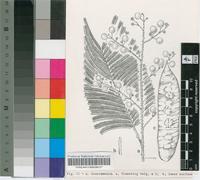
Acacia kamerunensis Gand. [family LEGUMINOSAE-MIMOSOIDEAE]
Acacia kamerunensis Gand.
Previous
Next

Name

Identification
Acacia kamerunensis Gand. [family FABACEAE ]
Related name
  • Acacia kamerunensis
Common name
  • ngobop (A.Chev.) (SENEGAL, SERER), Burkill, H.M. 1985. The useful plants of west tropical Africa, Vol. 3
  • gumi (JB) (SENEGAL, FULA-PULAAR (Senegal)), Burkill, H.M. 1985. The useful plants of west tropical Africa, Vol. 3
  • bulénay (JB) (SENEGAL, TUKULOR), Burkill, H.M. 1985. The useful plants of west tropical Africa, Vol. 3
  • ngaraap (A.Chev.; GR) (SENEGAL, WOLOF), Burkill, H.M. 1985. The useful plants of west tropical Africa, Vol. 3
  • tii (JB) tuft, tufin (JB) tuku (JB) (SENEGAL, MANDING-BAMBARA), Burkill, H.M. 1985. The useful plants of west tropical Africa, Vol. 3
  • bu mbãndi (JB) bu tulaos (A.Chev.) o golõ ni goli (JB) (SENEGAL, DIOLA), Burkill, H.M. 1985. The useful plants of west tropical Africa, Vol. 3

Flora

Entry for ACACIA kamerunensis Gandoger [family LEGUMINOSAE-MIMOSOIDEAE]
Herbarium
Royal Botanic Gardens, Kew (K)
Collection
Flora of Tropical East Africa
Resource Type
Reference Sources
Entry From
Flora of Tropical East Africa, page 1, (1959) Author: J. P. M. Brenan
Names
ACACIA kamerunensis Gandoger [family LEGUMINOSAE-MIMOSOIDEAE], in Bull. Soc. Bot. Fr. 60: 459 (1913). Type: British Cameroons, between Victoria and Bota, Winkler 447 (LY, holo.!)
ACACIA pennata [family LEGUMINOSAE-MIMOSOIDEAE], [sensu auct. pro parte, non (L.) Willd.]
Information
Scandent shrub. Young branchlets subglabrous or sparsely and minutely puberulous, glandular or not, soon yellow-brown and then grey. Prickles deflexed, scattered, arising from narrow brown longitudinal bands usually darker than the intervening ones. Leaves: petiole normally 1.5–3.5 cm. long, with a flat or rather convex gland 1–4.5 mm. long and 0.5–1.5 mm. wide; pinnae (10–)15–27(–36) pairs, (0.8–)1.5–4.5 cm. long; glands on rhachis between the top 3–10 pairs; leaflets linear, very numerous, 0.3–0.8 mm. wide, glabrous or very inconspicuously ciliolate, midrib nearer one margin at base. Flowers white, in small heads 4–8 mm. in diameter in ample panicles. Stipules at base of peduncles small, 0.3–0.75 mm. wide, inconspicuous, soon caducous, not subcordate at base. Calyx eglandular outside. Pods (Fig. 15/25, p. 66) subcoriaceous, oblong, brown or pale brown, flat, dehiscent, 8–14 cm. long, 1.7–2.8 cm. wide, margins not strongly thickened. Seeds dark brown, smooth, elliptic, compressed, 7–11 mm. long, 5–8 mm. wide; areole small, 4–5 mm. long and 1.5–2.5 mm. wide.
Range
DISTR. U4 Sierra Leone to Ubangi-Shari. French Cameroons, Belgian Congo and Uganda
Altitude range
1190–1220 m.
Distribution
UGANDA Mengo District Mukono, May 1915, Dummer 2446! & Kajansi Forest, Kampala-Entebbe road, Apr. 1935, Chandler 1239!
Notes
A. kamerunensis differs from A. pentagona (p. 100) in its narrow leaflets, thinner paler dehiscent pods, and seeds with a small central areole; from A. schweinfurthii (p. 99) in its narrow almost glabrous leaflets, normally smaller prickles, differently coloured young twigs, more numerous glands on the leaf-rhachis, the larger less gibbous gland on the petiole, and the more flattened seeds with a small central areole. Also it is a forest not a deciduous woodland or bushland species.

Related Materials

  • Terms and Conditions
  • Privacy Policy
  • Cookie Policy
  • Cookie Settings
  • Accessibility
  • Help
  • Contact Us
  • Facebook
  • Twitter
ITHAKA

JSTOR is part of ITHAKA, a not-for-profit organization helping the academic community use digital technologies to preserve the scholarly record and to advance research and teaching in sustainable ways.

©2000-2026 ITHAKA. All Rights Reserved. JSTOR®, the JSTOR logo, JPASS®, Aluka®, and ITHAKA® are registered trademarks of ITHAKA.

╳