JSTOR Global Plants Home
  • Home
  • Browse
  • About
  • Access
  • Account
    • Saved Items
    • Profile
  • Log in

Global Plants

Skip to Main Content
  • JSTOR Global Plants Home
  • Global Plants

    • Browse
    • About
    • Access
    • Account
      • Saved Items
      • Profile
Log in
  • Browse
  • About
  • Access
  • Account
    • Saved Items
    • Profile
Advanced Search

Compilation
Acacia hereroensis

9 Images see all

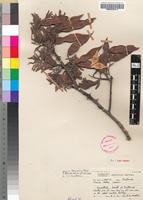
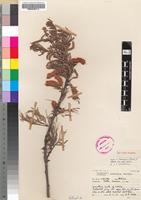
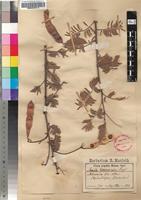
Syntype of Acacia mellei I.Verd. [family FABACEAE]
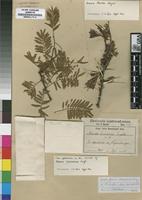
Acacia hereroensis Engl. [family LEGUMINOSAE-MIMOSOIDEAE]
Acacia hereroensis Engl.
Holotype of Acacia mellei I.Verd. [family FABACEAE]
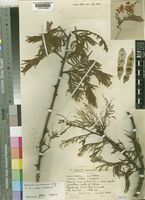
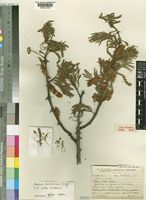
Syntype of Acacia mellei I.Verd. [family FABACEAE]
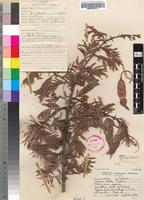
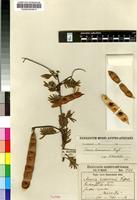
Isotype of Acacia mellei I.Verd. [family FABACEAE]
Isotype of Acacia hereroensis Engl. [family FABACEAE]
Acacia hereroensis Engl. [family LEGUMINOSAE-MIMOSOIDEAE]
Isotype of Acacia hereroensis Engl. [family FABACEAE]
Previous
Next

Name

Identification
Acacia hereroensis Engl. [family FABACEAE ]
Related name
  • Acacia hereroensis

Flora

Entry for Acacia hereroensis [family FABACEAE]
Herbarium
South African National Biodiversity Institute, Compton Herbarium, Cape Town (SAM)
Collection
Flora of Southern Africa
Resource Type
Reference Sources
Entry From
Flora of South Africa, (2003) Author: Dr J.P. Roux
Names
Acacia hereroensis [family FABACEAE]
Common names
A. gansbergensis Schinz in M6m. Herb. Boiss. 1 : 108 (1900); Dinter in Feddes Repert. 15 : 79 (1917); Bak.f., Leg. Trop. Afr. 3 : 833 (1930). Type: South West Africa, Gansberg, Fleck 437a (Z, holo.!). A. caffra sensu Schinz in Mern. Herb. Boiss. 1 : 105 (1900) pro parte quoad specim. Fleck 494a; sensu F. Bol. et al in Ann. Bolus Herb. 1 : 15 (1914), non (Thunb.) Willd. A. mellei Verdoorn in Flow. PI. S. Afr. 22 : t.860 (1942); O. B. Miller, Checklist Bech. Prot. 20 (1948); in J. S. Afr. Bot. 18 : 23 (1952) pro parte saltern excl. specim. Miller B/950; Young in Candoliea 15 : 109 (1955); Brenan in Kew Bull. 11 : 197 (1956); Von Breitenbach, Indig. Trees S. Afr 2 : 286 (1965). Type: Transvaal, Pretoria Distr., Zwartkop, 9,6 km S. of Pretoria, Melte sub PRE 26514 (PRE, holo.!; FHO!, K!).
Information
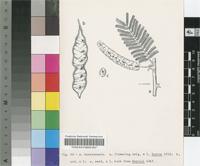
Shrub or tree to 10 m high; trunk to 0,35 m in diam.; branches usually ascending. Bark pale to dark greyish-brown or brown, rough; young branchlets grey- or reddish-brown, densely puberulous to pubescent, frequently with minute reddish glands scat­tered in amongst the pubescence. Stipules not spinescent, in pairs, linear, l,8-3,8x 0,2-0,7 mm, soon deciduous. Prickles in pairs just below the nodes, usually strongly recurved, sometimes straightish, often broad-based, up to 8 mm long. Leaves: petiole 0,3-1,3(2,2) cm long, adaxial gland usually present, variable in position, slightly raised or occasionally stalked, 0,4-1,1 x 0,1-0,4 mm; rhachis 1,7-6(10) cm long, puberulous to densely pubescent, abaxial surface often with scattered recurved prickles up to 2 mm long, with a gland at the junction of the top 1-3(7) pinnae pairs and occasionally between the lowest 1-3 pairs; pinnae 8-14(26) pairs; rhachillae (0,5)1-2,4(3,4) cm long, puberulous to densely pubescent; leaflets grey-green, (16)20-36(48) pairs per pinna, 1-4 x (0,25)0,5-1,1 mm, linear to linear-oblong, apex rounded to subacute, glabrous or sparingly to densely appressed-pubescent below, margins with or without spreading cilia. Inflorescences spicate, solitary, fascicled or crowded into an irregular terminal panicle. Flowers yellowish-white, sessile; spikes (2,2)3-7,4(8,6) cm long; peduncles 0,3-2,8 cm long, puberulous to densely pubescent, often glandular. Calyx densely puberulous to pubescent, tube 1-2 mm long, lobes 0,4-1,1 mm long. Corolla subglabrous or appressed-pubescent especially towards the apices of the lobes, tube up to 3,4 mm long, lobes up to 1,1 mm long. Stamen-filaments free, up to 7,5 mm long; anthers ± 0,15 mm across, with a deciduous apical gland. Ovary 0,7-1,5 mm long, glabrous, shortly stipitate. Pods olive- to reddish-brown or brown, (5)6-11(14) x (0,9)1,2-2,3 cm, straight, acute to distinctly acuminate apically, longitudinally dehiscent, margins entire or frequently irregularly constricted between the seeds, umbonate over the seeds, coriaceous, puberulous to densely pubescent, with numerous minute scattered reddish-brown glands. Seeds olive- to light brown, subcircular, 7-10 x 5-10 mm, compressed; central areole up to 4 x 3 mm, horse-shoe shaped.
Habitat
A. hereroensis is extremely closely related to A. caffra. It differs from A. caffra in the usually shorter and smaller leaves with more crowded pinnae pairs. These shorter leaves of A. hereroensis often tend to be held erect and do not droop as readily as the longer leaves of A. caffra. A. hereroensis has a more westerly distributional range than A. caffra although in the western Transvaal and south-eastern Botswana their ranges do overlap. However, in parts of the western Transvaal where the two species grow in close proximity, each species may usually be distinguished in the field without difficulty.
Use
13. Acacia hereroensis Engl, in Bot. Jahrb. 10 : 20 (1888); Schinz in Mem. Herb. Boiss. 1 : 112 (1900); Harms in Engl., Pfianzenw. Afr. 3,1 : 388 (1915); Dinter in Feddes Repert. 15 : 80 (1917); Bak. f., Leg. Trop. Afr. 3 : 835 (1930); O. B. Miller, Checklist Bech. Prot. 19 (1948); Ross in J. S. Afr. Bot. 31 : 220 (1965); in Webbia 22 : 213 (1967); Schreiber in F.S.W.A. 58 : 9 (1967); Brenan in F.Z. 3,1 : 73 (1970); Palmer & Pitman, Trees S. Afr. 2 : 761 (1973). Type: South West Africa, Otjimbingwe, Marloth 1331 (B, holo.f; GRA, pro parte!; PRE!).
Range
Found in South West Africa, south-eastern Botswana, the western Transvaal, western Orange Free State and the northern Cape Province. Occurs in dry habitats; in grassland, woodland, thornveld, on rocky slopes and flats or, in drier areas, along shallow watercourses. In the Transvaal A. hereroensis is frequently associated with dolomite formations.

Related Materials

  • Terms and Conditions
  • Privacy Policy
  • Cookie Policy
  • Cookie Settings
  • Accessibility
  • Help
  • Contact Us
  • Facebook
  • Twitter
ITHAKA

JSTOR is part of ITHAKA, a not-for-profit organization helping the academic community use digital technologies to preserve the scholarly record and to advance research and teaching in sustainable ways.

©2000-2026 ITHAKA. All Rights Reserved. JSTOR®, the JSTOR logo, JPASS®, Aluka®, and ITHAKA® are registered trademarks of ITHAKA.

╳