JSTOR Global Plants Home
  • Home
  • Browse
  • About
  • Access
  • Account
    • Saved Items
    • Profile
  • Log in

Global Plants

Skip to Main Content
  • JSTOR Global Plants Home
  • Global Plants

    • Browse
    • About
    • Access
    • Account
      • Saved Items
      • Profile
Log in
  • Browse
  • About
  • Access
  • Account
    • Saved Items
    • Profile
Advanced Search

Compilation
Acacia grandicornuta

7 Images see all

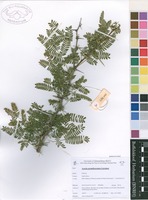
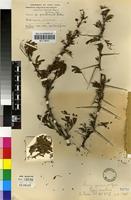
Acacia grandicornuta Gerstner
Filed as Acacia grandicornuta Gerstner [family MIMOSACEAE]
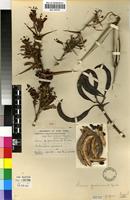
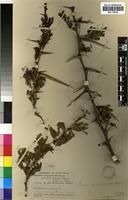
Acacia grandicornuta Gerstner
Type of Acacia grandicornuta Gerstner [family FABACEAE]
Previous
Next

Name

Identification
Acacia grandicornuta Gerstner [family FABACEAE ]
Related name
  • Acacia grandicornuta

Flora

Entry for Acacia grandicornuta [family FABACEAE]
Herbarium
South African National Biodiversity Institute, Compton Herbarium, Cape Town (SAM)
Collection
Flora of Southern Africa
Resource Type
Reference Sources
Entry From
Flora of South Africa, (2003) Author: Dr J.P. Roux
Names
Acacia grandicornuta [family FABACEAE]
Common names
A. clavigera E. Mey. subsp. clavigera pro parte quoad syn. A. grandicornuta sensu Von Breitenbach, Indig. Trees S. Afr. 2 : 302 (1965).
Information
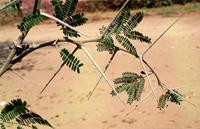
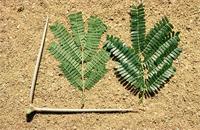
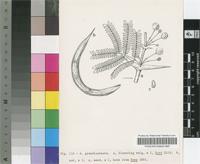
Tree to 12 m high, crown ± rounded, often irregularly so, branches usually ascen­ding. Bark grey to brownish-black or black, rough, longitudinally fissured; young branch-lets greyish to reddish-brown or purplish, lenticellate, glabrous, smooth, not flaking off to reveal a rusty-red inner layer. Stipules spinescent, in pairs, 0,2-10(14) cm long, straight or slightly curved, sometimes defle-xed, typically stout and slightly swollen, whitish but becoming greyish with age; other prickles absent. Leaves: petiole 0,4-2 cm long, glabrous, eglandular or with a rounded to elliptic gland up to 1,5 x 1 mm, variable in position; rhachis 0-3,6 cm long, glabrous or subglabrous, a small gland at the junction of the top or top 1-3 pinnae pairs; pinnae (1)2-3(5) pairs; rhachillae 0,9-3,6(5,2) cm long, glabrous; leaflets 7-18 pairs per pinna, 3-8 x (1)1,5-2,5(3,2) mm, linear to linear-or obovate-oblong, apex obtuse or rounded, glabrous throughout or rarely margins minutely ciliate, lateral nerves invisible or slightly conspicuous beneath. Inflorescences capitate, on axillary peduncles, fascicled. Flowers white, sessile; peduncles 1,2-2,5 cm long, glabrous or occasionally very sparingly puberulous, eglandular; involucel|-i-way up the peduncle. Calyx glabrous throughout or apices of lobes occasionally with a few hairs, tube 0,8-1,3 mm long, lobes up to 0,3 mm long. Corolla glabrous, tube 1,6-2,2 mm long, lobes up to 0,6 mm long. Stamen-filaments free, up to 5 mm long; anthers with a deciduous apical gland. Ovary up to 1 mm long, glabrous, very shortly stipitate. Pods brown to reddish-brown or purplish, (4,8)6-12,8(15,2) x 0,6-1,1 cm, falcate or occasionally straightish, sometimes irregu­larly constricted between some of the seeds, longitudinally dehiscent, valves rather thin, brittle, finely longitudinally veined, glabrous, attenuate basally. Seeds olive-brown, 6-10 x 5-7 mm, ± oblong, smooth, compressed; areole4-6 X 2,5,4-5mm.
Habitat
A. grandicornuta is closely related to A. robusta Burch. in its wide sense and a case could perhaps be made out for placing it under the latter species. However, A. grandicornuta is a very distinctive taxon and it seems best maintained as a distinct species.
Use
38. Acacia grandicornuta Gersln. in J.S. Afr. Bot. 4 : 55, fig. 1 (1938); O.B. Miller, Checklist Bech. Prot. 19 (1948); Codd, Trees & Shrubs Kruger Nat. Park 44, fig. 38c, d, e (1951); O.B. Miller in J.S. Afr. Bot. 18 : 21 (1952); Brenan in F.Z. 3,1 : 104 (1970); Ross, Acacia Spp. Natal 29, fig. 2/19 (1971); Van Wyk, Trees Kruger Nat. Park 1 : 140 (1972); Ross, Fl. Natal 193 (1973); Palmer & Pitman, Trees S. Afr. 2 : 805 (1973). Syntypes: Natal, flowered at Emkunzana and Mkuzi Drift between Nongoma and Magudu, 6 Jan. 1936, Gerstner 2870 (BOL!); fruits found at same places and at lower Pongola, 13 May 1936, Gerstner 2870 (BOL!).
Range
Found in south-eastern Botswana, Rhodesia, Mozambique, the Transvaal, Swaziland and Zululand. Occurs in dry thornveld and woodland; favours deep soils. Sometimes dominant over fairly large areas and forming thickets.

Related Materials

  • Terms and Conditions
  • Privacy Policy
  • Cookie Policy
  • Cookie Settings
  • Accessibility
  • Help
  • Contact Us
  • Facebook
  • Twitter
ITHAKA

JSTOR is part of ITHAKA, a not-for-profit organization helping the academic community use digital technologies to preserve the scholarly record and to advance research and teaching in sustainable ways.

©2000-2026 ITHAKA. All Rights Reserved. JSTOR®, the JSTOR logo, JPASS®, Aluka®, and ITHAKA® are registered trademarks of ITHAKA.

╳