JSTOR Global Plants Home
  • Home
  • Browse
  • About
  • Access
  • Account
    • Saved Items
    • Profile
  • Log in

Global Plants

Skip to Main Content
  • JSTOR Global Plants Home
  • Global Plants

    • Browse
    • About
    • Access
    • Account
      • Saved Items
      • Profile
Log in
  • Browse
  • About
  • Access
  • Account
    • Saved Items
    • Profile
Advanced Search

Compilation
Acacia erythrophloea

5 Images see all

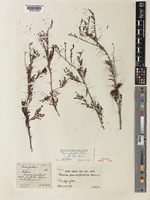
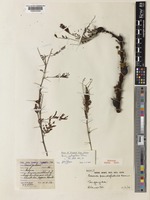
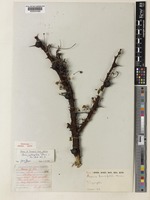
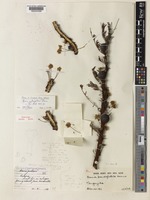
Acacia erythrophloea Brenan [family LEGUMINOSAE-MIMOSOIDEAE]
Acacia erythrophloea Brenan
Previous
Next

Name

Identification
Acacia erythrophloea Brenan [family FABACEAE ]
Related name
  • Acacia erythrophloea

Flora

Entry for ACACIA erythrophloea Brenan [family LEGUMINOSAE-MIMOSOIDEAE]
Herbarium
Royal Botanic Gardens, Kew (K)
Collection
Flora of Tropical East Africa
Resource Type
Reference Sources
Entry From
Flora of Tropical East Africa, page 1, (1959) Author: J. P. M. Brenan
Names
ACACIA erythrophloea Brenan [family LEGUMINOSAE-MIMOSOIDEAE], in K.B. 1957: 76 (1957). Type: Tanganyika, Tabora District, Kakoma, Glover 186 (K, holo.!)
Acacia sp. nov. [family LEGUMINOSAE-MIMOSOIDEAE], : “new species of gall-acacia” — B. D. Burtt in Journ. Ecol. 30: 98, 143 (1942)
Information
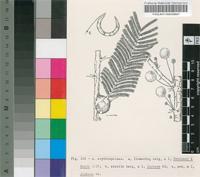
Small tree up to 3.6 m. high. Young branchlets very shortly grey-puberulous, then epidermis flaking away to expose the powdery, intensely brick-red inner bark. Stipules spinescent, nearly straight but rather short, black, 0.3–1.5 cm. long (on young coppice up to 2 cm. and whitish), some fused at base into round or ovoid “ant-galls” 1–2 cm. in diameter. Leaves with grey, inconspicuous puberulence on the 3–5 mm. long petiole and the 2–13 cm. long rhachis; pinnae of well-developed leaves of mature shoots 15–31 pairs (reduced leaves with fewer pairs usually also present), 1–2.9 cm. long; leaflets very numerous, 2–3 mm. long, about 0.75–0.9 mm. wide, acute or subacute at apex, ciliolate towards base or glabrous. Flowers white, in heads; involucel at base of the ± puberulous, nearly or quite eglandular, 0.5–0.75 mm. thick peduncle. Calyx 1–1.5 mm. long. Corolla ciliolate on lobes, 3 mm. long. Pods (Fig. 16/51, p. 67) falcate, grey-puberulous, acute at both ends, 3.5–6 cm. long, 0.4–0.8 cm. wide (? not fully mature).
Range
DISTR. T4 not known elsewhere
Altitude range
about 1130 m.
Distribution
TANGANYIKA Tabora District Kakoma, Feb. & Aug. 1934, C. H. N. Jackson 43! & 44! & 10 Aug. 1938, Glover 186! & 24 June 1949, Hoyle & Greenway 1037!
Notes
According to field- with Jackson 44, this is said to differ from A. pseudofistula in its white not cream flowers, in being smaller, and in having more delicate and slender fruits. I have not been able to check these differences. The following remarks relating to A. erythrophloea are extracted from Journ. Ecol. 30: 98 (1942): — “The heavy clay ‘mbugas’ [of Tabora District] are usually waterlogged for several months in the rainy season, and support a new species of gall-acacia. .. flowering in the dry season. This gall-acacia has very long leaves of a rich dark green colour, contrasting with the deep purply brown of the younger branches. The galls support paired stumpy thorns which are never silvery (as they are on the other gall-acacias) except in quite young coppice. In the north and east of the District [Tabora] A. formicarum [i.e. A. pseudofistuld ] dominates in the ‘mbugas’, but 40 miles S. of Tabora the new species replaces it as soon as the hilly country gives place to the great flat plateau.”

Related Materials

  • Terms and Conditions
  • Privacy Policy
  • Cookie Policy
  • Cookie Settings
  • Accessibility
  • Help
  • Contact Us
  • Facebook
  • Twitter
ITHAKA

JSTOR is part of ITHAKA, a not-for-profit organization helping the academic community use digital technologies to preserve the scholarly record and to advance research and teaching in sustainable ways.

©2000-2026 ITHAKA. All Rights Reserved. JSTOR®, the JSTOR logo, JPASS®, Aluka®, and ITHAKA® are registered trademarks of ITHAKA.

╳