JSTOR Global Plants Home
  • Home
  • Browse
  • About
  • Access
  • Account
    • Saved Items
    • Profile
  • Log in

Global Plants

Skip to Main Content
  • JSTOR Global Plants Home
  • Global Plants

    • Browse
    • About
    • Access
    • Account
      • Saved Items
      • Profile
Log in
  • Browse
  • About
  • Access
  • Account
    • Saved Items
    • Profile
Advanced Search

Compilation
Acacia erubescens

17 Images see all

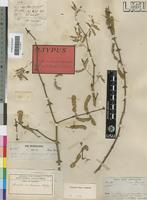
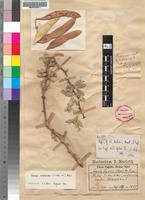
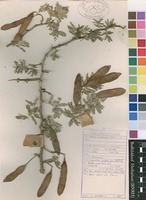
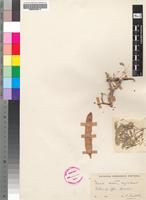
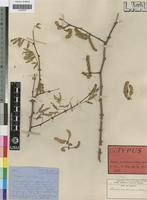
Holotype of Acacia erubescens Welw. ex Oliv. [family LEGUMINOSAE-MIM]
Acacia erubescens Welw. ex Oliv.
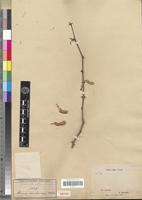
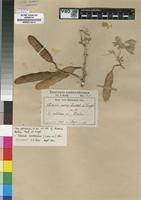
Isotype of Acacia erubescens Oliver [family FABACEAE-MIMOSOIDEAE]
Filed as Acacia erubescens Oliv. [family FABACEAE]
Filed as Acacia erubescens Welw. ex Oliv. [family MIMOSACEAE]
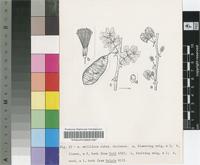
Isotype of Acacia dulcis Marloth&Engl. [family FABACEAE]
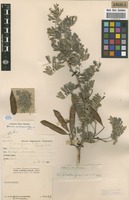
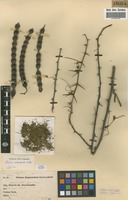
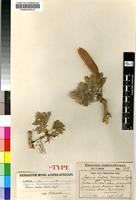
Type of Acacia erubescens Welw. ex Oliv. [family LEGUMINOSAE]
Acacia erubescens Welw. ex Oliv.
Isotype of Acacia dulcis Marloth & Engl. [family FABACEAE]
Acacia erubescens Welw. ex Oliv.
Filed as Acacia subalata Vatke [family FABACEAE]
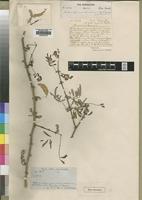
Isotype of Acacia dulcis Marloth & Engl. [family FABACEAE]
Acacia erubescens Welw. ex Oliv.
Isotype of Acacia erubescens Welw. ex Oliv. [family FABACEAE]
Acacia erubescens Welw. ex Oliv.
Isotype of Acacia erubescens Welw. ex Oliv. [family LEGUMINOSAE-MIM]
Previous
Next

Name

Identification
Acacia erubescens Welw. ex Oliv. [family FABACEAE ]
Related name
  • Acacia erubescens

Flora

Entry for Acacia erubescens [family FABACEAE]
Herbarium
South African National Biodiversity Institute, Compton Herbarium, Cape Town (SAM)
Collection
Flora of Southern Africa
Resource Type
Reference Sources
Entry From
Flora of South Africa, (2003) Author: Dr J.P. Roux
Names
Acacia erubescens [family FABACEAE]
Common names
A. caffra Willd. var. pechuelii Kuntze in Jahrb. K. Bot. Gart. Mus. Berl. 4 : 264 (1886). Type: South West Africa, Hereroland, Pechuel-Loesche (? B, holo. t). A. dulcis Marloth & Engl, in Bot. Jahrb. 10 : 24 (1888); Marloth in Trans. S. Afr. Phil. Soc. 5 : 269 (1889); Schinz in Mem. Herb. Boiss. 1 : 107 (1900); Harms in Engl., Pflanzenw. Afr. 3, 1 : 388 (1915); Dinter in Feddes Repert. 15 : 79 (1917); Bak.f., Leg. Trop. Afr. 3 : 830 (1930); Burtt Davy, Fl. Transv. 2 : 337 (1932); Codd, Trees & Shrubs Kruger Nat. Park 42, fig. 37a, b (1951): O. B. Miller in J. S. Afr. Bot. 18 : 20 (1952); Gilbert & Boutique in F.C.B. 3 : 151 (1952); Story, Mem. Bot. Surv. S. Afr. 30 : 22 (1958); Von Breitenbach, Indig. Trees S. Afr. 2 : 282 (1965). Type: South West Africa, Karibib Distr., Usakos, Marloth 1259 (B, holo. t; BOL!, GRA!, PRE!). A. longipetiolata Schinz in Mem. Herb. Boiss. 1 : 114 (1900). Syntypes: South West Africa, Hereroland, Fleck 491 (Z!); Kuiseb Fleck 492a (Z!), Fleck 493a (?Z). A. aff. trispinosa sensu Schinz in Mem. Herb. Boiss. 1 :116 (1900). The specimen which Schinz referred to, namely, Luderitz 122 from Herero­land, is in the University of Zurich herbarium. This specimen is without leaves or fruits but is clearly referable to A. erubescens. However, it is as well to point out here that there is more than one Luderitz specimen from Hereroland with the collector's number 122 in the University of Zurich herbarium. Another specimen of Luderitz 122 is A. karroo Hayne. A. sp. sensu Schinz in M6m. Herb. Boiss. 1 : 116
Information
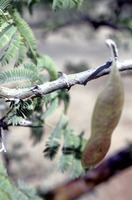
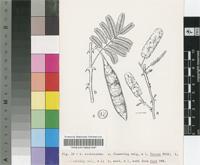
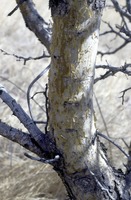
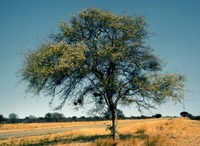
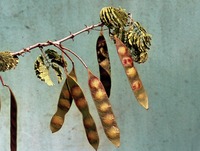
Shrub, often with many stems, or a tree to 10 m high; trunk to 0,3 diam.; crown often flattened and spreading somewhat. Bark pale to dark yellowish- or greyish-brown, rough, the outer layer papery and flaking or peeling off; young branchlets yellowish- or greyish-brown to purplish, puberulous to pubescent, sometimes glabrous, indumentum usually slightly golden. Stipules not spinescent, in pairs, linear, 2-4,2 X 0,2-0,8 mm, soon deciduous. Prickles in pairs below the nodes (very rarely in threes but then all three prickles point downward), usually strongly recurved, broad-based, grey-brown to blackish, up to 7 mm long. Leaves: petiole (0,7)1,3-2,5(4) cm long, adaxial gland present or absent, variable in position, often slightly raised, 0,3-0,7(1) X 0,1-0,5 mm; rhachis (1)1,5-2,7(5) cm long, usually puberulous to densely pubescent, glands variable, either at the junction of some of the pinnae pairs, between the top pair only or sometimes absent; pinnae 3-7 pairs; rhachil-lae (1)1,2-3(3,9) cm long, usually puberulous to densely pubescent; leaflets 10-27 pairs per pinna, 3-7,5(10) X (0,75)1-1,6(2,8) mm, obliquely oblong, often slightly falcate or the upper somewhat obovate, apex usually oblique, acute or subacute, sometimes ± rounded, veins often prominent beneath at first but becoming obscure with age, glabrous below or occasionally sparingly pubescent, margins with or without cilia. Inflorescences spicate, fascicled or crowded into an irregular terminal panicle, sometimes solitary. Flowers yellowish-white, sessile; spikes (1,8)2,2-4,5(6) cm long, peduncles (0,6)1,2-2,5 cm long, pubescent. Calyx campanulate, puberu­lous to densely pubescent, tube 1-2,2 mm long, lobes 0,6-1,8 mm long. Corolla tubular, appressed-pubescent, especially towards apices of lobes.tube up to 3 mm long, lobes up to 1,5 mm long. Stamen-filaments free, up to 8 mm long ;anthers 0,2-0,25 mm across, with a deci­duous apical gland. Ovary 0,5-1,9 mm long, glabrous, sessile or shortly stipitate. Pods fawn to dark brown, 3-13 X 1,1-1,8(2,3) cm, linear-oblong, straight, rounded to acute or acuminate apically, longitudinally dehis­cent, venose, coriaceous, subglabrous except for pubescence on the margins and stipe, glands absent or few and inconspicuous. Seeds olive-brown, usually subcircular, 7-11 X 7-11 mm, compressed; areole 1-3 X 2-4,5 mm, horse-shoe shaped.
Habitat
In A. erubescens the inflorescences are often produced when the plants are leafless. The flowers are usually sweet-smelling.
Use
15. Acacia erubescens Welw. ex Oliv. in F.T.A. 2 : 343 (1871); Benth. in Trans. Linn. Soc. Lond. 30 : 518 (1875); Harms in Engl., Pflanzenw. Afr. 3,1 : 385 (1915); Bak.f., Leg. Trop. Afr. 3 : 830 (1930) ;0. B. Miller in J. S. Afr. Bot. 18 : 20 (1952); Young in Can-dollea 15 : 111 (1955);Torre in C.F.A. 2 : 276, t.53B (1956); Brenan in F.T.E.A. Legum. -Mimos. : 88, fig. 14/13 (1959); F. White, For. Fl. N. Rhod. 83, fig. 17G (1962); Schreiber in F.S.W.A. 58 : 7 (1967); Brenan in F.Z. 3,1 : 73 (1970); Van Wyk, Trees Kruger Nat. Park 1 : 135 (1972); Palmer & Pitman, Trees S. Afr. 2 : 757 (1973); Schreiber in Mitt. Bot. Staatssamml. Munchen 11 : 116 (1973). Type: Angola, Mocamedes District, between Bumbo and Bruco, Welwitsch 1826 (LISU holo., BM!, K!)
Range
Found in Zaire, Tanzania, Zambia, Malawi, Rhodesia, Mozambique, Angola, South West Africa, Botswana and the Transvaal. Occurs in drier types of mixed deciduous woodland or scrub, often on rocky outcrops, in open bush on sand or along the sandy banks of dry watercourses.

Related Materials

  • Terms and Conditions
  • Privacy Policy
  • Cookie Policy
  • Cookie Settings
  • Accessibility
  • Help
  • Contact Us
  • Facebook
  • Twitter
ITHAKA

JSTOR is part of ITHAKA, a not-for-profit organization helping the academic community use digital technologies to preserve the scholarly record and to advance research and teaching in sustainable ways.

©2000-2026 ITHAKA. All Rights Reserved. JSTOR®, the JSTOR logo, JPASS®, Aluka®, and ITHAKA® are registered trademarks of ITHAKA.

╳