JSTOR Global Plants Home
  • Home
  • Browse
  • About
  • Access
  • Account
    • Saved Items
    • Profile
  • Log in

Global Plants

Skip to Main Content
  • JSTOR Global Plants Home
  • Global Plants

    • Browse
    • About
    • Access
    • Account
      • Saved Items
      • Profile
Log in
  • Browse
  • About
  • Access
  • Account
    • Saved Items
    • Profile
Advanced Search

Compilation
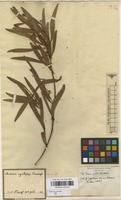
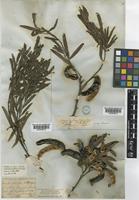
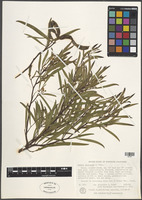
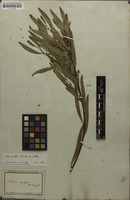
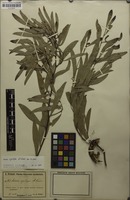
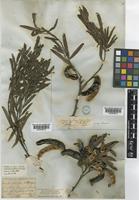
Acacia cyclops

6 Images see all

Filed as Acacia cyclops A.Cunn. ex G.Don [family LEGUMINOSAE-MIMOSACEAE]
Acacia cyclops A.Cunn. [family LEGUMINOSAE-MIMOSOIDEAE]
Acacia cyclops A. Cunn. ex G. Don [family FABACEAE]
Filed as Acacia cyclops A.Cunn. ex G.Don [family MIMOSACEAE]
Acacia cyclops A.Cunn. [family LEGUMINOSAE-MIMOSOIDEAE]
Previous
Next

Name

Identification
Acacia cyclops A.Cunn. [family LEGUMINOSAE-MIMOSOIDEAE ] (stored under name);
Related name
  • Acacia cyclops

Flora

Entry for Acacia cyclops [family FABACEAE]
Herbarium
South African National Biodiversity Institute, Compton Herbarium, Cape Town (SAM)
Collection
Flora of Southern Africa
Resource Type
Reference Sources
Entry From
Flora of South Africa, (2003) Author: Dr J.P. Roux
Names
Acacia cyclops [family FABACEAE]
Common names
A. cyclopis A. Cunn. ex Loudon, Hort. Britt. 407 (1830) nomen nudum.
Information
Unarmed shrub or small tree up to 6 m high; young branchlets usually angular and glabrous. Leaves phyllodic, apparently simple, glabrous, 3-9 x 0,6-1,5 cm, narrowly-oblong, usually ± straight, some­times slightly falcate, obliquely mucronate apically, narrowed basally, with 3-5 promi­nent longitudinal nerves and anastomosing almost longitudinal veins. Inflorescences glo­bose, solitary or two or three in short axillary racemes. Flowers bright yellow; peduncles up to 7 mm long. Calyx pubescent apically, more than half as long as the corolla. Petals free. Pods brown, 5-15 X 0,8-1,3 cm, oblong, falcate or variously coiled or spirally twisted, flattened, margins not constricted between the seeds, dehiscing longitudinally along both margins. Seeds dark brown, 5-7 x 3-4 mm, smooth, compressed; areole ±4x2 mm; funicle thickened, bright red or orange, encircling the seed in a double fold.
Habitat
Like A. saligna, A. cyclops was introduced on the Cape Flats in the 1870's in an attempt to stabilize the shifting dune sands. It proved highly successful for this purpose and soon started spreading by natural means. A. cyclops is now found far beyond the area of the Cape Flats and has become a serious menace in many parts of the Cape Peninsula and on the mainland by invading and displacing the indige­nous vegetation. In many areas A. cyclops occurs in dense almost impenetrable stands.
Use
58. Acacia cyclops A. Cunn. ex G. Don, Gen. Syst. 2 : 404 (1832); Benth. in Fl. Austral. 2 : 388 (1864); in Trans. Linn. Soc. Lond. 30 : 481 (1875); Salter in Adamson & Salter, Fl. Cape Penins. 454 (1950); Roux in S. Afr. J. Sci. 57 : 99 (1961); Roux & Middlemiss in S. Afr. J. Sci. 59 : 286 (1963); Middlemiss in S. Afr. J. Sci. 59 : 419 (1963); Henderson & Anderson, Mem. Bot. Surv. S. Afr. 37 : 172, fig. 85 (1966); Ross in Bothalia 11 : 468 (1975). Syntypes: Western Australia, King George's Sound, A. Cunning­ham 104/1818 (K!), 328/1821 (K!).
Range
Introduced into the Cape Province from Australia and now widespread in coastal areas from Lambert's Bay in the north-west to Kidd's Beach in the north-east.

Related Materials

  • Terms and Conditions
  • Privacy Policy
  • Cookie Policy
  • Cookie Settings
  • Accessibility
  • Help
  • Contact Us
  • Facebook
  • Twitter
ITHAKA

JSTOR is part of ITHAKA, a not-for-profit organization helping the academic community use digital technologies to preserve the scholarly record and to advance research and teaching in sustainable ways.

©2000-2026 ITHAKA. All Rights Reserved. JSTOR®, the JSTOR logo, JPASS®, Aluka®, and ITHAKA® are registered trademarks of ITHAKA.

╳