JSTOR Global Plants Home
  • Home
  • Browse
  • About
  • Access
  • Account
    • Saved Items
    • Profile
  • Log in

Global Plants

Skip to Main Content
  • JSTOR Global Plants Home
  • Global Plants

    • Browse
    • About
    • Access
    • Account
      • Saved Items
      • Profile
Log in
  • Browse
  • About
  • Access
  • Account
    • Saved Items
    • Profile
Advanced Search

Compilation
Acacia ankokib

4 Images see all

Acacia ankokib Chiov. [family LEGUMINOSAE-MIMOSOIDEAE]
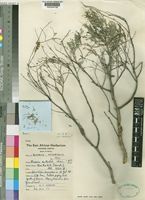
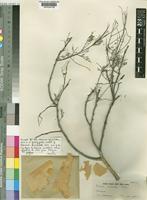
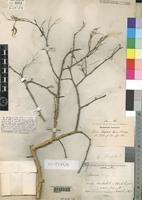
Syntype of Acacia ankokib Chiov. [family LEGUMINOSAE]
Acacia ankokib Chiov.
Previous
Next

Name

Identification
Acacia ankokib Chiov. [family FABACEAE ]
Related name
  • Acacia ankokib

Flora

Entry for ACACIA ankokib Chiov. [family LEGUMINOSAE-MIMOSOIDEAE]
Herbarium
Royal Botanic Gardens, Kew (K)
Collection
Flora Somalia
Resource Type
Reference Sources
Entry From
Flora Somalia, Vol 1, (1993) Author: by M. Thulin (Acacia by M. Thulin, A. S. Hassan & B. T. Styles) [updated by M. Thulin 2008]
Names
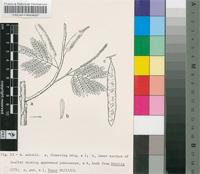
ACACIA ankokib Chiov. [family LEGUMINOSAE-MIMOSOIDEAE], (1932);. types: N3, without precise locality, Robecchi-Bricchetti 529 (FT syn.), “Bender Merajo”, Guidotti 35 (syn., not seen). Fig. 203.
Information
Shrub or tree to 6 m high; bark yellowish, papery, peeling; young branchlets puberulous, glabrescent. Prickles in pairs, often absent. Leaves: pinnae (2–)3–6 pairs; leaflets (4–)6–10 pairs, 4–10 x 0.75–2.5 mm, oblong, distinctly petiolulate, glaucous, appressed puberulous on both surfaces. Flowers cream or somewhat pinkish, in spikes up to 6 cm long. Calyx 1–1.5 mm long. Corolla 2–2.5 mm long. Pods brown, straight or almost so, 4.5–10 x 0.9–1.1 cm, finely transversely veined, puberulous.
Range
N3 not known elsewhere.
Altitude range
10–750 m.
Distribution
SOMALIA Gillett 23064; Bally & Melville 15627; Thulin & Warfa 5597.
Notes
Ankokib, xankokib (Som.). The nature of the armature in A. ankokib has not previously been known with certainty as prickles are mostly absent. Ross (1979) tentatively placed the species in the group with prickles in threes. However, Thulin & Warfa 5597 clearly shows paired prickles and it now seems obvious that A. ankokib is nearest related to A. manubensis. Still, in both A. manubensis and A. ankokib a third prickle is sometimes present, but then some distance below the paired prickles. A. ankokib produces an edible gum of local importance.

Related Materials

  • Terms and Conditions
  • Privacy Policy
  • Cookie Policy
  • Cookie Settings
  • Accessibility
  • Help
  • Contact Us
  • Facebook
  • Twitter
ITHAKA

JSTOR is part of ITHAKA, a not-for-profit organization helping the academic community use digital technologies to preserve the scholarly record and to advance research and teaching in sustainable ways.

©2000-2026 ITHAKA. All Rights Reserved. JSTOR®, the JSTOR logo, JPASS®, Aluka®, and ITHAKA® are registered trademarks of ITHAKA.

╳