

Compilation
Abutilon umtaliense
2 Images see all
Name
Identification
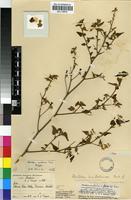
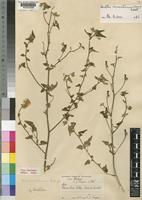
Isotype of Abutilon umtaliense Baker f. [family MALVACEAE ] Verified by Not on sheet, Abutilon sonneratianum (Cav.) Sweet [family MALVACEAE ] (stored under name); Verified by Not on sheet,
Related name
- Sida unrecorded
- Abutilon umtaliense
- Abutilon sonneratianum
Flora
Entry for Abutilon sonneratianum Cav. Sweet [family MALVACEAE]
Herbarium
Royal Botanic Gardens, Kew (K)
Collection
Flora Zambesiaca
Resource Type
Reference Sources
Entry From
FZ, Vol 1, Part 2, page 420, (1961) Author: A. W. Exell
Names
Abutilon umtaliense Bak. f. [family MALVACEAE], in Journ. of Bot. 74: 194 (1936). Type; S. Rhodesia, Umtali, Teague 385 (BM, holotype; BOL; K; SRGH).
Sida sonneratiana Cav. [family MALVACEAE], Diss. 1: 29, t. 6 fig. 4 (1790). Type as above.
Abutilon sonneratianum Cav. Sweet [family MALVACEAE], Hort. Brit.: 54 (1826). — Harv. in Harv. & Sond., F.C. 1: 168 (1860). — Bak. f. in Journ. Linn. Soc., Bot. 40: 27 (1911). — Ulbr. in Engl., Bot. Jahrb. 51: 14 (1913). — Eyles in Trans. Roy. Soc. S. Afr. 5: 413 (1916). — Burtt Davy, F.P.F.T. 2: 275 (1932). TAB. 93 fig. 8. Type from Cape Prov.
Information
Shrubby perennial 0·5–1·5 (2) m. tall, usually with only one or a few main stems, with a very dense short soft velvety indumentum and additional sparse long white patent hairs (rarely completely absent), less often long-pilose; stems slender, terete or slightly angular when young, tough or wiry, olive-drab to purplish-brown, woody when older, and ultimately covered with a grey to dark brown thin bark densely marked with short longitudinal shallow grooves. Leaf-lamina 2–7 (10) × 1–5 (7) cm., usually triangular-cordate or ovate-cordate, sometimes somewhat 3-lobed with blunt lobes on either side of the lamina near the middle, apex acuminate, margin ± dentate, crenate or serrate, dark green, brownish-green when dry, dark grey-green or olive-green on upper surface, paler greyish- to light-glaucous-green on the lower surface, venation of lower surface distinct, fine but prominent; petiole lender, terete, with the long patent hairs often only at the very apex, that of lower leaves often longer, that of upper leaves often shorter than the lamina. Flowers yellow or orange-yellow, solitary in axils on developed branches; pedicels c. 6 cm. (in fruit 10 cm.) long, slender, terete, articulated in the upper 6–12 mm. Calyx 8–10 mm. long and 6 mm. in diam. at the throat, greyish to olive-drab, divided to or beyond the middle; lobes 4–10 mm. long, ovate-elliptic, ovate-lanceolate to lanceolate-triangular, attenuate-acuminate into an acute tip, median-veined. Petals c. 10 mm. long, glabrous except at the base. Staminal tube glabrous except at line of fusion with the petals. Fruit 12–15 × 20 mm., subcylindric-semiglobose, truncate, densely and finely stellate-pubescent. Mericarps 8–15, often 9–11, 10–14 × 7–9 mm., much compressed, papery, subrectangular in outline, with rounded base and nearly horizontal truncate apical edge produced at the dorsal apical angle into a point or subulate awn up to 2 mm. long, the ventral tooth often somewhat upturned at the apex, 3–8 (often 4 or 5)-seeded. Seeds c. 2 × 2 mm., finely verruculose-rugulose, glabrous.
Habitat
In S. Rhodesia and in the Transvaal mountains a typical forest-edge plant on mountain slopes, on rocky or loamy soils, usually in light shade or growing among scrub or low herbaceous plants, often locally frequent, but in Natal and the Cape Prov. down to sea-level in coastal bush.
Altitude range
usually from 1000–2000 m.,
2000
1000
Distribution
Mozambique MS Vila Pery, Pedro & Pedrógão 6030 (LMJ).Mozambique M Namaacha, fl. & fr. 25.iv.1947, Pedro & Pedrógão 758 (LMJ; PRE).Zimbabwe E Chirinda, Swynnerton 504 (BM; K); Umtali, fl. 11.xii.1945, Wild 472 (K; SRGH).
Distribution (external)
Transvaal
Swaziland
Natal
Cape Prov
Notes
The flowers open after 4 p.m.From observation of specimens growing wild in my garden in Pretoria it appears that this species loses much of its lower foliage in the cold (and dry) winter-season. The tips of the branches still produce some flowers late in the season and young shoots start flowering in spring again. When collected in these stages the specimens often have, apart from the small leaves, smaller flowers and fruit. The type gathering of A. umtaliense is apparently from such seasonally depauperate plants. The description given here applies to the Rhodesian specimens; plants from the Cape are often more loosely stellate-pubescent, but there are many intermediates and Rhodesian specimens can be matched with some Cape specimens.A. sonneratianum is an example of the so-called “Cape Floral Element” (see H. Wild in Proc. & Trans. Rhod. Sci. Ass. 44: 53 (1956)) mainly found in the Eastern Border Mts. of S. Rhodesia and consisting of genera and species with their main distribution in the south.